An identity restoration service is a specialist-led remediation process that actively repairs the damage caused by identity theft, covering disputes, documentation, and direct coordination with creditors, credit bureaus, and government agencies. Unlike passive identity monitoring, which only alerts you to suspicious activity, restoration services take hands-on action to fix the problem. The identity restoration process can take anywhere from a few months to over a year, depending on how complex your case is. If you’ve ever wondered what is identity restoration service and whether it’s worth having, the short answer is: when your identity is stolen, you need more than an alert. You need a specialist in your corner.
What is identity restoration service and how does it work?
Identity restoration service is the active, case-managed side of identity theft protection. When fraud is confirmed, a dedicated restoration specialist is assigned to your case. That specialist becomes your point of contact for every step of the recovery process.
The typical restoration process follows a clear sequence:
- Case assignment. A specialist reviews your situation and opens a case file. They gather details about what was stolen and which accounts or records were affected.
- Fraud alerts and credit bureau contact. The specialist contacts Equifax, Experian, and TransUnion to place fraud alerts. For serious cases, they can place 7-year extended fraud alerts that require creditors to verify your identity before opening new accounts.
- FTC and police reports. The specialist files an identity theft report with the Federal Trade Commission and, where needed, a police report. These documents are critical for disputing fraudulent accounts.
- Creditor disputes and documentation. The specialist contacts each affected creditor, submits dispute letters, and tracks responses. This step often requires multiple rounds of follow-up.
- Limited power of attorney. Many services provide a limited power of attorney, allowing the specialist to act on your behalf. This removes the burden of you having to call every institution yourself.
- Three-way calls. Premium services may connect you, your bank, and the specialist on a three-way call to resolve disputes faster and reduce the number of times you have to explain your situation.
- Case closure. Once fraudulent entries are removed and accounts are secured, the specialist documents the resolution and closes the case.
Pro Tip: Ask your restoration service upfront whether they offer limited power of attorney. If they don’t, you will personally need to sign and submit every dispute letter, which can add weeks to your recovery.
Complex cases involving synthetic identity fraud or multiple compromised accounts can take well over a year to fully resolve. Set realistic expectations from day one.

What services and protections are included in identity restoration plans?
Most identity restoration plans bundle several layers of support into a single subscription. Understanding what’s included helps you avoid surprises when you actually need to file a claim.
Typical inclusions:
- Dedicated restoration specialist. A case manager guides you through every step. As the Consumer Financial Protection Bureau notes, specialists provide case management, not legal advice. They help you navigate bureaucracy and paperwork without replacing an attorney.
- Identity theft insurance. Most plans carry coverage between $1 million and $5 million for out-of-pocket recovery costs.
- Expense reimbursement. Covered costs typically include legal fees, lost wages from time off work, notary fees, and mailing expenses.
- Claims kits. Pre-prepared document packages that help you file reports and disputes correctly the first time.
One distinction matters a great deal: identity theft insurance covers your recovery costs, not the stolen money itself. If a thief drains your bank account, your financial institution handles that reimbursement separately. The insurance bundled with restoration plans pays for what it costs you to fix the damage.
| Coverage type | What it pays for | What it does NOT cover |
|---|---|---|
| Identity theft insurance | Legal fees, lost wages, mailing costs | Stolen funds from bank or credit accounts |
| Restoration specialist support | Case management, dispute filing, creditor coordination | Legal representation in court |
| Fraud alert placement | Extended alerts at all three credit bureaus | Ongoing credit monitoring after case closure |
| Expense reimbursement | Out-of-pocket costs during recovery | Pre-existing fraud losses before enrollment |
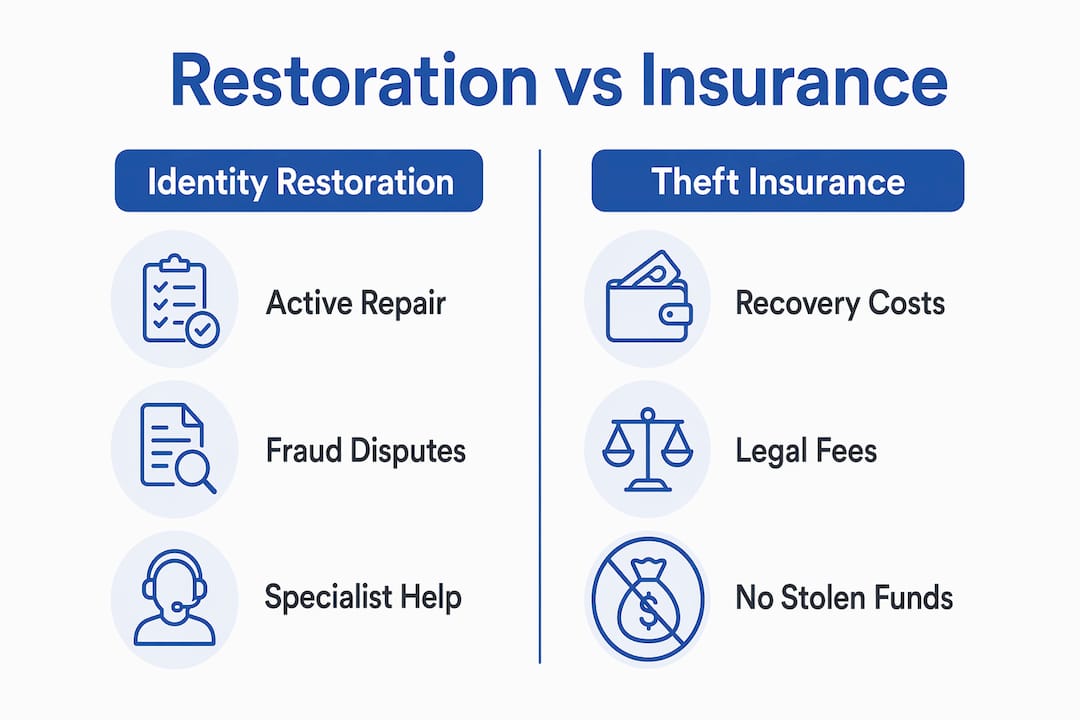
Understanding reimbursement limits before you sign up is critical. A plan with a $1 million insurance cap sounds impressive, but check the fine print on per-incident limits and deductibles.
Why is active participation critical when using identity restoration services?
A restoration specialist does the heavy lifting, but you are not a passive bystander. Your participation directly affects how fast and how completely your identity is restored.
Here’s what you need to do on your end:
- Respond quickly. Specialists need your signature on dispute letters and authorization forms. Delays on your end stall the entire process.
- Keep every record. Meticulous documentation of all communications, confirmations, and case updates is critical. Save emails, take notes on phone calls, and store copies of every form you sign.
- Verify the service itself. Consumer protection experts at the Consumer Financial Protection Bureau emphasize verifying service legitimacy before engaging. Scammers sometimes pose as restoration services and target recent identity theft victims.
- Provide complete information. Incomplete or inaccurate information slows disputes and can result in rejections from creditors or credit bureaus.
- Follow up proactively. Creditors and bureaus do not always respond on time. Your specialist will follow up, but you should also track open items and ask for status updates regularly.
Pro Tip: Create a dedicated folder, physical or digital, for your identity theft case. Label every document with the date and institution. This single habit can cut weeks off your restoration timeline.
The victims who recover fastest are the ones who treat restoration like a part-time job for the duration of the case. That means checking in with your specialist weekly and responding to requests within 24 hours.
How to choose and use an identity restoration service effectively
Not every service that markets itself as identity theft recovery delivers real results. Evaluating your options carefully before you need them is far smarter than scrambling after fraud hits.
Ask these questions before you commit to any plan:
- Are the specialists licensed or certified? Look for services that employ trained case managers with verifiable credentials, not just customer service representatives reading from a script.
- What is the insurance coverage limit? Plans range widely. Check whether the limit applies per incident or per year, and whether there is a deductible.
- Does the plan include limited power of attorney? This feature separates basic plans from genuinely useful ones.
- How do you reach your specialist? 24/7 access matters when fraud is discovered on a weekend or holiday.
- What does the plan NOT cover? Read the exclusions. Some plans exclude certain fraud types or require enrollment before the theft occurs.
“The best identity restoration service is the one you understand before you need it. Read the terms, know your coverage limits, and confirm your specialist’s role before fraud ever happens.”
Technology tools can also support your recovery. Checking your credit score impact regularly during restoration helps you track progress and catch new fraudulent activity early. Pairing restoration services with strong preventive tools, including a reputable password manager and a VPN, reduces the risk of repeat theft while your case is still open.
Techstacktoday reviews and ranks identity protection services based on hands-on testing, not paid placements. The best identity protection services ranked by Techstacktoday are evaluated on specialist quality, insurance terms, alert speed, and real-world usability.
Key Takeaways
An identity restoration service is an active, specialist-managed process that repairs fraud damage through disputes, documentation, and direct coordination with creditors and agencies, and it requires your participation to succeed.
| Point | Details |
|---|---|
| Restoration vs. monitoring | Restoration fixes fraud damage actively; monitoring only alerts you to threats. |
| Specialist role | A dedicated case manager handles disputes and paperwork but does not provide legal advice. |
| Insurance coverage | Plans typically cover $1M–$5M in recovery costs, not stolen funds. |
| Your participation matters | Responding quickly and keeping records directly speeds up your case resolution. |
| Evaluate before you need it | Check for limited power of attorney, insurance limits, and specialist credentials before enrolling. |
The part most people get wrong about identity restoration
After reviewing dozens of identity protection services at Techstacktoday, one pattern stands out clearly. Most people assume that signing up for a restoration service means someone else handles everything. That assumption is the single biggest reason restorations drag on longer than they should.
The specialist is your guide and your advocate. They are not a magic fix. The victims I’ve seen recover fastest are the ones who stay engaged, respond within hours, and treat every document request as urgent. The ones who take days to return calls or sign forms watch their cases stall for weeks at a time.
There’s also a widespread myth that identity restoration is a quick process. It is not. Complex cases involving multiple fraudulent accounts can take well over a year to fully resolve. Setting that expectation early prevents panic and keeps you focused on the right actions.
The emotional toll is real, too. Discovering that someone has been using your name to open credit cards or take out loans feels violating. A good restoration service acknowledges that and provides consistent support throughout. If your service treats you like a ticket number, find a better one.
— TechStackTeam
Protecting your identity before and after a theft

Recovery from identity theft is possible, but prevention is always faster and cheaper. Techstacktoday tests and ranks the privacy tools that reduce your exposure before fraud happens and support your recovery after it does.
Start by reducing your digital footprint. Techstacktoday’s guide on removing yourself from the internet walks you through pulling your personal data from data broker sites that feed identity thieves. Pair that with a top-rated password manager to lock down your accounts, and a tested VPN from Techstacktoday’s reviewed VPN services to protect your connection on public networks. Every layer you add makes you a harder target and a faster recovery case if theft does occur.
FAQ
What is the difference between identity monitoring and identity restoration?
Identity monitoring detects suspicious activity and sends you alerts. Identity restoration is the active process of repairing fraud damage after theft has already occurred, involving a specialist who disputes accounts and coordinates with creditors on your behalf.
How long does the identity restoration process take?
The restoration timeline ranges from a few months to over a year. Cases involving multiple fraudulent accounts or synthetic identity fraud take the longest to resolve.
Does identity theft insurance cover stolen money?
No. Identity theft insurance covers out-of-pocket recovery costs like legal fees and lost wages. Stolen funds from bank or credit accounts are handled separately by your financial institution.
Do I need to do anything if I have a restoration service?
Yes. You must provide information, sign authorization forms, and respond to your specialist promptly. Active participation is the single biggest factor in how quickly your case resolves.
How do I verify that an identity restoration service is legitimate?
Check the service against the Consumer Financial Protection Bureau’s guidance and look for verifiable specialist credentials, clear insurance terms, and a documented complaints history before enrolling.