Identity theft recovery is defined as the process of disputing fraudulent accounts, correcting damaged credit, and restoring your legal and financial identity after a thief has used your personal information. Why identity theft recovery takes long comes down to one core reality: you are not dealing with one institution but many, each with its own verification rules, timelines, and bureaucratic requirements. Recovery typically requires 100–200 hours of your time across 6–12 months, and nearly 48% of cases remain unresolved after a full year. That figure alone tells you this is not a quick fix. Understanding the reasons behind that timeline is the first step toward managing it.
Why does identity theft recovery take so long?
Detection latency is the single biggest driver of a prolonged recovery. The longer fraud goes unnoticed, the more embedded the fraudulent accounts become. A thief who has had six months to open credit lines, file tax returns, or take out loans in your name creates a far messier trail than one caught in week one.
The type of identity theft also determines how many hours you will spend. Not all cases are equal:
- Credit card fraud: Typically resolved in 1–4 weeks with 5–10 hours of effort. Banks have established chargeback processes that move relatively fast.
- Synthetic identity theft: A thief combines your real Social Security number with fabricated details to create a new identity. This can take 100–300+ hours to resolve over 6–24 months because the fraudulent identity has a credit history of its own.
- Criminal identity theft: Someone uses your name during an arrest. Clearing your criminal record requires court orders, law enforcement cooperation, and sometimes legal representation.
- Medical identity theft: Fraudulent medical records can affect your insurance and health history for years.
The gap between simple and complex cases is enormous. A stolen credit card number is a contained problem. Synthetic or criminal identity theft is a systemic one, touching multiple institutions simultaneously.
Pro Tip: Check your credit reports at AnnualCreditReport.com every few months, not just once a year. Early detection is the single most effective way to shorten your recovery timeline. You can also review identity theft warning signs to catch fraud before it compounds.

How coordination with institutions slows the resolution process
Recovery requires you to work with multiple agencies at the same time, and none of them talk to each other automatically. Each institution operates on its own verification timeline, which means your case moves only as fast as the slowest responder.
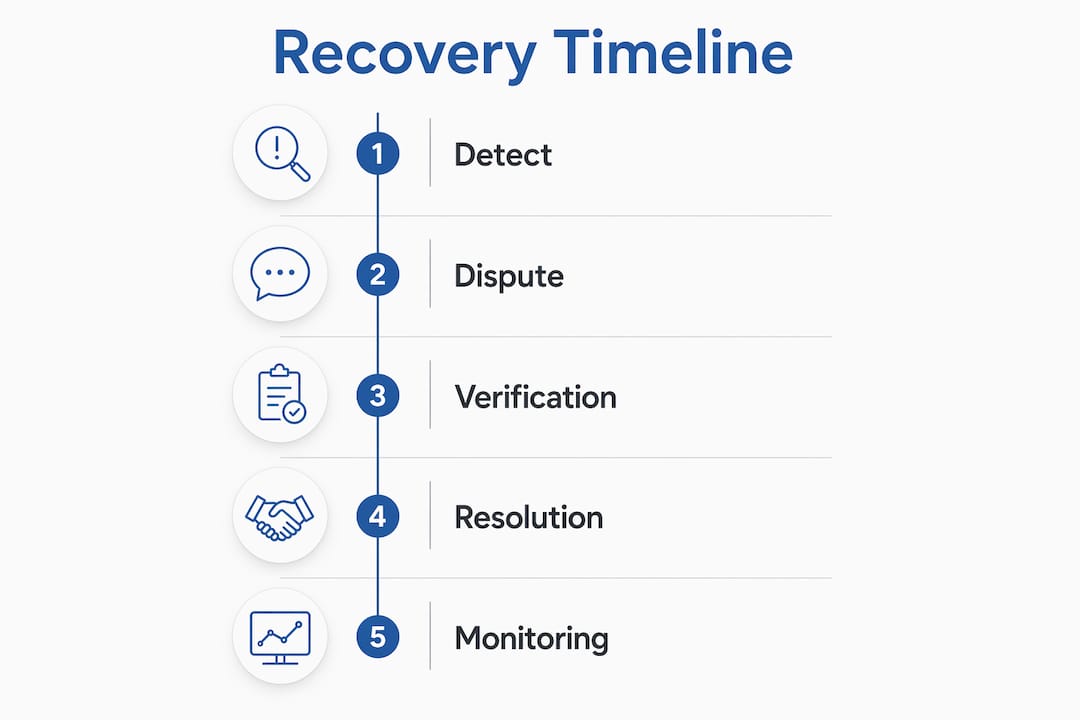
Here is the sequence most victims face:
- File an FTC Identity Theft Report at IdentityTheft.gov. This creates your official recovery plan and gives you legal standing to dispute accounts.
- File a police report. Some creditors require a case number before they will investigate. Getting one can take days or weeks depending on your local department’s workload.
- Place fraud alerts or credit freezes with all three major credit bureaus: Equifax, Experian, and TransUnion. A freeze is free and stops new credit from being opened in your name.
- Send written dispute letters to each creditor. Phone calls do not count. Under the Fair Credit Billing Act, disputes must be written and certified to trigger a formal investigation and legal protections.
- Follow up with the IRS if tax fraud is involved. This is a separate process entirely.
- Contact your bank directly to freeze or close compromised accounts and request new account numbers.
Each of these steps generates its own waiting period. A creditor has 30 days to respond to a written dispute. A credit bureau has 30–45 days to complete its investigation. If one institution requests more documentation, the clock resets. Victims who make informal phone calls instead of written disputes lose their legal protections and add weeks to their timeline.
Pro Tip: Keep a dedicated folder, physical or digital, with copies of every letter you send and receive. Note the date, the recipient, and the certified mail tracking number. This paper trail protects you if a dispute is ignored or denied.
Why tax identity theft takes the longest to resolve
Tax identity theft is the most time-consuming category by a wide margin. The IRS reported an average of 506 days to resolve tax identity theft cases in fiscal year 2025. That is down from 676 days in fiscal year 2024, but still well over a year of waiting.
The delay happens because the IRS must manually verify your identity, match your legitimate return against the fraudulent one, and process a corrected refund. The agency handles millions of returns and has a structured queue. Your case moves through that queue at the IRS’s pace, not yours.
| Stage | What happens | Typical wait |
|---|---|---|
| Initial filing and fraud flag | IRS detects a duplicate return | Weeks to months |
| Identity verification | You submit Form 14039 and supporting documents | 60–120 days |
| Case assignment | IRS assigns a specialist | Several months |
| Resolution and refund | Corrected return processed and refund issued | Up to 506 days total |
Two specific mistakes extend this timeline further. First, submitting a duplicate Form 14039 resets your place in the queue. Second, calling the IRS repeatedly to check your status can trigger additional review flags. The IRS explicitly advises victims to submit once and wait. That advice is hard to follow when your refund is frozen, but acting impatiently makes things worse.
- Do submit Form 14039 once, with all required documentation attached.
- Do not call for status updates more than once every 60 days.
- Do request your IRS account transcript to monitor progress without triggering delays.
- Do not file a second return while your case is open.
Practical steps that reduce your identity theft recovery time
Starting recovery within 48 hours cuts your average resolution time by more than half. The first 24–48 hours require 3–4 hours of focused work, and that effort sets the trajectory for everything that follows.
The first two weeks are the most intensive, demanding 2–4 hours per day for critical reporting and credit freezes. Failing to act fast in this window substantially increases your total recovery time. Here is how to structure your early response:
- Hour 1: Go to IdentityTheft.gov and create your FTC report. Print or save your personalized recovery plan.
- Hour 2: Freeze your credit at all three bureaus online. Each bureau has its own portal. Do all three in one session.
- Hour 3: Call your bank and flag compromised accounts. Request new account numbers and cards.
- Hour 4: File a police report online if your local department allows it, or visit in person.
- Week 1: Send certified dispute letters to any creditors with fraudulent accounts. Use return receipt so you have proof of delivery.
- Weekly after that: Make one follow-up call per institution per week. Document every call with the date, the representative’s name, and what was said.
After the initial resolution, monitoring does not stop. Ongoing credit monitoring demands 3–5 hours per week for months beyond the initial phase. Thieves sometimes return to use the same stolen data years later. Review your identity theft recovery steps regularly to stay on track.
Pro Tip: Set a weekly calendar reminder to check your credit report, bank statements, and any open dispute letters. Treating recovery like a part-time job for the first three months dramatically reduces the chance of missing a deadline or letting a dispute lapse.
Key Takeaways
Identity theft recovery takes long because it requires coordinated action across multiple institutions, each operating on independent timelines, while the damage compounds with every day fraud goes undetected.
| Point | Details |
|---|---|
| Detection speed is decisive | The longer fraud goes unnoticed, the more embedded it becomes and the harder it is to undo. |
| Case type determines hours | Simple credit card fraud takes 5–10 hours; synthetic identity theft can require 300+ hours over two years. |
| Written disputes are legally required | Phone calls do not trigger creditor investigations; certified written letters are mandatory under the Fair Credit Billing Act. |
| Tax cases take longest | The IRS averaged 506 days to resolve tax identity theft in fiscal year 2025. |
| Early action cuts total time | Starting within 48 hours and front-loading effort in the first two weeks reduces overall recovery time significantly. |
The part nobody warns you about
The administrative grind of identity theft recovery is genuinely exhausting. Most articles focus on the steps. Few talk about what it feels like to be in month seven, still waiting on a credit bureau response, still checking your mail for a letter that has not arrived.
What I have seen consistently is that victims underestimate the maintenance phase. The first two weeks feel urgent and manageable because there is a clear checklist. Then the waiting begins, and that is where people lose momentum. They stop following up. They assume no news is good news. It rarely is.
The other thing worth saying plainly: the system is not designed with victims in mind. Credit bureaus, the IRS, and banks all have their own priorities. Your case is one of thousands. Persistent, documented follow-up is not optional. It is the mechanism that actually moves your case forward. Persistent follow-up and escalation by victims produces measurable acceleration. That is not a soft suggestion. It is the documented reality.
Treat recovery like a second job for the first three months. Block time weekly. Keep your folder updated. And do not mistake a temporary silence from an institution for resolution.
— TechStackTeam
Protect yourself before and after recovery
Recovery is hard. Prevention is far less costly in time and stress.

Techstacktoday has reviewed and ranked over 50 privacy and identity protection services, tested in real-world conditions with no paid rankings influencing the results. If you want to reduce the risk of going through this process again, start with a top-rated VPN service to encrypt your connection and limit exposure of your personal data online. Pair that with a reviewed identity protection service that monitors your credit and dark web activity in real time. Early alerts are the fastest way to cut recovery time before it starts. Techstacktoday’s rankings are updated regularly so you always have current, unbiased options.
FAQ
How long does identity theft recovery take on average?
Recovery typically takes 6–12 months and 100–200 hours of effort, though complex cases like synthetic or criminal identity theft can extend beyond two years with nearly 48% of cases unresolved after 12 months.
Why does tax identity theft take so long to resolve?
The IRS averaged 506 days to resolve tax identity theft cases in fiscal year 2025 due to manual verification processes, systemic backlogs, and a structured case queue that moves at the agency’s pace.
Does starting recovery early actually make a difference?
Starting within 48 hours cuts average resolution time by more than half. The first two weeks are the most critical, requiring focused daily effort to freeze credit, file reports, and contact financial institutions.
Why can’t I just call my bank or creditor to dispute a charge?
Phone calls do not trigger formal investigations. Under the Fair Credit Billing Act, disputes must be submitted in writing and sent by certified mail to activate legal protections and compel creditors to investigate.
What should I monitor after my case is resolved?
Continue reviewing your credit reports and bank statements for at least 12 months after resolution. Thieves sometimes reuse stolen data years later, and ongoing identity monitoring is the only reliable way to catch a repeat attempt early.