The fastest way to start a LexisNexis opt out is the official online suppression form. If you need to submit documents it can’t accept online, call the Consumer Center at 1-866-490-1920 or mail your paperwork. Just know suppression won’t touch FCRA-regulated products or law enforcement access. ✅
TL;DR:
- Using the online suppression form at optout.lexisnexis.com is the fastest way to start the LexisNexis opt-out process, especially for non-FCRA products.
- Different opt-out options target prescreen offers, marketing lists, or public safety reasons, with public-safety suppression requiring proof of eligibility.
- Providing accurate identification details and supporting documents, especially for public safety cases, is essential, and never mailing original documents is recommended.
- Suppression narrows data visibility but does not remove information from law enforcement access, FCRA products, or other data brokers.
- Requesting a consumer disclosure and disputing inaccuracies can be more effective than immediate suppression, which may slow down automated identity checks.
Table of Contents
- How Do You Opt Out of LexisNexis?
- Prescreen, Marketing, or Public Safety: Which Opt-Out Applies to You?
- What Documents Does LexisNexis Actually Ask For?
- Step-by-Step: Submitting Your LexisNexis Opt-Out Request
- What Suppression Won’t Fix (and Why That Matters)
- What Happens After You Submit Your Request?
- What Should You Do Next?
- TechStackToday’s Take: Suppress Smart, Not First
- Sources
How Do You Opt Out of LexisNexis?
You have four official channels, and picking the right one saves you weeks of back and forth. Start with the opt-out and suppression form at optout.lexisnexis.com. It’s built for people requesting Information Suppression on non-FCRA products, and it walks you through the category that fits your situation.
If your request involves a state privacy law request (California residents, for example), use the Consumer Portal instead. It handles disclosure requests and prescreen opt-outs in one place.
For anything that needs documents (a police report, a protective order, a supervisor letter), the portal often won’t take the upload. That’s when phone and mail take over:
- Phone: 1-866-490-1920 for general suppression questions, 1-866-897-8126 for state privacy law and printable-form support
- Mail: LexisNexis Risk Solutions Consumer Center, Attn: Printable Request Form, P.O. Box 105108, Atlanta, GA 30348-5108
- Email: Use only when the portal or mailing instructions direct you there
Pro Tip: Call before you mail anything. A five-minute call confirms which form version and documents your specific request needs, so you’re not resubmitting three weeks later.
Prescreen, Marketing, or Public Safety: Which Opt-Out Applies to You?
Not every opt-out does the same thing, and picking the wrong one wastes your time. Here’s how the three main options break down:
- Prescreen opt-out. This stops firm offers of credit and insurance built from your credit file. You can do it online, by phone, or by mail, and calling 1-888-567-8688 also opts you out with the major credit bureaus at once.
- Direct marketing opt-out. This removes you from LexisNexis marketing lists specifically. It has no effect on other data brokers still selling or renting your contact information.
- Public-safety suppression. Reserved for judges, law enforcement, domestic violence survivors, and similar categories. It requires documentation proving you qualify, not just a request.
What Documents Does LexisNexis Actually Ask For?
Expect to provide standard identity fields plus, in some cases, formal proof of your situation. The baseline identity information includes:
- Full legal name and any prior names
- Current address and addresses from the past several years
- Date of birth
- Either your Social Security number (optional, but it speeds verification) or a driver’s license number and state
If you’re requesting suppression as a public official, law enforcement officer, or someone facing a documented safety threat, LexisNexis will ask for supporting evidence: a police report, a protective order, or an employer/supervisor letter confirming your role. LexisNexis’s own policy language makes clear these documentation requirements exist specifically for covered persons under certain state laws.
- Redact anything unrelated to the request, like case numbers tied to unrelated legal matters
- If the portal rejects your upload, mail copies to the P.O. Box above or email privacy.information.mgr@lexisnexis.com
Pro Tip: Never mail original documents. Send clear copies and keep the originals in your own file in case a dispute or resubmission comes up later.
Step-by-Step: Submitting Your LexisNexis Opt-Out Request
Follow this sequence and you’ll cut down on the back-and-forth that slows most requests down.
- Identify the right category first. Read the instructions on the suppression form closely. Prescreen, direct marketing, and public-safety suppression are handled differently, and starting with the wrong one means starting over.
- Fill in every required field. Skipped fields are the number one reason requests bounce back for clarification.
- Attach whatever documentation you have ready. If you don’t have it yet, note in your submission that it’s coming by mail.
- Set your communication preference to email. It’s the fastest way LexisNexis will confirm receipt and follow up.
- If mailing anything, label every page with your name and a callback number. Loose pages get separated from case files more often than you’d expect.
- Save your confirmation. Written supporting documents can take up to 30 days from receipt to process, so a paper trail matters.
- Record your case or reference number. You’ll need it if you have to call and check status later.
📌 By the numbers: LexisNexis states that mailed supporting documentation can take up to 30 days from receipt to process, separate from the initial online submission. Build that window into your expectations before you follow up.
What Suppression Won’t Fix (and Why That Matters)
Suppression narrows what’s visible. It doesn’t erase you. Here’s the honest scope:
- It applies to certain LexisNexis-owned, non-FCRA products and specific marketing lists.
- It does not remove your information from FCRA-regulated products or from databases law enforcement can access.
- It is not deletion from the public record itself, and it has zero effect on other data brokers holding the same information.
- It can create friction with automated identity checks used by insurers, lenders, or account-opening systems.
Suppression can create authentication gaps that show up later, in an insurance quote that stalls or an account opening that suddenly requires manual verification. Weigh that friction against the privacy gain before you submit, especially if you rely on fast automated approvals.
LexisNexis’s own documentation flags this tradeoff directly: opting out reduces exposure, but it can also slow down processes that depend on quickly verifying who you are.
What Happens After You Submit Your Request?
Processing moves faster online than by mail, but neither is instant. Here’s what to expect and what to do if things stall:
- Timeline: Online requests without extra documentation process in a reasonable timeframe; mailed supporting documents can take up to 30 days from receipt.
- Notification: LexisNexis typically confirms by email if that’s your preferred contact method. No confirmation after a reasonable wait is your signal to call.
- Status checks: Use 1-866-490-1920 for general suppression status or 1-866-897-8126 for state privacy law requests.
- If denied: Ask specifically what was missing or unclear. Resubmit with sharper, more complete documentation rather than repeating the same form.
- If underlying data is wrong: Request your consumer disclosure and dispute the inaccuracy directly instead of just resubmitting the suppression request.
What Should You Do Next?
Suppression is one tool, not the whole plan. Before or instead of opting out, consider these moves:
- Request your free consumer disclosure first. Reviewing your file tells you whether the record is even accurate before you decide what to do about it.
- Dispute, don’t suppress, if the data is wrong. A correct record hidden through suppression can resurface elsewhere; an incorrect one fixed through dispute stays fixed.
- Register at Donotcall to cut down telemarketing tied to your number, separate from anything LexisNexis controls.
- Use DMAchoice for broader direct-mail marketing reduction.
- Opt out at other brokers, since LexisNexis suppression has zero effect on separate companies holding the same data. Our guide on removing yourself from the internet walks through that broader process, and if state law gives you extra leverage, our breakdown of state privacy laws and broker removal explains how to use it.
TechStackToday’s Take: Suppress Smart, Not First
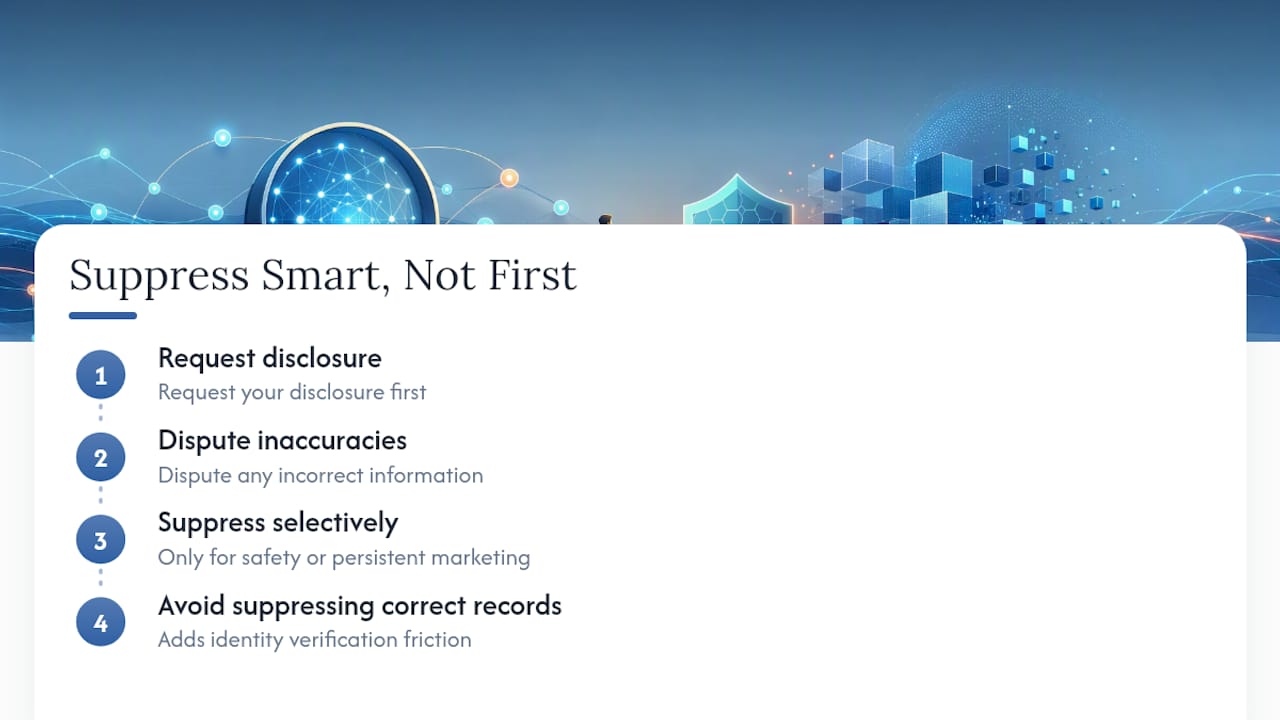
Our recommendation, based on how these systems actually behave: request your disclosure first, dispute anything inaccurate, and save suppression for safety concerns or marketing that won’t quit. Jumping straight to suppression on a correct record just adds friction to your own identity checks later.
A few habits that consistently cut down on follow-up requests: submit clear document copies (never originals), pick email as your contact preference, and log your reference number the moment you get it.
For readers weighing whether a paid service makes sense given how many brokers exist beyond LexisNexis, our data removal service comparison breaks down when DIY opt-outs stop scaling. Readers dealing with identity verification friction after suppression may also find our analysis of privacy tradeoffs in verification-heavy industries useful context for what to expect.
— TechStackTeam
If suppression is only step one, a broader plan matters more than a single form. Techstacktoday’s data removal service comparisons and our personal data deletion action plan both walk through coordinating requests across brokers instead of chasing one company at a time. If you’d rather not manage a dozen opt-out forms yourself, comparing data removal services is worth ten minutes before you decide.
Sources
- Individual Requests for Information Suppression | LexisNexis
- Opt Out Request – LexisNexis Risk Solutions Consumer Disclosure
- Printable request form instructions (LexisNexis)
- Consumer and data access policies (LexisNexis)
- LexisNexis consumer access / consumer disclosure information