For most households, the smartest move is a low-cost rider added to a homeowners or renters policy, paired with a tested monitoring plan. Skip the rider only if you already have strong monitoring and can absorb a few hundred dollars in recovery paperwork costs. Choose a standalone policy or subscription protection plan (like Experian or LifeLock) if you want higher reimbursement caps and hands-on restoration help. Compare coverage limits and monitoring features before you buy anything.
TL;DR:
- Most households benefit from pairing a low-cost rider with a tested monitoring plan, unless they already have strong monitoring and can handle some recovery paperwork costs.
- Reimbursement limits vary: riders from Travelers and Nationwide typically cover up to $25,000 for specific expenses, while subscription protection plans like Experian usually advertise up to $1 million but cover only certain costs.
- Insurance generally reimburses legal fees, lost wages, travel costs, and document replacement; it does not cover stolen money or business-related fraud.
- Monitoring plans with fast alerts and broad dark web coverage are more effective at preventing extensive damage than relying solely on insurance reimbursement.
- Choosing the right plan depends on your online activity level, with most households better served by pairing a cheap rider with a reliable monitoring service.
Table of Contents
- Is Identity Theft Insurance Worth It? Top Options Ranked
- What Does Identity Theft Insurance Cover?
- Insurance vs. Monitoring: Which Do You Actually Need?
- What Does Identity Theft Insurance Cost?
- How to Choose an Identity Theft Insurance Policy
- Why Monitoring Quality Changes the Insurance Math
- Our Take: Match the Plan to Your Risk, Not the Marketing
- Compare Monitoring Plans Before You Buy Insurance
- Sources
- FAQ
Is Identity Theft Insurance Worth It? Top Options Ranked
Here’s the deal: you’re choosing between three different products that all get lumped together under “identity theft insurance,” and picking the wrong category wastes money.
An insurer add-on rider adds identity coverage to a policy you already own. A standalone policy is a dedicated identity insurance product, usually sold separately. A subscription protection service bundles monitoring with some reimbursement, but leads with detection rather than payout size.
Pro Tip: Read the word “reimbursement” carefully on every plan. It means the company pays you back after you spend the money, not that it covers a loss directly.
| Option | Type | Coverage cap | Monitoring included | Price cue |
|---|---|---|---|---|
| Experian | Subscription protection | High advertised caps for defined expenses | Credit monitoring, dark web scans | Tiered monthly plans |
| LifeLock (Norton LifeLock) | Subscription protection | Bundled reimbursement via Million Dollar Protection Package | Credit and identity monitoring | Tiered monthly plans |
| Travelers | Insurer rider | Up to $25,000 for named expenses | Not the focus; expense reimbursement only | Add-on to home policy |
| Nationwide | Insurer add-on | Reimbursement for covered recovery expenses | Monitoring portal access | Low annual add-on cost |
| Progressive | Subscription protection (Experian-powered) | Advertised reimbursement tied to monitoring plan | Credit monitoring, dark web scanning | Tiered monthly plans |
| Equifax | Monitoring/protection resources | Varies by plan | Credit monitoring products | Varies by plan |
A few notes worth sitting with before you pick a lane:
- Travelers and Nationwide function as riders. They’re cost-efficient add-ons, but reimbursements are capped and subject to your existing policy’s claims handling.
- Experian, LifeLock, and Progressive sell subscription protection. They advertise higher reimbursement limits, but those typically apply to a defined set of expenses rather than direct stolen funds, according to Experian’s coverage details.
- Equifax is mostly a monitoring and education resource rather than a packaged insurance product, so treat it as a research stop, not a purchase decision.
What Does Identity Theft Insurance Cover?
Most types of insurance don’t automatically cover identity theft. You typically have to add a rider, buy a standalone policy, or get coverage bundled into a protection plan, according to Experian. What gets reimbursed tends to fall into a predictable list:
- Legal fees for hiring an attorney to dispute fraudulent debts or defend against creditors.
- Lost wages when you miss work to handle paperwork, calls, or court dates. Travelers, for example, covers up to $1,000 per week for lost wages tied to recovery, per its identity fraud coverage page.
- Travel expenses, also capped around $1,000 per week under some Travelers plans, for trips required to resolve the fraud.
- Document replacement costs, like fees for reissuing a driver’s license, passport, or Social Security card.
- Notary, mailing, and phone charges tied directly to filing disputes.
What almost never gets covered: the actual stolen money, losses tied to a business you own, and fraud that started before your policy existed. Mass makes this distinction clearly. A rider on your homeowners policy handles the smallest slice of these costs. A standalone policy or protection plan usually reimburses a wider list.
Insurance vs. Monitoring: Which Do You Actually Need?
Identity theft insurance is reactive. It pays you back after the damage happens. Protection and monitoring plans are proactive. They try to catch the fraud before it spirals, according to Allstate’s identity theft resources.
Monitoring plans typically include:
- Dark web scans that flag your data showing up on criminal marketplaces.
- Credit alerts for new account openings or hard inquiries.
- SSN trace tools that show where your Social Security number is being used.
For most people, the smartest setup pairs a cheap insurance rider with a monitoring plan that has fast, reliable alerts. Monitoring catches the problem early. The rider covers whatever paperwork costs slip through anyway.
Pro Tip: If you can only afford one, buy monitoring first. Catching fraud in week one is worth more than any reimbursement check that arrives in month three.
What Does Identity Theft Insurance Cost?
Basic add-on riders typically run $25 to $60 per year, according to Mass.gov. Subscription protection plans start around $9.99 a month and climb from there depending on how many people and how much monitoring depth you want.
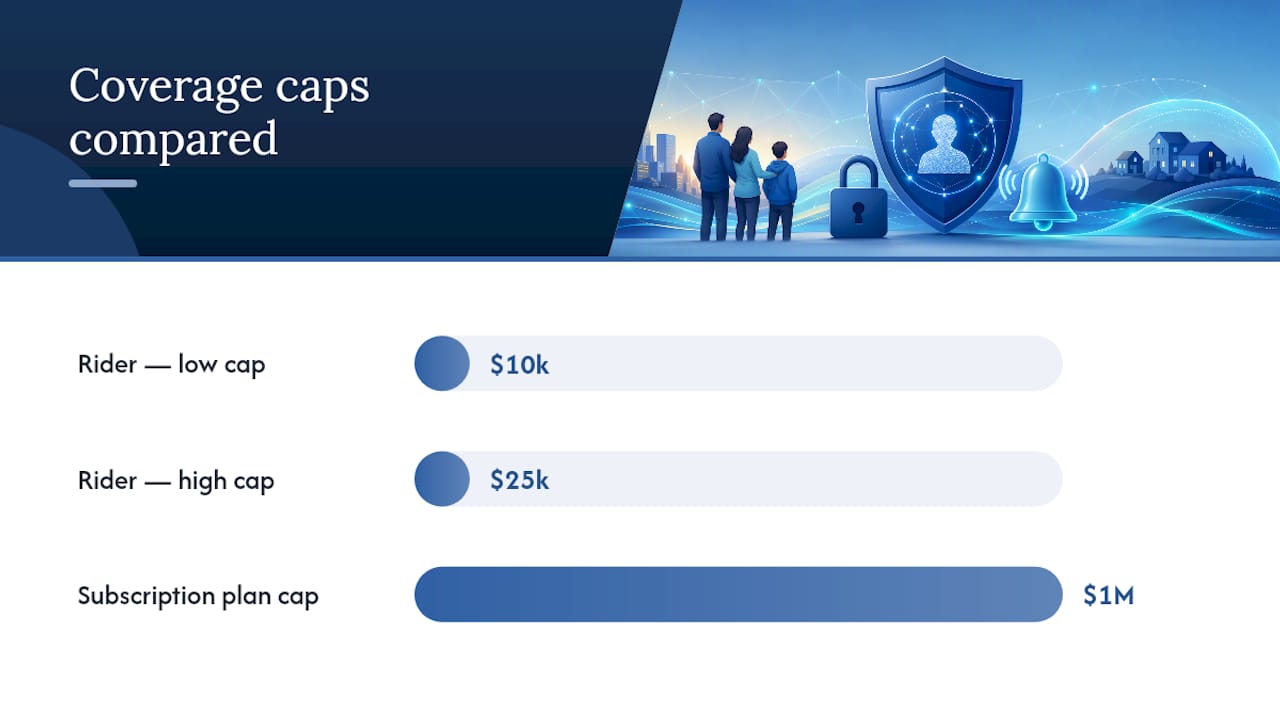
Coverage caps vary just as widely. Insurer riders like those from Travelers or Nationwide often max out between $10,000 and $25,000 for defined expenses. Subscription protection plans, including some tied to Experian or IDnotify partnerships, advertise coverage up to $1 million for certain identity-theft-related expenses, though that figure applies to a specific set of reimbursable costs, not a blank check for any loss.
A few practical notes before you compare numbers:
- Most policies carry a deductible and require receipts or documentation to file a claim.
- More effective monitoring can reduce claim frequency and size by detecting fraud earlier.
- Advertised limits like “up to $1 million” usually represent combined coverage across multiple expense categories, not a single lump sum payout.
How to Choose an Identity Theft Insurance Policy
Run through this checklist before signing anything:
- Check the coverage cap. Know whether it’s $10,000 or $1 million, and what expenses count against that limit.
- Confirm reimbursement type. Does it cover expenses only, or does it touch stolen funds at all? Most only cover expenses.
- Ask about restoration specialists. Are they U.S.-based, and can they act on your behalf with creditors and agencies?
- Read the exclusions list. Business losses, pre-existing fraud, and certain digital assets are commonly excluded.
- Check the deductible. A high deductible on a low-cap rider can make a claim not worth filing.
- Ask if a claim affects your primary policy. Nationwide notes that bundled riders may be subject to the parent policy’s claims-handling rules, which can affect future premiums.
Watch for red flags: vague language like “coverage for identity theft related costs” with no defined list, no mention of restoration specialists at all, or pressure to pre-approve legal fees before you’ve even filed a claim.
Pro Tip: Call the insurer and ask them to name three covered expenses and one thing they won’t pay for. A rep who can’t answer that in thirty seconds is selling you a policy they don’t understand either.
Why Monitoring Quality Changes the Insurance Math
Monitoring services can be tested against factors such as the number of unique data sources scanned in dark web checks, how quickly alerts are received after a breach, and whether restoration agents are available to assist. Weak performance on any of these means slower detection and a bigger recovery bill.
Faster alerts let you freeze accounts before a fraudster opens five more. That’s the entire game. A monitoring plan built for speed reduces the number of expenses an insurance claim ever needs to cover.
- Broader dark web coverage catches leaked credentials sooner.
- Fast alerts (hours, not days) limit account takeover damage.
- U.S.-based restoration support cuts the paperwork burden significantly.
For most households, a modest rider paired with a well-tested monitoring plan beats an expensive standalone policy with mediocre alerts.
Our Take: Match the Plan to Your Risk, Not the Marketing
If you’re a typical adult household with average online exposure, pair a cheap rider with a solid monitoring plan. Heavy online users and seniors managing finances for family members should lean toward a standalone policy or subscription protection with real restoration support. Either way, monitoring plus a rider beats any single product sold on reimbursement numbers alone.
— TechStackTeam
Compare Monitoring Plans Before You Buy Insurance
Some testing approaches for identity protection services are hands-on, scored by performance, with rankings unaffected by paid placements. That matters here because the insurance side of this decision only works well when the monitoring side is actually catching fraud early.

We evaluate monitoring depth, alert speed, and restoration support across dozens of services, then rank them by what actually performed in testing rather than what marketing pages claim. If you’re deciding what to pair with a rider or standalone policy, start with our best identity protection services roundup to see which plans scored well on alert timeliness, and check our identity monitoring explainer if you want to understand what “dark web scan” actually means before you pay for one.
FAQ
Is Identity Theft Insurance a Good Idea?
For most people, yes, as a low-cost add-on. A rider running $25 to $60 a year covers recovery expenses that would otherwise come out of pocket, and it works best paired with a monitoring plan that catches fraud early.
What Is the Best Insurance for Identity Theft?
There’s no single best option. Insurer riders from Travelers or Nationwide suit people who want a cheap add-on to existing coverage, while subscription protection services like Experian or LifeLock suit people who want higher reimbursement caps and restoration specialists.
What Does Identity Theft Insurance Cover?
Most policies reimburse legal fees, lost wages, travel expenses, and document replacement costs tied to recovering from fraud. They typically exclude direct stolen funds, business losses, and pre-existing fraud cases.
Does Dave Ramsey Recommend Identity Theft Insurance?
Financial personalities generally advise against expensive standalone identity theft insurance, favoring free protections like credit freezes and fraud alerts instead. A low-cost rider or monitoring plan can still add value if it fits your budget and risk level.
How Is Identity Theft Insurance Different From a Credit Freeze?
A credit freeze is free and blocks new credit accounts from opening in your name, which prevents certain fraud outright. Identity theft insurance doesn’t prevent fraud. It reimburses costs after fraud has already happened.