Background check turnaround time is defined as the full period from the moment a screening is initiated to when the completed report is delivered and any required employer actions are concluded. For most U.S. employment screenings, checks complete in 1–3 business days, with comprehensive packages often running 3–5 business days. How background check turnaround works depends on three core variables: the scope of checks ordered, the responsiveness of third parties like courts and employers, and mandatory legal steps under the Fair Credit Reporting Act (FCRA). Understanding these variables helps both candidates and hiring managers set realistic expectations and avoid unnecessary delays.
How background check turnaround works: components and timing
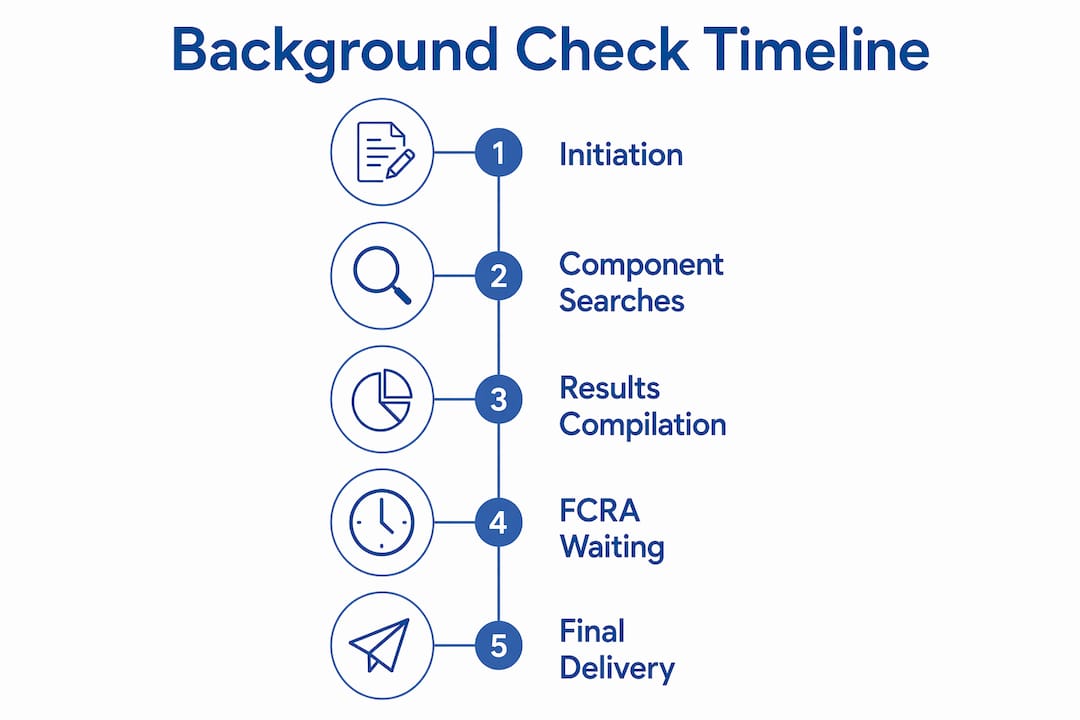
The total duration of a background check is determined by its slowest component. Background checks run in parallel, meaning multiple searches happen simultaneously, but the one that takes longest sets the finish line.
Here is a breakdown of the most common components and their typical processing speeds:
| Component | Method | Typical Turnaround |
|---|---|---|
| National criminal database search | Automated | Minutes to hours |
| Sex offender registry check | Automated | Minutes to hours |
| County court criminal record search | Manual or semi-manual | 1–5 business days |
| Employment verification | Manual (third-party contact) | 2–5 business days |
| Education verification | Manual (third-party contact) | 2–5 business days |
| Professional license verification | Manual or automated | 1–3 business days |
Database searches pull from aggregated national records and return almost instantly. County court searches are a different story. Many courthouses still rely on paper records or in-person clerk requests, which means a vendor must wait for a human to physically pull and review a file. Employment and education verifications commonly extend turnaround to 3–5 business days because they depend entirely on how quickly a former employer or registrar responds.

Adding more components to a screening package does not multiply the time proportionally, since parallel processing helps. But each new manual verification adds risk of becoming the slowest link.
Pro Tip: Ask your screening provider which specific component is still pending. Providers like Bib.com and Cisive offer status tracking that identifies exactly where a check is held up, so you can focus follow-up efforts instead of waiting blindly.
What causes delays in background check timing?
Delays in background check duration are almost always caused by third-party responsiveness issues, not the screening provider itself. Courts vary widely in digitization, backlogs, and holiday schedules, and that variation directly impacts how long your check takes.
Here are the most common delay causes, ranked by frequency:
- Courthouse backlogs. Some counties process record requests within 24 hours. Others take a week or more, especially in jurisdictions that still use paper filing systems.
- Slow employer or school responses. Former employers may route verification requests through HR departments that only respond weekly. Some schools require written requests before releasing records.
- Candidate data mismatches. Identity disambiguation issues occur when a candidate’s name is common or their submitted information contains errors. The vendor must then expand searches manually to confirm the right individual.
- Holiday closures and seasonal spikes. Courts and HR departments close for federal and state holidays. Hiring surges in January and September create backlogs at screening providers.
- Jurisdictional differences. Digitized courts can return results in 24–48 hours, while paper-based courts may take five or more business days for the same search.
Pro Tip: Candidates can cut delay risk significantly by double-checking every piece of submitted information before the check begins. A wrong middle name or an outdated employer address triggers manual review and can add two or more days to the process.
The fix for most delays is not pressure on the provider. It is targeted follow-up on the specific pending component. If a county court is the bottleneck, your provider may be able to escalate or use an alternative access method. If an employer is unresponsive, the candidate can sometimes provide supplemental documentation to move things forward.
How does FCRA compliance extend the final timeline?
Employers often calculate background check duration as the time from submission to report delivery. That is only part of the picture. The FCRA adds mandatory legal steps that extend the total timeline before a hiring decision can be finalized.
FCRA requires a two-step adverse action process when a background check result may negatively affect a hiring decision. Here is how that process adds time:
| Step | Description | Typical Duration |
|---|---|---|
| Report delivery | Screening provider sends completed report | Day 1–5 |
| Pre-adverse action notice | Employer sends candidate a copy of the report and summary of rights | Day 1 of notice period |
| Waiting period | Candidate has time to review and dispute findings | At least 5 business days |
| Candidate dispute (if filed) | Reinvestigation triggered by candidate | Up to 30 additional days |
| Final adverse action notice | Employer formally communicates the negative decision | After waiting period ends |
Five business days is the widely accepted best practice for the waiting period after a pre-adverse notice, though some states now require longer windows. This means even a background check that completes in two days can take ten or more business days before a final hiring decision is legally sound.
Candidate disputes add another layer. If a candidate contests a finding, the FCRA gives them up to 30 days for reinvestigation. These compliance steps are non-optional and exist specifically to protect candidates from inaccurate information affecting their employment prospects.
Pro Tip: Build the FCRA waiting period into your hiring timeline from day one. If you need a role filled by a specific date, count backward from that date and factor in at least 5 business days for the adverse action window, plus your expected report turnaround.
What can you do to speed up the process?
You have more control over background check speed than most people realize. Both candidates and employers can take concrete steps to reduce delays.
For employers:
- Choose a screening provider with direct court access and real-time status tracking. Providers with established court relationships retrieve records faster than those relying on third-party runners.
- Submit complete and verified candidate information. Errors in a candidate’s name, date of birth, or Social Security number trigger manual identity resolution and add days to the process.
- Plan hiring timelines around realistic turnaround windows. A 3–5 business day report window plus a 5 business day FCRA waiting period means building at least two weeks into your offer-to-start timeline for roles requiring comprehensive checks.
- Use a candidate portal that sends automated reminders. Providers that prompt candidates to complete their portion quickly reduce the time a check sits waiting for consent or additional information.
For candidates:
- Respond immediately to any requests from the screening provider. Quick corrections to data mismatches prevent multi-day delays caused by manual verification stages.
- Have your employment history ready with exact dates, supervisor names, and contact information. Gaps or vague entries slow down employer verification.
- Check your email and spam folder daily during the screening period. Providers often send time-sensitive requests that candidates miss for days.
- If you believe a finding is inaccurate, file a dispute immediately. Early disputes are resolved faster than those filed at the last minute.
Pro Tip: Candidates with common names like “John Smith” or “Maria Garcia” should proactively provide additional identifying information such as a middle name, prior addresses, or a driver’s license number. This helps the vendor distinguish your records from others and avoids a lengthy manual disambiguation process.
How do different background check types compare in turnaround?
Employment screening is the most common use case, but background checks are ordered for many other purposes. Each type carries different turnaround expectations based on scope and data sources.
| Check Type | Typical Turnaround | Complexity Level |
|---|---|---|
| Employment (basic criminal) | 1–3 business days | Low |
| Employment (comprehensive) | 3–5 business days | Medium |
| Tenant screening | 1–3 business days | Low to medium |
| Volunteer or nonprofit check | 1–3 business days | Low |
| FBI fingerprint check | 3–7 business days | Medium |
| International background check | 2–8 weeks | High |
| Government security clearance | Months | Very high |
Tenant screening typically mirrors basic employment checks in speed because it relies on similar database searches for credit and criminal history. Volunteer checks are often limited to national criminal databases and return quickly.
FBI fingerprint checks add a biometric verification layer. The FBI processes prints through its Next Generation Identification system, which is faster than older methods but still requires physical submission or electronic scanning at an authorized location.
International checks are the outlier. Accessing criminal records in countries like India, Brazil, or Germany requires working through local authorities or credentialed third-party vendors in each country. Some nations have no centralized criminal database at all, which means manual record requests that can take weeks. Government security clearances operate on an entirely different timeline, often spanning months, because they involve interviews, financial reviews, and interagency coordination.
Key takeaways
Background check turnaround time is determined by the slowest component in the process, not the average speed of all components combined.
| Point | Details |
|---|---|
| Typical employment check duration | Most employment checks complete in 1–5 business days depending on scope and verification types. |
| Slowest component sets the timeline | Parallel processing helps, but court records and manual verifications are the most common bottlenecks. |
| FCRA adds mandatory legal time | The adverse action process adds at least 5 business days to the hiring timeline after report delivery. |
| Candidate accuracy reduces delays | Submitting complete, accurate information upfront prevents identity mismatches and manual review delays. |
| Check type determines complexity | International checks and government clearances operate on entirely different timescales than standard employment screening. |
What i’ve learned after reviewing dozens of screening services
The single biggest misconception I see is that employers treat background check turnaround as a black box. They submit the request, wait, and assume any delay is the provider’s fault. That is rarely true. After reviewing background check services across dozens of platforms, the pattern is consistent: delays almost always trace back to a specific court, a slow employer HR department, or a data entry error on the candidate’s initial form.
What separates good providers from mediocre ones is not raw speed. It is transparency. The best platforms tell you exactly which component is pending, which jurisdiction is causing the hold, and what your options are. That information lets you act instead of wait.
Candidates often feel powerless during a background check. They should not. Responding to provider requests within hours instead of days, correcting data errors immediately, and staying reachable by email are all within your control. Those actions genuinely shorten timelines.
The FCRA compliance layer frustrates employers who want to move fast. But the waiting period exists for a real reason. Inaccurate background check data does appear, and candidates deserve time to correct it before a job offer is withdrawn. Building that window into your hiring plan is not a burden. It is good process.
Technology is improving turnaround at the database level. Automated searches that once took hours now return in minutes. The hard ceiling is still manual verification and legal compliance. No technology eliminates the need for a court clerk to pull a physical file or for a candidate to have a fair chance to dispute a finding.
— TechStackTeam
Take control of your background check process today
Knowing how background check turnaround works is the first step. Acting on that knowledge is what gets you hired faster or fills your role sooner.
Techstacktoday reviews and ranks the top background check platforms based on real-world testing, not paid placements. We evaluate turnaround speed, status transparency, FCRA compliance tools, and candidate portal quality so you can choose a provider that actually performs. If you are also concerned about how your personal data appears in screening databases, our guide on removing yourself from the internet covers the steps to clean up your digital footprint before a check is even ordered.
FAQ
How long does a standard employment background check take?
Most standard employment background checks complete in 1–3 business days. Comprehensive checks that include employment verification and county court searches typically take 3–5 business days.
What is the FCRA adverse action waiting period?
The FCRA requires employers to send a pre-adverse notice and wait at least 5 business days before issuing a final adverse action notice. Some states require longer waiting periods.
Why is my background check taking longer than expected?
The most common causes are courthouse backlogs or slow employer responses. Ask your provider which specific component is still pending so you can target follow-up efforts.
Can a candidate speed up their own background check?
Yes. Responding quickly to provider requests and correcting any data mismatches immediately are the two most effective actions a candidate can take to reduce delays.
How long do international background checks take?
International background checks typically take 2–8 weeks depending on the country. Nations without centralized criminal databases require manual record requests through local authorities, which extends timelines significantly.