Identity protection for seniors is the proactive use of prevention, detection, and recovery methods designed to shield older adults from identity theft, financial fraud, and scam-driven exploitation. This identity protection for seniors guide covers the tools, tactics, and resources you need to stay safe. Scammers specifically target older adults because they tend to hold more savings, have stronger credit histories, and may be less familiar with digital fraud methods. The Federal Trade Commission (FTC), IRS, AARP, and Consumer Financial Protection Bureau (CFPB) all publish resources to help. With the right knowledge and a few key tools in place, you can significantly reduce your risk.
What scams and tactics target seniors most?
Scammers targeting older adults rely on one core weapon: fear. Losses for older adults due to imposter scams increased nearly sevenfold from 2020 to 2024. That number reflects how aggressively criminals have shifted their focus toward seniors.

Government and business imposter scams
The most common attack starts with a fake alert. A caller or pop-up message claims your bank account is compromised, your Social Security number has been flagged, or your computer has been hacked. The goal is to create panic so you act without thinking. The FTC confirms that urgency in communication is never proof of legitimacy. Scammers rely on that panic to override your judgment.
⚠️ Warning: Real government agencies will never ask you to move money to “protect it,” demand payment via gift cards or wire transfer, or require your Social Security number to claim a grant. The HHS Federal Elder Justice Action Plan calls these the “Never EVER” rules of imposter scams.
Tax-related identity theft
Tax fraud is a separate and serious threat. A criminal files a fake tax return using your Social Security number before you do, then collects your refund. You only find out when the IRS rejects your legitimate return. This type of fraud requires its own defense, which you will find in the tools section below.
Phishing, medicare fraud, and social media risks
Phishing emails and texts mimic Medicare, Social Security, or your bank. They ask you to click a link or call a number to “verify” your account. Social media oversharing is another entry point. Posting your birthdate, hometown, or family details publicly gives scammers the raw material to impersonate you or answer your security questions.
Pro Tip: Never call a phone number or click a link provided in a suspicious message. Look up the agency’s official number independently, then call that number to verify.
Which identity protection tools are best for seniors?
Senior citizen fraud prevention requires more than one tool. The most effective approach combines an IRS Identity Protection PIN, credit monitoring, trusted contacts, and a password manager. Each layer blocks a different type of attack.
The IRS identity protection PIN (IP PIN)
The IRS IP PIN program issues a six-digit number that must appear on your tax return. Without it, the IRS rejects any electronic return filed under your Social Security number. That single step blocks tax identity fraud at the source. You enroll at IRS.gov and receive a new PIN each january. The process takes about 15 minutes online.
Critically, the IP PIN does not replace credit monitoring. Tax return fraud and credit identity theft are separate threats requiring separate defenses. You need both. Think of the IP PIN as one lane of protection, and credit monitoring as another.
Identity monitoring services
Identity monitoring services watch for your personal information appearing in places it should not. They scan data breaches, the dark web, and credit bureau files. Techstacktoday has reviewed and ranked top identity protection services based on real-world testing with no paid rankings influencing results.
Trusted contacts and bank coordination
The CFPB recommends that older adults set up a trusted contact with their financial institutions. A trusted contact is someone your bank can reach if they notice unusual activity on your account. This person cannot make transactions, but they can confirm whether you are safe and acting freely. It is one of the most underused protections available.
Key tools compared
| Tool | What It Does | Best For |
|---|---|---|
| IRS IP PIN | Blocks fraudulent tax returns | Tax identity theft prevention |
| Credit monitoring service | Alerts you to new accounts or inquiries | Broad identity theft detection |
| Trusted contact at bank | Flags suspicious financial activity | Financial exploitation prevention |
| Password manager (e.g., Bitwarden, 1Password) | Stores strong, unique passwords | Securing online accounts |
| Data removal service | Removes your info from data broker sites | Reducing your online exposure |
Pro Tip: Enroll in the IRS IP PIN program even if you have never been a victim of tax fraud. The IP PIN’s reject-at-filing design stops fraud before it starts, not after.
How can seniors prevent identity theft day to day?
Prevention is where you take back control. These steps form the core of any solid guide to senior identity security. Follow them consistently and you close the most common entry points scammers use.
Step-by-step prevention plan
- Verify every unexpected contact independently. If someone calls claiming to be the IRS, Medicare, or your bank, hang up. Find the official number on the agency’s website and call back. Never use contact info supplied in a suspicious message.
- Freeze your credit at all three bureaus. Contact Equifax, Experian, and TransUnion directly. A credit freeze is free and prevents new accounts from being opened in your name.
- Set up a trusted contact with your bank or credit union. Call your financial institution and ask how to add one. This takes about 10 minutes and costs nothing.
- Enroll in the IRS IP PIN program. Go to IRS.gov and complete the online identity verification. Renew your PIN each january.
- Use a password manager. Tools like Bitwarden or 1Password generate and store strong, unique passwords for every account. You only need to remember one master password.
- Review your credit report regularly. Visit AnnualCreditReport.com to get free reports from all three bureaus. Look for accounts or inquiries you do not recognize.
Daily and periodic security habits
Your best practices for elderly identity protection also include ongoing habits, not just one-time setups.
- Do not post your full birthdate, address, or phone number on Facebook or other social platforms.
- Shred all mail containing personal or financial information before discarding it.
- Check your bank and credit card statements every week, not just monthly.
- Sign up for transaction alerts from your bank so you get a text or email for every charge.
- Ask your phone carrier about call filtering tools. Services like Nomorobo block known scam numbers automatically.
Pro Tip: Pair your credit freeze with fraud alerts at the three major bureaus. A fraud alert requires lenders to verify your identity before opening new credit, adding a second layer even if someone has your personal data.
The CFPB confirms that long-term fraud prevention depends on coordination between you, a trusted contact, and your financial institutions. Build that network before you ever need it.
What should you do if you suspect identity theft?
Don’t panic. Identity theft is recoverable, especially when you act quickly and document everything. Here is your step-by-step recovery plan.
- Document the incident. Write down what happened, when, and what information may have been exposed. Save any suspicious emails, texts, or letters.
- Report to the FTC at IdentityTheft.gov. AARP recommends filing an FTC report first. The site generates a personalized recovery plan and pre-filled letters you can send to creditors and agencies.
- File a police report. Bring your FTC report and any documentation. A police report number is often required by banks and creditors to resolve fraudulent accounts.
- Contact your bank and credit card companies. Report the fraud, request new account numbers, and ask about fraud claim procedures.
- Place a fraud alert or credit freeze. Call one bureau and they are required to notify the others. A freeze stops new credit from being opened in your name immediately.
Thorough documentation is the single most important factor in a smooth recovery. Every report, letter, and record you keep speeds up the resolution process and unlocks consumer protections.
For a detailed walkthrough, Techstacktoday’s identity theft recovery steps guide covers each stage with specific instructions.
Recovery resources at a glance
| Resource | What It Provides | Where to Access |
|---|---|---|
| FTC IdentityTheft.gov | Personalized recovery plan and form letters | IdentityTheft.gov |
| AARP Fraud Helpline | Free counseling and recovery guidance | 1-877-908-3360 |
| Credit bureaus (Equifax, Experian, TransUnion) | Fraud alerts and credit freezes | Each bureau’s website |
| Local police department | Official police report for creditor disputes | In person or online |
| Consumer Financial Protection Bureau | Complaint filing and financial recovery tools | ConsumerFinance.gov |
Key takeaways
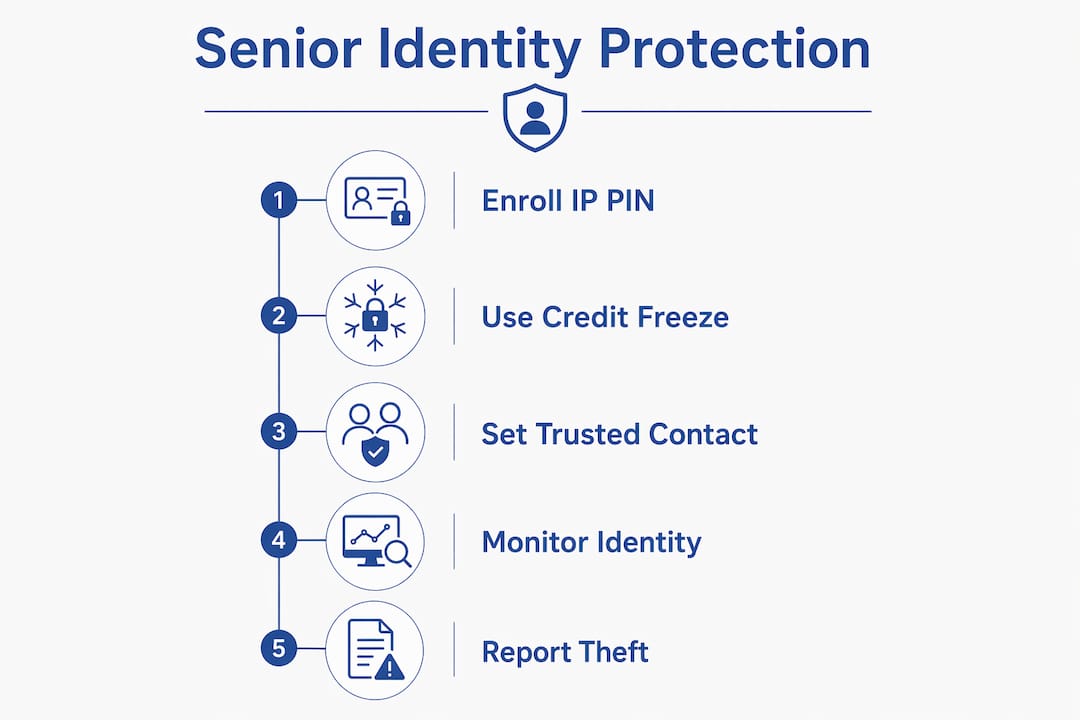
Seniors who combine the IRS IP PIN, a credit freeze, trusted contacts, and regular monitoring have the strongest multi-layered defense against identity theft and financial fraud.
| Point | Details |
|---|---|
| Enroll in the IRS IP PIN | This six-digit code blocks fraudulent tax returns filed under your Social Security number. |
| Freeze your credit now | A free credit freeze at Equifax, Experian, and TransUnion stops new accounts from being opened in your name. |
| Set up a trusted contact | Ask your bank to add a trusted contact who can flag suspicious activity on your behalf. |
| Verify every unexpected contact | Always call agencies back using independently sourced numbers, never numbers from suspicious messages. |
| Document everything if victimized | FTC reports, police reports, and written records unlock consumer protections and speed up recovery. |
What i’ve learned testing identity protection for seniors
After reviewing more than 50 privacy and identity protection services at Techstacktoday, one pattern stands out clearly: most seniors are not under-protected because they lack access to tools. They are under-protected because no one has explained which tools solve which specific problems.
The IRS IP PIN is a perfect example. It is free, takes 15 minutes to set up, and completely blocks one of the most common forms of senior identity theft. Yet most people have never heard of it. Credit monitoring alone does not cover tax fraud. That gap costs people real money every year.
The other thing I have seen repeatedly is how much damage urgency does. Scammers are skilled at creating a sense of crisis that shuts down rational thinking. The best defense against that is a pre-made plan. Decide now that you will always hang up and call back independently. Decide now who your trusted contact will be. Make those decisions before a scammer calls, because in the moment, panic is a powerful force.
I also want to push back on the idea that digital tools are too complicated for older adults. Password managers like Bitwarden and 1Password are genuinely easier to use than trying to remember 20 different passwords. Data removal services that reduce your online exposure do the hard work for you. The learning curve is real but short. The protection is lasting.
You do not need to become a cybersecurity expert. You need a checklist, a trusted contact, and a few specific tools. That combination is enough to stop the vast majority of attacks targeting seniors today.
— TechStackTeam
Protect your privacy with tools Techstacktoday has already tested
You now have the knowledge. The next step is putting the right tools in place. Techstacktoday has hands-on tested and ranked the services that matter most for seniors: VPNs that encrypt your internet connection and block data interception, password managers that secure every account with one master key, and data removal services that scrub your personal information from broker databases.

No paid rankings. No guesswork. Every review reflects real-world performance. Browse VPN services reviewed and ranked to find the right fit for your budget and needs. If you want to reduce how much of your personal data is publicly available, explore Techstacktoday’s data removal options to start cutting your exposure today.
FAQ
What is the IRS identity protection PIN?
The IRS Identity Protection PIN is a six-digit code that must appear on your tax return. Without it, the IRS rejects any return filed under your Social Security number, blocking tax identity fraud at the point of filing.
How do i freeze my credit as a senior?
Contact Equifax, Experian, and TransUnion directly by phone or online. A credit freeze is free, takes effect immediately, and prevents new credit accounts from being opened in your name until you lift it.
What should i do first if my identity is stolen?
File a report at IdentityTheft.gov immediately. The FTC site generates a personalized recovery plan, pre-filled dispute letters, and step-by-step guidance tailored to your specific situation.
Are identity monitoring services worth it for older adults?
Yes. Identity monitoring services scan data breaches, dark web forums, and credit bureau files for your personal information. They alert you to threats early, giving you time to act before serious damage occurs.
How do i recognize an imposter scam?
Any contact that creates urgency, demands unusual payment methods like gift cards or wire transfers, or asks for your Social Security number to claim a benefit is a scam. Real government agencies never operate this way.