Getting your personal data removed from dozens of broker sites and shadow services is slow and unreliable. Many services only cover a limited number of brokers, require manual filing, or do not show proof of removal. This review lets privacy-conscious individuals, families, and professionals match subscription plans and audit controls to the level of verification they need.
Table of Contents
TechStackToday
At a Glance
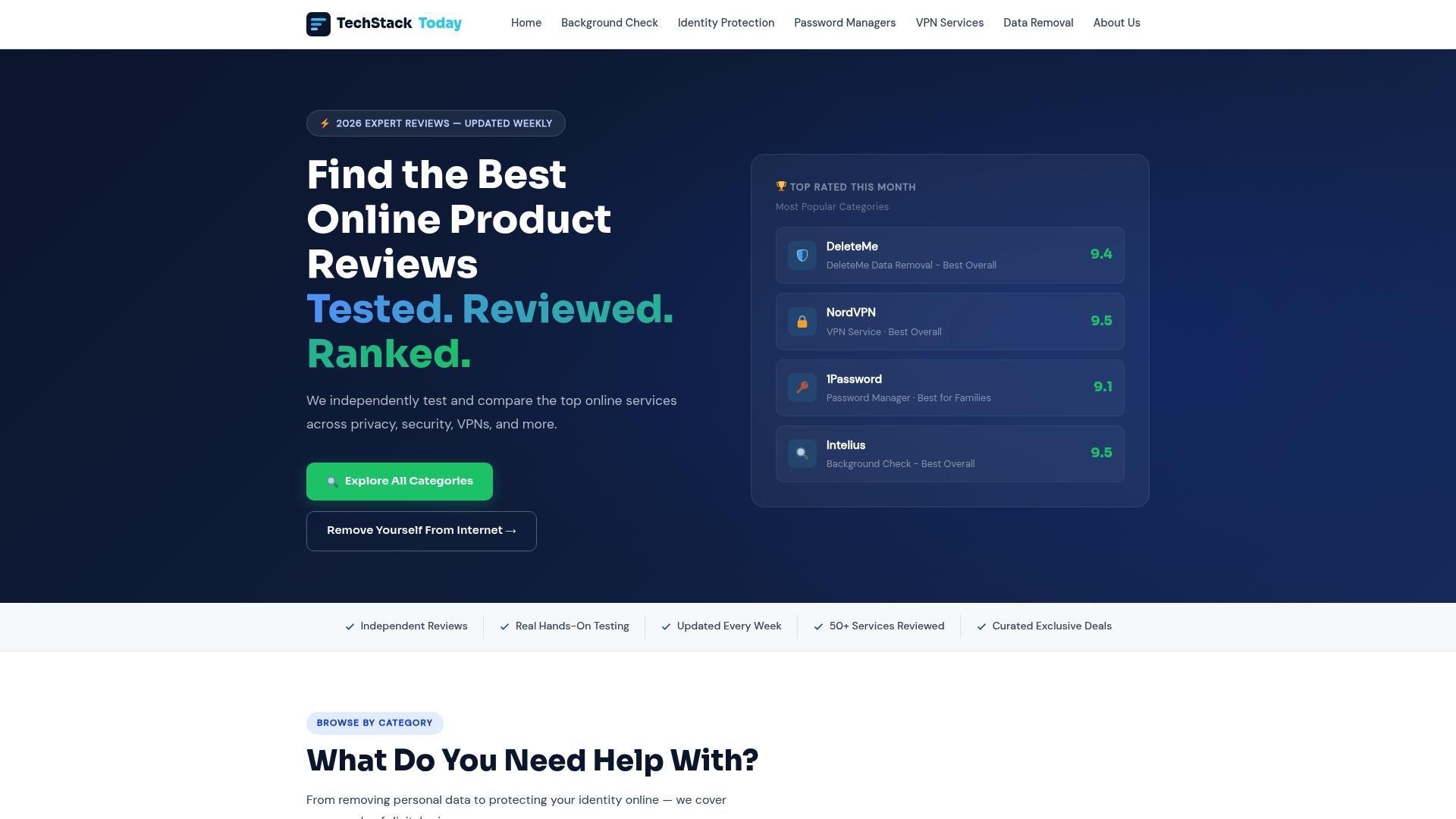
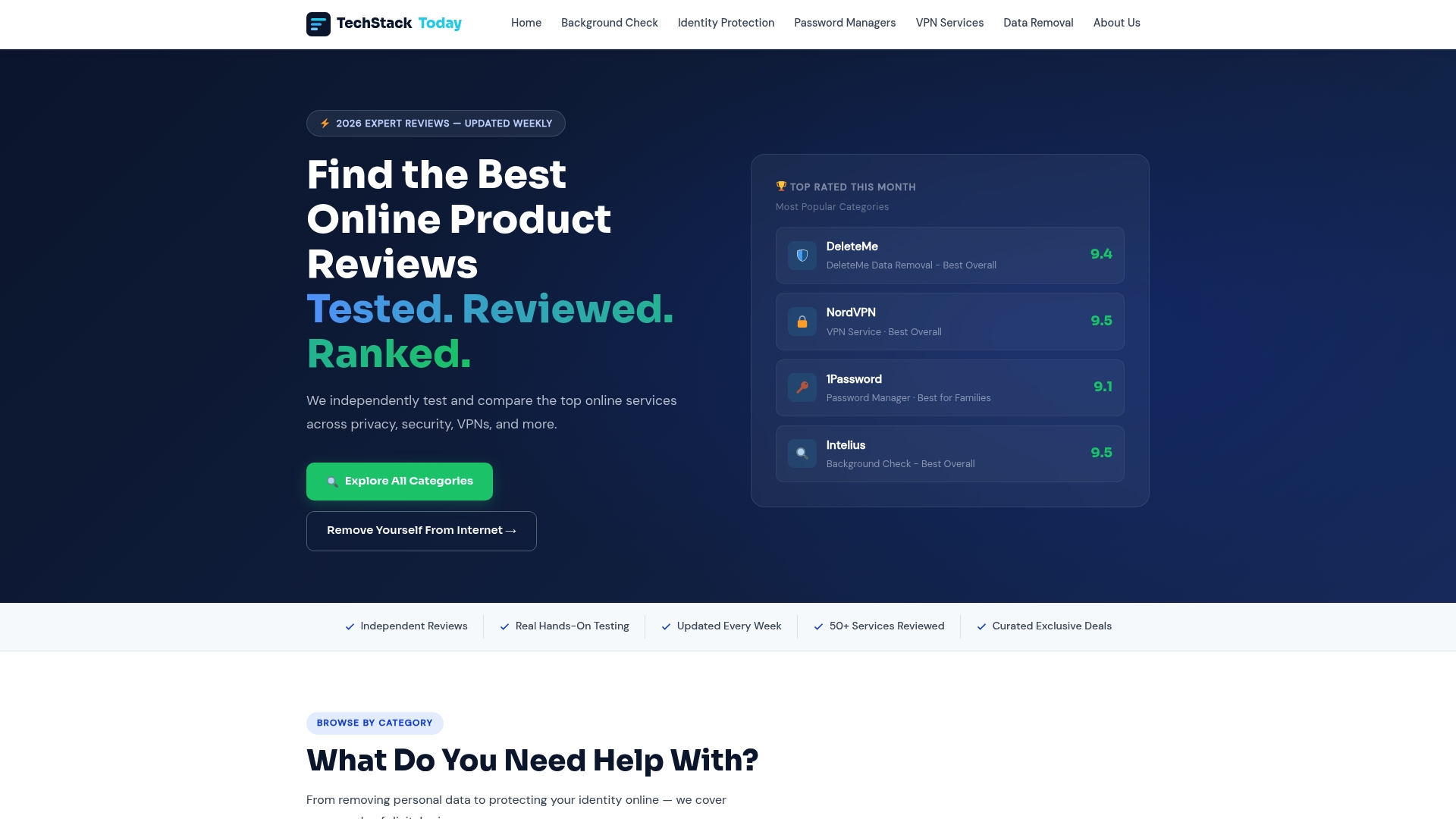
TechStackToday reports hands-on testing over 60 days. That testing targets VPNs, password managers, data removal, background checks, and identity protection for 2026.
The site emphasizes independent reviews and transparency about its testing process. That focus makes its ranking pages easier to read and trust.
Core Features
The editorial team runs real accounts and repeat tests across vendors, then publishes detailed comparison tables and ranked reviews. The vendor advertises regular monthly updates to re-evaluate service performance, keeping scores current as vendors change features and policies.
Content covers practical how-to guidance for deploying privacy tools and curated buying advice for readers who want clear next steps. The site also states it avoids paid rankings and affiliate influence in its editorial workflow.
Key Differentiator
Hands-on, real-world testing combined with ongoing refreshes makes the review set feel operational rather than hypothetical. The team rechecks services against live settings, privacy claims, and removal flows so rankings reflect current product behavior. That ongoing verification reduces the chance a recommendation is out of date.
Pros
The editorial approach produces deep, source-linked reviews and side-by-side comparison tables that show where vendors differ in features and policy. The site claims to review over 50 services and refresh those reviews regularly, which broadens coverage across categories. Transparency about methods, use of real accounts, and a clear affiliate disclosure helps you judge the recommendations for your own needs.
Cons
- Dependent on the availability and transparency of third-party service data, which can limit coverage depth for niche providers.
Who It’s For
You if you care about practical privacy steps and want direct comparisons between services rather than marketing copy. TechStackToday fits privacy-conscious individuals, families, and professionals looking for plain-language guidance on VPNs, password managers, data removal, and identity protection. The site suits readers who will interpret side-by-side details and pick a vendor based on specific needs.
Unique Value Proposition
A strict no-paid-rankings policy keeps editorial decisions separate from affiliate payouts. That guardrail preserves the value of hands-on tests because recommendations are tied to observed behavior rather than commercial influence. For someone comparing technical features, removal success, or privacy policy nuance, that separation makes it easier to trust the ranking and act on a single clear recommendation.
Real World Use Case
You want a VPN and a password manager that work together with minimal fuss. Search the VPN and password manager rankings, read the method notes, and compare the table entries for platform support and leak protection. Use the recommended how-to guide to configure both tools and follow the sites removal checklist if you need older account data scrubbed.
Website: https://techstacktoday.com
Incogni
At a Glance
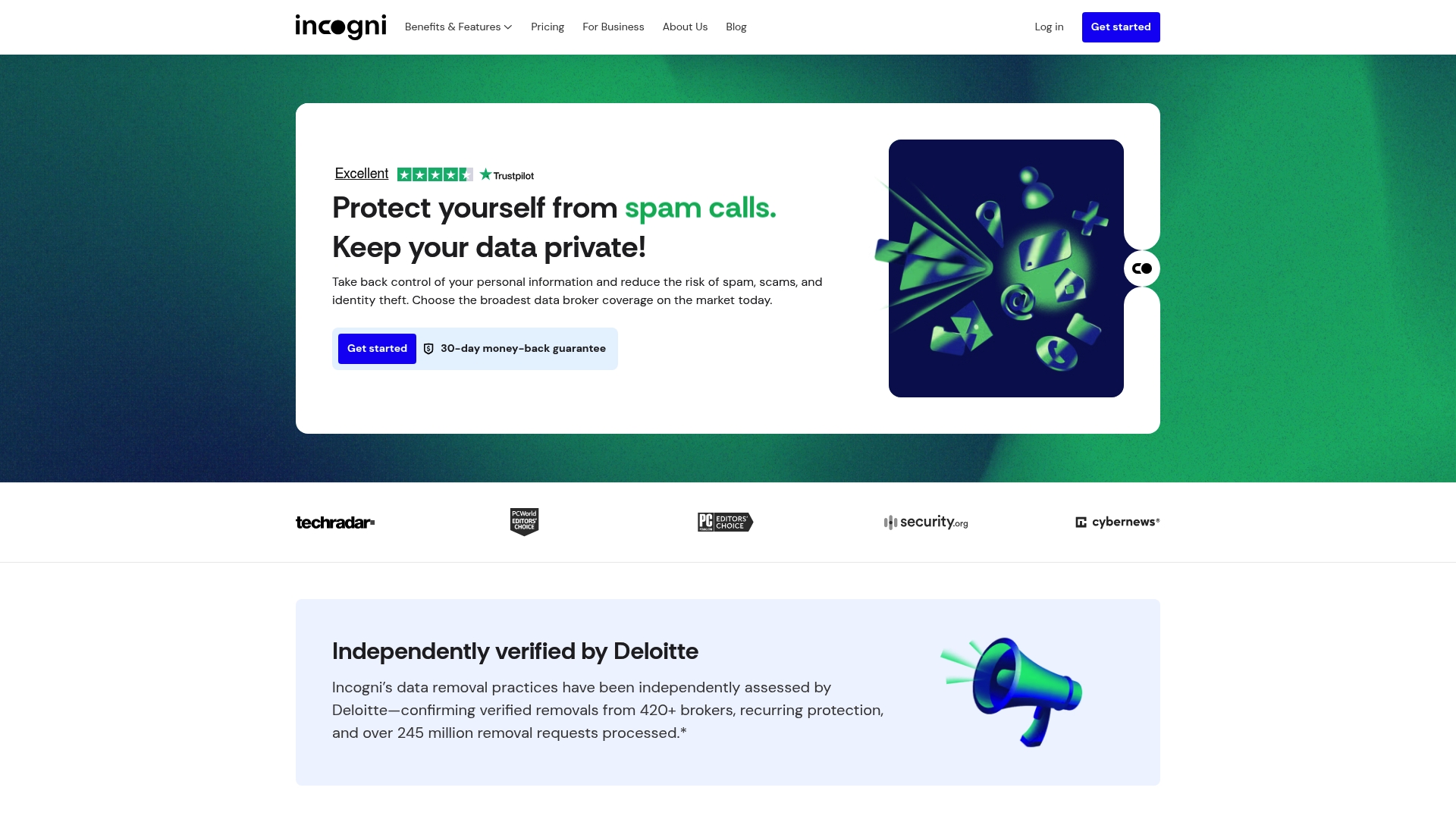
Incogni reports verified removal of over 245 million requests, a figure Deloitte verified. The service runs automated, recurring opt-out requests across a broad set of broker listings. Plans cover individuals, families, and enterprise employee protection with a simple progress dashboard.
Core Features
Incogni automates removal submissions across more than 420+ data broker sites and repeats requests to reduce re-listings. The service tracks progress with dashboarded progress reports and supports multiple emails, addresses, and phone numbers. Family and group plans let you manage members together and centralize removal work.
Key Differentiator
The vendor advertises automated, recurring requests verified by industry experts and independent audits. That setup shifts the burden of repeat filing from you to the service, so follow-up happens without manual re-entry. For people facing frequent reappearances, the recurring approach is the main advantage.
Pros
The Deloitte-verified removal figure gives the service measurable credibility, and that figure signals substantial volume behind its operations. Broad broker coverage and the recurring request model cut the time you spend filing opt-outs. Industry recognition from PCMag, PCWorld, and Cybernews adds third-party attention to vendor claims and helps validate its public profile.
Cons
- Some users report longer removal times for certain data brokers. Process durations vary by broker and entry type.
- Limited control over specific requests once submitted. Narrow edits or cancellations often require contacting support.
- Subscription pricing may make the service less attractive for infrequent users. Pay-as-you-go alternatives are not available.
When It May Not Fit
If your personal data sits with private or non-public brokers, Incogni may not fully remove it. Sites that refuse opt-out requests will block the automated workflow. If you need guaranteed immediate removal from every source, this service may not match that requirement.
Who It’s For
You should consider Incogni if you want to reduce online exposure without filing dozens of forms yourself. It suits privacy-conscious individuals, families protecting members, and organizations safeguarding employees in high-risk roles. You value an ongoing service that sends repeat opt-outs and shows progress in a central dashboard.
Real World Use Case
A privacy-minded person signs up, adds their emails and phone numbers, and lets the service run removal requests across many brokers. The dashboard shows which brokers removed entries and which still list the person. When a record reappears, the service resends removal requests until the entry clears.
Website: https://incogni.com
Optery
At a Glance
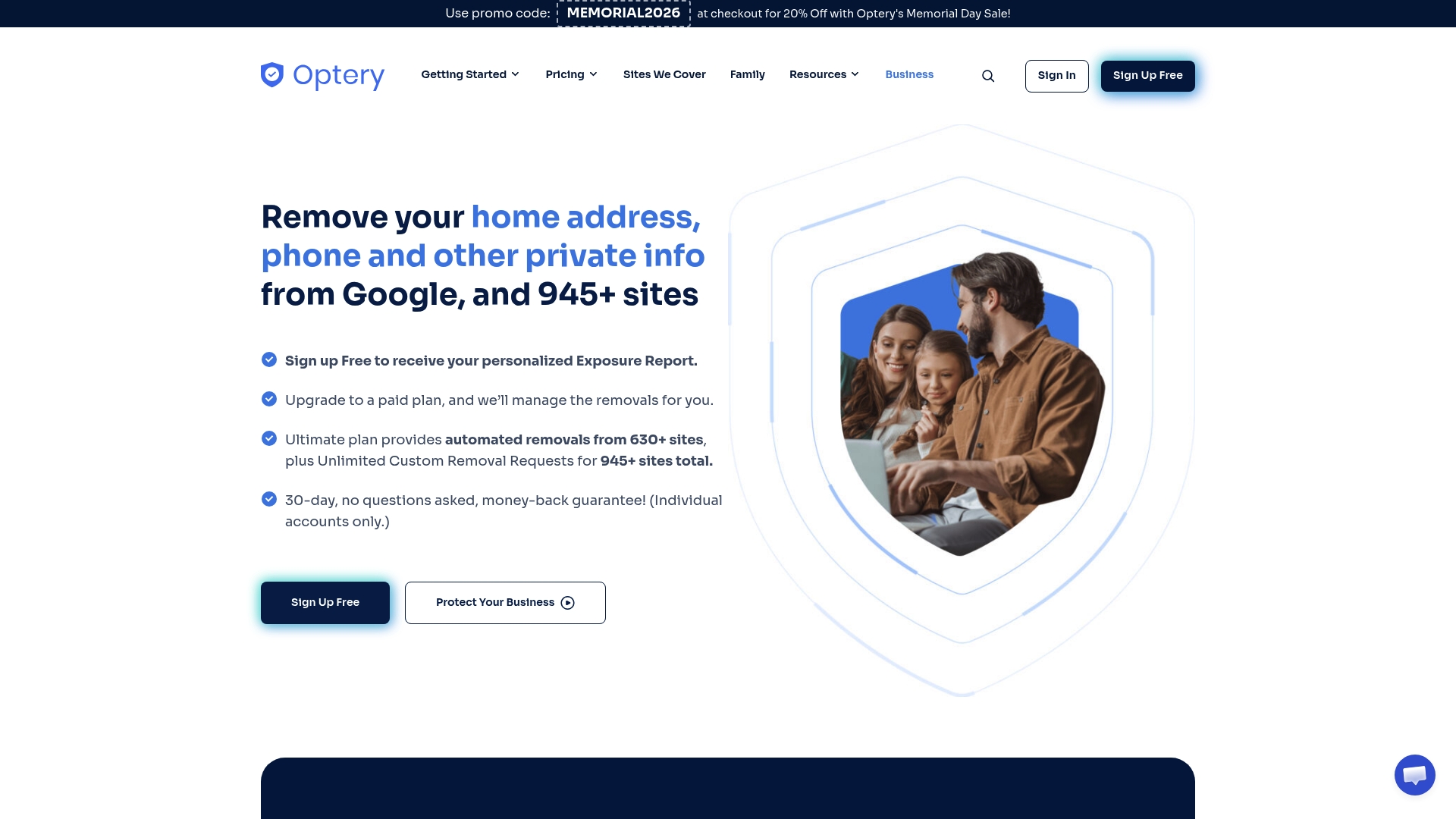
Optery reports automated removals from 630+ sites. According to the company, it also holds PCMag Editors’ Choice recognition and SOC 2 Type II compliance. The service pairs automated scans with live screenshot verification to track removals over time.
Core Features
Optery provides a personalized exposure report with screenshots, monthly automatic scans on paid plans, and unlimited custom removal requests. The platform offers both self-service tools and hands-off managed removal options, plus a real-time dashboard that records activity history and verification screenshots. Paid tiers add automated removals and ongoing monitoring for identified broker listings.
Key Differentiator
Optery’s standout capability is its proprietary AI-powered opt-out engine combined with live screenshot verification and continuous monitoring. That combination lets you see proof of removal in the dashboard and keeps watch for reappearance on broker sites.
Pros
Optery earned industry recognition, and that recognition boosts confidence for people seeking documented results. The service gives visible proof with live screenshots and a detailed exposure report, which helps you track progress. Its AI-assisted opt-out processes speed common removals, and ongoing scans reduce the need for manual checks.
Cons
- Removing all personal data is never guaranteed. Some data persists despite repeated requests.
- Several removals require cooperation from brokers, which can delay or block outcomes.
- Paid plans may feel costly for casual users who only need occasional cleanups.
- The service does not cover social media, most general websites, or dark web listings.
When It May Not Fit
If you need removal from general websites, social networks, or the dark web, Optery will not meet that need. If you require immediate deletion of every instance, the platform may fall short because broker compliance can be slow. Small one-off requests could be more cost effective with a cheaper manual approach.
Who It’s For
Optery fits privacy-conscious individuals who want continuous monitoring and documented removals. It suits professionals, public figures, and people at risk of stalking who prefer proof of action. Choose managed plans if you want a hands-off approach with active follow-up.
Real World Use Case
A clinician used Optery to remove address listings from broker sites and to prevent stalker access. They ran a self-service exposure report first, then switched to a managed plan for ongoing removals and screenshot verification. The dashboard provided a clear audit trail for each removal request.
Pricing
A free tier offers basic exposure reports and self-service tools. Paid plans start at $39/month for Core, then $149/month for Extended, and $249/month for Ultimate, with annual billing discounts available.
Website: https://optery.com
onerep.com
At a Glance
Cloudflare challenge loops and bot verification troubleshooting are the site focus. The resource hub collects targeted documentation and practical fixes for challenge loops, verification redirects, and network-level problems. It serves site administrators and security staff who need direct troubleshooting steps rather than a hosted product.
Core Features
The site centralizes documentation and troubleshooting guides for Cloudflare challenges, including explanations of challenge loops and methods to resolve them. It includes implementation notes and API reference links that help developers integrate challenge management into their sites. The material also covers compatibility details for common browsers and devices to reduce verification friction.
Key Differentiator
The standout element is the concentration on hands-on troubleshooting for Cloudflare challenge issues. Content goes beyond conceptual overviews to show concrete steps for diagnosing and breaking challenge loops. That focus makes the site a practical reference for people handling verification problems day to day.
Pros
The documentation delivers clear, step-by-step troubleshooting instructions that you can follow during an incident. The site organizes guidance for both configuration and network troubleshooting, which helps when verification problems span browser, proxy, or client differences. Compatibility notes for a range of browsers and devices reduce guesswork when a verification flow works for some visitors but not others. The resource hub format keeps the material accessible without requiring a commercial engagement or account.
Cons
-
Limited to documentation only. There is no hosted service or tool to run automated removals or fixes.
-
No productized workflow for teams. The site does not provide team workspaces, ticketing, or collaboration features.
-
Sparse details about maintenance or update cadence. The documentation does not list an obvious release or revision history.
When It May Not Fit
If you need an active service that applies fixes directly, this site will not meet that need. Organizations seeking a managed challenge-solving product or an SLA backed vendor should look elsewhere. Larger security teams that require integration into ticketing or change management will find the site insufficient for their workflow.
Who It’s For
Website security administrators and developers troubleshooting Cloudflare challenge configurations will find the site useful. Security professionals who diagnose bot verification, challenge loops, or client compatibility problems will value the procedural guidance. The site suits teams that already have deployment and change processes and only need technical run books and reference material.
Real World Use Case
A site owner is seeing repeated verification pages for returning customers. The administrator follows the site guide to identify a misconfigured challenge rule and a proxy header issue. After applying the documented configuration change and testing the browser compatibility notes, the verification loop stops and customer sessions restore normal access.
Website: https://onerep.com
PrivacyHawk
At a Glance
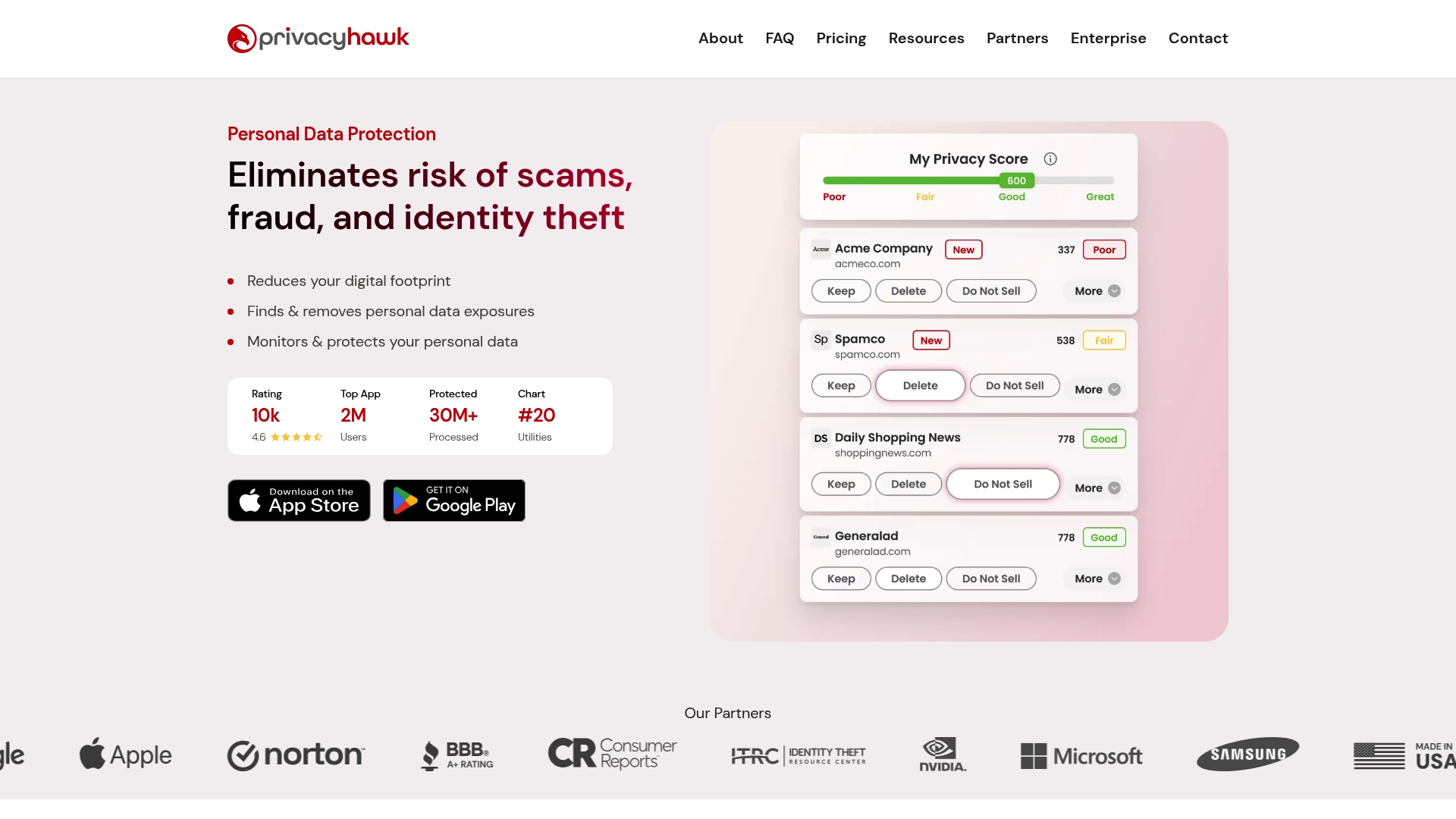
According to the company, PrivacyHawk automates deletion requests across over 20,000 third-party services. That reach covers data brokers, shadow IT assets, and common consumer services. The platform pairs monitoring with a patented AI-engine that searches inboxes and linked accounts for exposed personal data. This combination aims to reduce the number of places where your personal data can be reused for scams or fraud.
Core Features
PrivacyHawk uses AI to locate exposed personal data across connected accounts and third-party services, then generates and tracks removal requests. It reduces email clutter with automatic unsubscribe functions and continuously monitors the dark web for breached credentials and leaked records. The service bundles identity theft protection and recovery options, and it integrates with enterprise email and security tools for centralized management.
Key Differentiator
The patented AI-engine focuses on shadow data exposures found in employee inboxes and third-party services. It automates the detection-to-removal workflow instead of only flagging risks for manual cleanup. That workflow makes privacy cleanup less labor intensive for security teams and HR, and it centralizes remediation where dispersed data otherwise persists.
Pros
The company reports high customer satisfaction and verified real-world effectiveness. Patented detection finds shadow exposures that standard scanners often miss. Automation handles bulk removal requests and email unsubscribes, which reduces manual cleanup work for security and privacy teams. Plans scale from individual subscriptions to organizational deployments and include identity theft protection and recovery services.
Cons
- Buyer reviews raise concerns about enterprise pricing and total cost of ownership.
- The free tier gives limited detail, and ongoing costs can rise with broader coverage needs.
- The service requires users to connect and actively manage accounts for best results.
When It May Not Fit
PrivacyHawk may not fit teams that cannot link employee accounts or refuse active participation in account management. Effectiveness depends on you proactively connecting and maintaining linked services. Costs can grow if your exposure volume is large or if you require broad coverage. Non-English application support is limited, which reduces value for globally distributed teams.
Who It’s For
You should consider PrivacyHawk if you are a privacy-conscious individual who wants to shrink your digital footprint. HR and security managers will find it useful for cleaning shadow IT data across employee accounts. Cybersecurity teams and data protection officers benefit from centralized removal workflows and identity protection add-ons.
Real World Use Case
A large corporation rolls out PrivacyHawk to employee mailboxes and cloud accounts to locate outdated or duplicated personal records. The platform identifies shadow exposures, sends removal requests, and tracks completion across services. That process reduces the number of exposed records and supports privacy compliance efforts.
Pricing
Organizational plans start from $3.99 per employee per month, with tiered options that add dark web monitoring, identity protection, and priority support. Individual plans begin at $19.99 per month or $74.99 per year for premium protection. Family and enterprise packages are available with expanded coverage and support levels.
Website: https://privacyhawk.com
Comparison of alternatives
Evaluating options for personal privacy management highlights the unique strengths and tradeoffs of each listed service.
Visibility into Removal Verification
Optery earns distinction for its verification visibility. The inclusion of live screenshots paired with exposure reports significantly aids users who demand proof of action and a trail of accountability. For privacy-focused professionals requiring real-time confirmation and monitoring of removals, Optery excels in delivering transparency not matched by other providers.
Automated Processing Effectiveness
PrivacyHawk provides expanded automation efficiency with its patented AI-driven mechanisms. By proactively scanning linked accounts for shadow data and automating bulk removal notifications, PrivacyHawk caters to large-scale usage scenarios, such as enterprise security and IT-focused operations sequestering employee data exposures. Groups desiring centralized automation on an organizational scale benefit notably from PrivacyHawk’s technological capabilities.
Best fit
- Seek clarity and validated test results? Explore TechStackToday, which maintains a non-commercial editorial policy and transparency through detailed comparison and review protocols.
- Want visibility into verified removals? Choose Optery for live proof dashboards and exposure scans bolstered with SOC 2 Type II compliance.
- Need fixes for Cloudflare challenge loops? Consult onerep.com, whose guide hub addresses direct troubleshooting methods and compatibility debugging resources.
- Require removal of data assets across shadow IT inventories? Select PrivacyHawk for automated identification, AI-driven workflows scaling to larger deployments, and integration with identity protection protocols.
- Prefer independently audited opt-outs? Incogni provides recurring request automation and coverage spanning over 400+ relevant broker lists with third-party verifications.
Our pick
TechStackToday elevates itself as the reader’s trusted source for rankings derived from verified, expert-conducted tests across multiple scenarios. The hands-on, unbiased nature of its operations makes it the strongest choice for those valuing deep transparency and zero affiliate prioritizations. Readers needing specific advice tailored through clear and unbiased reviews benefit most from this primary recommendation.
To aid readers in selecting an optimal platform based on their preferences for review authenticity and data coverage, here is a concise comparison of Techstacktoday and similar services:
| Service | Core Strength | Best For | Pricing | Limitation |
|---|---|---|---|---|
| Techstacktoday | Hands-on test-driven review updates | Individuals comparing privacy tools | Price not published | Limited depth for niche provider coverage |
| Incogni | Automated recurring opt-out requests | Privacy-conscious families | Subscription-based plans | Limited control over specific requests |
| Optery | AI-powered opt-outs with screenshot verification | Public figures needing proof of action | $39–$249 per month | Does not cover social media or general sites |
| onerep.com | Cloudflare challenge troubleshooting documentation | Developers resolving verification loops | Price not published | Documentation only, no automated solutions |
| PrivacyHawk | Automated exposure detection and removal requests | HR managing employee data privacy | $3.99–$19.99 per month | Requires active management of connected accounts |
Choosing the Right Data Removal Solution for Your Privacy Needs
Finding reliable easyoptouts.com alternatives means understanding the challenges of managing your personal data online. Privacy-conscious individuals and families need clear, practical comparisons that highlight how data removal services perform in real conditions. Techstacktoday offers detailed, hands-on reviews of top privacy tools with transparent testing that reveals real-world effectiveness and ongoing service updates.
Explore Techstacktoday’s Data Removal category to compare options clearly and confidently. Use the real account testing insights to pick services that successfully scrub old records and reduce your digital exposure. Visit https://techstacktoday.com to get actionable recommendations that help you make safe choices for your online privacy today.
FAQ
How does Techstacktoday help with online privacy?
Techstacktoday offers hands-on testing and reviews for various online privacy services. Their editorial team publishes independent reviews and comparison tables, which help users understand the performance and features of different privacy tools. Readers should check out the detailed reviews to choose the best privacy services for their needs.
What is the difference between PrivacyHawk and Techstacktoday?
PrivacyHawk automates deletion requests and supports monitoring across over 20,000 third-party services, making it highly effective for ongoing data removal. Techstacktoday, in contrast, emphasizes hands-on testing and independent reviews to help readers compare services in a detailed manner. Users looking for continuous data monitoring may prefer PrivacyHawk, while those wanting comprehensive service comparisons should turn to Techstacktoday.
Can I use Incogni alongside Techstacktoday services?
Yes, you can use Incogni for automated removal requests while utilizing Techstacktoday’s insights for selecting the right privacy tools. Incogni focuses on data removal from brokers, allowing users to delegate that task, while Techstacktoday compares various privacy services and evaluates their performance.
What are the pricing options for Techstacktoday’s recommended services?
Techstacktoday regularly publishes pricing details for the services they review, helping users find options that fit their budgets. Each service has its unique pricing structure, so readers should check the comparison tables for detailed pricing information.
How frequently does Techstacktoday update its reviews?
Techstacktoday commits to regular monthly updates to re-evaluate service performance. This ensures that their reviews reflect the latest changes in features and policies among privacy service providers. Keeping an eye on their updates will help you stay informed about the best options available.