Background checks are defined as the formal verification of a candidate’s criminal history, employment record, education credentials, and identity before a job offer is finalized. Over 90% of employers conduct some form of pre-employment screening today, making it a standard part of due diligence in hiring. Yet many HR professionals and small business owners still run checks incorrectly, exposing themselves to Fair Credit Reporting Act (FCRA) lawsuits, Equal Employment Opportunity Commission (EEOC) discrimination claims, and negligent hiring liability. This guide explains why background checks matter for hiring, what they cover, and how to run them without creating new legal problems.
Why background checks matter for hiring decisions
Background screening is not a formality. It is a risk management tool that protects your workplace, your customers, and your business from preventable harm.
Approximately 84% of employers uncover misrepresentations or inaccuracies on resumes during background checks. That number means most hiring managers are reading at least one false claim per search. Without verification, you are making a significant financial decision based on unconfirmed data.

The benefits of background screening extend beyond catching dishonest candidates. They help you avoid workplace violence by flagging relevant criminal history. They confirm that licensed professionals actually hold the credentials they claim. They protect your business from liability if an employee later causes harm, because you can demonstrate you performed reasonable due diligence in the hiring process.
Background checks also protect your existing team. Hiring someone with a history of harassment or fraud into a position of trust puts your current employees at risk. Screening is one of the clearest ways to signal that employee safety is a priority, not an afterthought.
What do background checks typically include?
Most pre-employment background checks cover five core areas. Each one targets a different category of risk.
| Screening element | Typical source | Risk mitigated |
|---|---|---|
| Criminal record check | County, state, and federal courts | Workplace violence, theft, fraud |
| Employment verification | Previous employers, HR records | Resume fraud, inflated titles |
| Education verification | Institutions, degree databases | Credential fabrication |
| Identity confirmation | SSN trace, government ID | Identity fraud, ineligible workers |
| Professional license check | Licensing boards | Unqualified practitioners |
Criminal record checks are the most commonly requested component. They surface convictions that may be relevant to the role, though relevance must be assessed individually under EEOC guidance.
Employment and education verification directly address the resume fraud problem. A candidate claiming a senior director title at a Fortune 500 company is easy to verify. A candidate inflating a GPA or fabricating a degree from a state university is equally easy to catch.
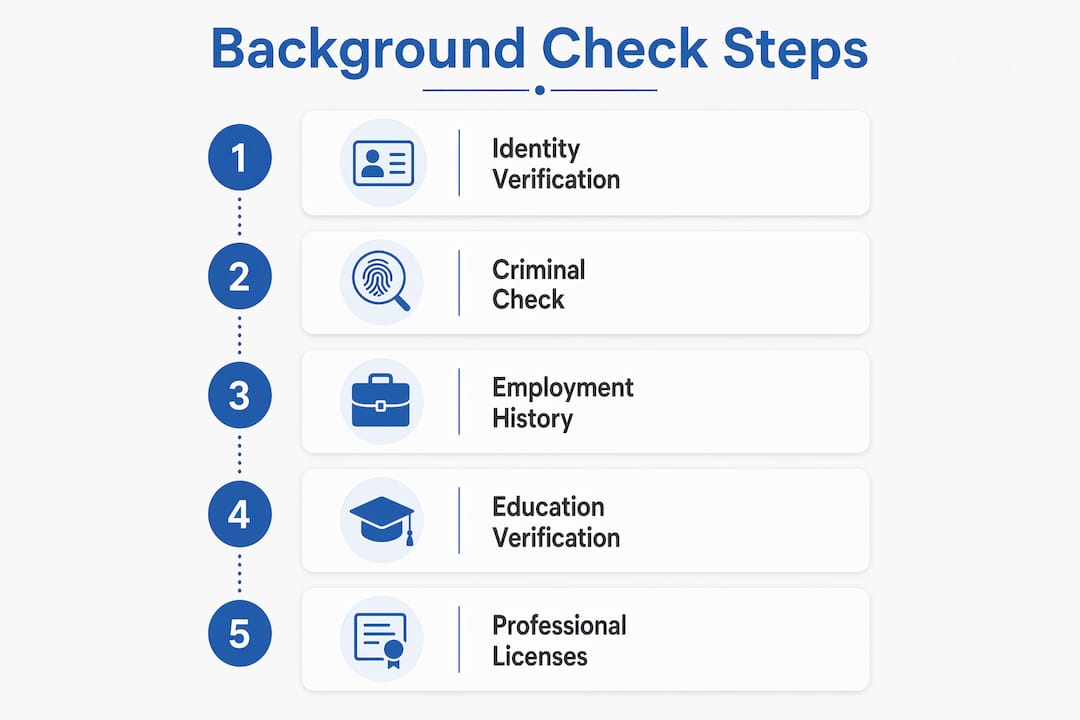
Identity confirmation via a Social Security Number trace is often the first step. It confirms the person is who they say they are and surfaces any aliases that might require additional searches.
Pro Tip: Always verify professional licenses directly with the issuing board, not just from a copy the candidate provides. Licenses can be revoked after the copy was made.
How do background checks reduce legal and financial risk?
Skipping or mishandling background checks creates three distinct legal exposures: FCRA violations, EEOC discrimination claims, and negligent hiring lawsuits.
“FCRA-related class-action settlements against employers for defective hiring practices range from hundreds of thousands to tens of millions of dollars.” — Prepzo, 2026
The FCRA governs how consumer reports, including background checks, are obtained and used. It requires a standalone written disclosure and signed authorization before you order a check. It also requires a specific adverse action process if you plan to reject a candidate based on findings. Skipping any of these steps is not a technicality. Consent form defects are a leading cause of FCRA lawsuits, with settlements often reaching tens of millions of dollars.
EEOC guidance adds another layer. Blanket policies that automatically disqualify anyone with a criminal record are considered discriminatory. The EEOC requires an individualized assessment that weighs the nature of the offense, how much time has passed, and whether the offense is directly relevant to the job duties.
Negligent hiring liability is the third risk. If you hire someone who later harms a coworker or customer, and a court finds you failed to conduct reasonable screening, you can be held financially responsible. This exposure is especially high in roles involving access to vulnerable populations, financial accounts, or private homes.
The financial case for proper screening is straightforward. A single FCRA class-action or negligent hiring lawsuit costs far more than a year of screening fees for your entire workforce.
Common misconceptions about background checks
The biggest mistake HR professionals make is treating background checks as performance predictors. They are not. Background checks are filters for risk, not indicators of future job success. A clean record does not mean a candidate will perform well. A past offense does not mean they will perform poorly.
Researchers at The Human Capital Hub highlight this misconception directly. They recommend pairing background checks with structured reference checks and behavioral assessments to actually predict performance. Screening tells you who to exclude from consideration for specific risk reasons. Structured interviews and references tell you who to hire.
A second misconception is that more screening is always better. Running checks on every applicant before a conditional offer wastes money, slows your process, and creates legal exposure. Running checks before extending conditional offers is a common error that increases both cost and risk.
A third misconception is that a single national database search is sufficient. No single database contains all criminal records in the United States. County court searches, state repository checks, and federal searches each capture different records. Relying on one source alone creates a false sense of security.
Pro Tip: Do not mix your background check authorization form with your job application. The FCRA requires a standalone disclosure document. Combining them is one of the most common and costly compliance errors small businesses make.
Best practices for running background checks effectively
A well-run screening process protects you legally and helps you hire faster. Follow these steps in order.
- Extend a conditional offer first. Run the background check after the offer, not before. This reduces unnecessary screenings and aligns with EEOC best practices.
- Provide a standalone FCRA disclosure. Give the candidate a separate written notice that a background check will be conducted. Get signed authorization before ordering.
- Choose a credible screening provider. Background check turnaround time directly affects your ability to close candidates. Delays cause lost talent and longer vacancies. Prioritize providers with verified turnaround times and clear accuracy standards.
- Run the right checks for the role. A warehouse associate needs a different screening package than a licensed financial advisor. Match the check to the risk profile of the position.
- Conduct an individualized assessment for any adverse findings. Before rejecting a candidate based on a criminal record, document your analysis of offense type, time elapsed, and job relevance.
- Follow the adverse action process. If you plan to reject based on findings, send a pre-adverse action notice with a copy of the report, wait the required time, then send the final adverse action notice.
Here is a quick reference for small businesses and HR teams:
- ✅ Always use a standalone authorization form
- ✅ Wait for a conditional offer before ordering the check
- ✅ Use county, state, and federal searches together
- ✅ Document your individualized assessment in writing
- ❌ Never use a blanket exclusion policy for criminal records
- ❌ Never skip the adverse action notice process
- ❌ Never rely on a single national database as your only search
Pro Tip: Use a reviewed screening provider that integrates directly with your applicant tracking system. Manual processes create gaps where compliance errors happen.
Key takeaways
Background checks reduce hiring risk only when they are run correctly, at the right time, with the right scope, and with full FCRA and EEOC compliance in place.
| Point | Details |
|---|---|
| Timing is critical | Run checks after a conditional offer to reduce legal exposure and unnecessary cost. |
| Consent forms must stand alone | A combined authorization and application form is a leading cause of FCRA lawsuits. |
| Checks filter risk, not performance | Pair screening with structured references to actually predict job success. |
| Individualized assessment is required | Blanket criminal record exclusions violate EEOC guidance and create discrimination claims. |
| Provider speed matters | Turnaround delays cause lost candidates; choose a provider with verified accuracy and fast results. |
My honest read on where background checks still go wrong
I have reviewed dozens of screening workflows across small businesses and mid-size HR teams. The compliance failures are almost never intentional. They come from outdated templates, rushed processes, and a genuine misunderstanding of what background checks are supposed to do.
The most persistent problem I see is the performance prediction trap. HR teams invest in thorough criminal and employment checks, then use a clean result as a proxy for “good hire.” That logic fails regularly. The candidate with a spotless record who interviews well but has no structured reference check is still an unknown. The science on this is clear: screening alone does not predict job success.
The second issue I see constantly is timing. Small businesses especially tend to run checks early in the process to feel more confident before investing interview time. That instinct is understandable. But it creates real FCRA exposure and wastes screening fees on candidates who may not receive offers anyway.
The fix is not complicated. Build a checklist. Lock in your conditional offer trigger point. Separate your consent forms. And stop treating a background check result as a hiring decision on its own. It is one input in a larger process, and it works best when you treat it that way.
— TechStackTeam
Protect your hiring data with the right privacy tools
Background checks involve sensitive personal data: Social Security numbers, criminal records, financial history. That data needs to be handled securely at every step of your process.
Techstacktoday reviews and ranks the privacy tools that protect sensitive information in real-world scenarios. From VPN services that secure your HR team’s remote access to data removal tools that reduce your exposure when candidate data is mishandled, Techstacktoday tests each service without paid rankings. If you are managing background check data for new employees, the right privacy stack is not optional. Check Techstacktoday’s internet privacy tools checklist to see what your hiring process is missing.
FAQ
Why do background checks matter for hiring?
Background checks verify candidate history, credentials, and identity before a hire is finalized. They reduce the risk of workplace harm, resume fraud, and negligent hiring liability.
When should you run a background check on a new employee?
Run the check after extending a conditional offer, not before. This approach aligns with EEOC guidance, reduces unnecessary screenings, and lowers your legal exposure under the FCRA.
What happens if you skip background checks?
Skipping screening creates three risks: negligent hiring liability if the employee causes harm, EEOC discrimination claims if your process is inconsistent, and FCRA violations if you later try to use informal information to reject a candidate.
Do background checks predict job performance?
No. Background checks are risk filters, not performance predictors. The Human Capital Hub research confirms that structured reference checks and behavioral assessments are needed alongside screening to assess how a candidate will actually perform.
What is the most common background check compliance mistake?
Combining the FCRA authorization form with the job application is the most common error. The FCRA requires a standalone disclosure document, and mixing it with other paperwork is a leading cause of class-action lawsuits against employers.