A background check data broker is a company that collects, aggregates, and sells personal information about individuals to third parties, often without the subject’s knowledge or consent. These companies sit at the center of a largely unregulated industry that feeds data to employers, landlords, lenders, and marketers. Understanding how they operate is the first step toward protecting your privacy. Major players like Acxiom and LexisNexis hold files on hundreds of millions of people, and the background check process you encounter when applying for a job or apartment almost certainly runs through one of them.
What is a background check data broker?
A background check data broker, known in the industry as a “people-search broker” or “personal data aggregator,” is a business that profits by compiling and reselling detailed personal profiles. These are not companies you hire directly. They operate in the background, supplying raw data to background check services, advertisers, insurance companies, and anyone else willing to pay.
The scale is staggering. Acxiom (now operating under LiveRamp) maintains files on over 2.5 billion people with more than 3,000 data points per profile. That means there is almost certainly a file on you, whether you have ever heard of these companies or not.

Data brokers collect information from publicly accessible sources. They do not hack your accounts or access private systems. Their sources include public records like court filings and property deeds, commercially licensed data from retailers and loyalty programs, social media profiles, and marketing surveys you may have filled out years ago. The result is a profile that can include your full name, address history, phone numbers, relatives, employment history, financial indicators, and consumer habits.
How do background check data brokers collect and sell data?
Data brokers use several methods to gather and monetize personal information. The process is more technical than most people realize.
- Public records scraping: Automated tools pull data from county court systems, DMV records, voter registrations, and property databases.
- Commercial data licensing: Retailers, apps, and loyalty programs sell anonymized (and sometimes not-so-anonymized) purchase data directly to brokers.
- Web scraping: Bots crawl social media profiles, forum posts, and news articles to extract names, locations, and affiliations.
- Browser fingerprinting: Data brokers use browser fingerprinting and web scraping to track users across websites without requiring a login. This creates a unique device identifier tied to your browsing behavior, even in private mode.
The business model splits into two main categories. People-search brokers like Spokeo, BeenVerified, and Whitepages focus on individual profiles sold to consumers, employers, and landlords. Marketing and analytics brokers like Acxiom focus on bulk data sold to advertisers and corporations for targeting purposes.
Pricing reflects the depth of the report. Background report pricing ranges from free to over $30 depending on report complexity. Free tiers typically show basic name and location data. Paid tiers unlock criminal records, financial indicators, and relationship maps.
Pro Tip: If you want to see what a people-search broker has on you, search your full name plus your city on Spokeo or BeenVerified. What you find is exactly what landlords and employers can buy about you.
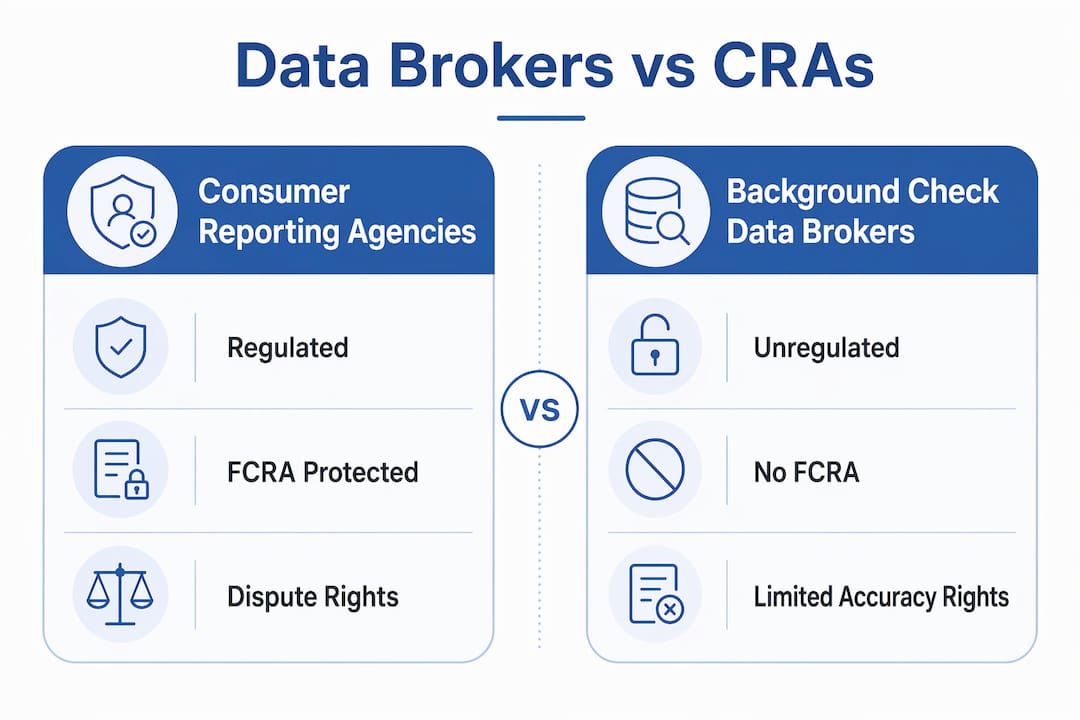
Data brokers vs. consumer reporting agencies: what’s the difference?
Most people assume data brokers operate under the same rules as credit bureaus. They do not. This is one of the most consequential misconceptions in personal privacy.
Consumer Reporting Agencies (CRAs) like Equifax, Experian, and TransUnion are regulated by the Fair Credit Reporting Act (FCRA). The FCRA requires CRAs to maintain data accuracy, limit data use to permissible purposes, and give consumers the right to dispute errors. Most people-search brokers operate unregulated and are not obligated to verify their data or restrict who buys it.
| Feature | Consumer Reporting Agencies (CRAs) | Background Check Data Brokers |
|---|---|---|
| Regulated by FCRA | Yes | No (in most cases) |
| Must verify data accuracy | Yes | No |
| Consumer dispute rights | Legally required | Voluntary, if offered |
| Restricted buyer access | Yes, permissible use required | No restrictions |
| Data sources disclosed | Partially | Rarely |
The practical impact is significant. A CRA error on your credit report gives you a legal right to dispute and correct it. An error in a data broker’s file, like a criminal record belonging to someone with your name, carries no such guarantee of correction. The broker has no legal obligation to fix it.
Pro Tip: Before any major job application, run a search on yourself through a people-search site. If you find errors, submit removal requests immediately. Waiting until after a rejection is too late.
What privacy risks do background check data brokers create?
The privacy risks from data brokers are real and specific. Here are the four most serious threats you face.
-
Identity theft exposure. Data brokers sell data to anyone without verifying identity or purpose, including scammers and identity thieves. A criminal can purchase your address, phone number, relatives’ names, and financial indicators for under $30.
-
Stalking and physical safety risks. People-search sites publish home addresses and daily patterns. Domestic abuse survivors and public figures face direct physical risk when this data is freely available to anyone who searches.
-
Inaccurate records causing real harm. Data brokers do not verify the accuracy of their reports, which increases the risk of outdated or incorrect data harming individuals. A misattributed arrest record or wrong address can cost you a job or apartment.
-
Data reappearance after opt-out. Deleting your data from one broker does not delete it everywhere. Opt-out requests often require repeated efforts because brokers sell and resell information widely. Your data gets purchased by a second broker before your opt-out at the first one is even processed.
“Privacy experts stress that opting out is a long-term maintenance task, not a one-time fix, due to ongoing data trades between brokers.” — Challenges in Data Broker Removal
The tracking technology angle makes this worse. Users consistently underestimate how browser fingerprinting assigns unique identifiers to aggregate activity across websites without consent. You do not need to log in anywhere. Your device’s configuration, screen resolution, installed fonts, and browser settings combine into a fingerprint that follows you across the web.
How do you protect yourself from data brokers?
You can reduce your exposure significantly. The process requires effort and consistency, but it works.
Step 1: submit opt-out requests directly
Every major people-search broker offers an opt-out process. Start with the highest-traffic sites: Spokeo, BeenVerified, Whitepages, Intelius, and PeopleFinder. Each has its own removal form. A single opt-out request does not propagate industry-wide because each broker retains its own copy of your data. You must submit requests to each one separately.
When you submit a removal request, include enough identifying information to match your record. Opt-out requests must contain sufficient unique identifiers to avoid deletion errors. Include your full name, current address, and any previous addresses listed in the profile.
Step 2: use a data removal service
Manual opt-outs across hundreds of brokers take hours. Services like DeleteMe and Kanary automate the process and send recurring removal requests on your behalf. Techstacktoday has tested and ranked the leading data removal services based on real-world performance, not paid placements.
Step 3: reduce your digital footprint going forward
- Use a VPN to mask your IP address and prevent location-based tracking. See Techstacktoday’s privacy tools comparison for tested options.
- Use a password manager to avoid reusing credentials across sites. Reused passwords make it easier for data brokers to link your accounts.
- Limit what you share on social media. Public profiles are a primary data source for people-search brokers.
- Use a separate email address for loyalty programs and retail accounts to limit commercial data sales.
Pro Tip: Set a calendar reminder every 90 days to re-check your listings on the top five people-search sites. Data reappears regularly, and catching it early keeps your profile minimal.
For a complete walkthrough of the removal process, Techstacktoday’s guide on removing yourself from the internet covers every major broker with step-by-step instructions.
Key takeaways
Background check data brokers operate largely without legal accountability, making personal vigilance the most reliable defense against data misuse.
| Point | Details |
|---|---|
| Data brokers are unregulated | Unlike CRAs, most data brokers face no FCRA obligations to verify accuracy or restrict buyers. |
| Scale is enormous | Acxiom alone holds profiles on over 2.5 billion people with 3,000+ data points each. |
| Opt-out is ongoing | Deleted data reappears because brokers buy and resell information continuously. |
| Errors cause real harm | Inaccurate broker records can cost you jobs or housing with no legal recourse. |
| Protection requires layers | Combine opt-outs, VPN use, password managers, and cautious sharing for the best results. |
The uncomfortable truth about data broker “regulation”
I have spent years reviewing privacy services, and the question I hear most often is: “Why isn’t this illegal?” The honest answer is that most of it is completely legal. Data brokers collect information from sources you voluntarily made public, even if you did not realize it at the time. That voter registration, that old forum post, that loyalty card signup — all of it feeds the machine.
What frustrates me most is the accuracy problem. 96% of employers use background screening and 98% consider data accuracy essential. Yet the brokers supplying that data have zero legal obligation to get it right. You could lose a job offer because of a criminal record belonging to someone who shares your name, and the broker responsible faces no consequence.
The other thing most articles skip over: opting out feels productive but is not a solution on its own. I have seen people submit 50 removal requests and feel done. Six months later, their profiles are back. The data broker ecosystem is a web of interlinked companies, each holding separate copies of your data. Suppressing one copy does not suppress the others.
My recommendation is to treat data privacy like you treat your credit score. Check it regularly. Act when something looks wrong. Use tools that automate the monitoring. And do not wait for a problem to motivate you. By then, the damage is already done.
— TechStackTeam
Take control of your data today
Your personal information is being bought and sold right now. The good news is that you have real options to fight back.
Techstacktoday has independently tested and ranked the top VPN services and data removal tools based on real-world performance. A VPN blocks the IP-based tracking that feeds broker profiles. A data removal service handles the opt-out grind so you do not have to. Together, they form the most practical defense available to everyday users. Start with Techstacktoday’s data removal reviews to find the right service for your situation, with no paid rankings influencing the results.
FAQ
What is a background check data broker?
A background check data broker is a company that collects personal information from public records, commercial sources, and online activity, then sells it to employers, landlords, and other buyers. They operate without direct relationships with the individuals whose data they sell.
Are data brokers the same as credit bureaus?
No. Credit bureaus like Equifax and TransUnion are regulated by the FCRA, which requires accuracy and gives consumers dispute rights. Most data brokers face no equivalent regulation and are not required to verify their data.
How do data brokers get my information?
Data brokers collect information from publicly accessible sources including court records, property filings, social media, retail loyalty programs, and web scraping. They do not access private accounts or breach systems.
Can i remove my data from background check brokers?
Yes, but it requires ongoing effort. Each broker requires a separate opt-out request, and data frequently reappears after deletion because brokers continuously buy and resell information from each other.
How do i know if a data broker has inaccurate information about me?
Search your name on major people-search sites like Spokeo or Whitepages. If you find errors, submit a removal or correction request directly to that broker. There is no centralized system to fix errors across all brokers at once.