Standard employers typically pay between $25 and $100 per candidate, depending on package scope. The FTC and the EEOC both shape how that check gets run, not just what it costs. Low-cost instant checks often skip county-level manual searches, while executive or international screens can exceed $150 to $200. Testing perspectives indicate the price gap often corresponds to a real accuracy gap.
TL;DR:
- County criminal searches account for the largest cost increase, especially when multiple jurisdictions are involved over the candidate’s history.
- Pass-through government fees and labor-intensive courthouse research significantly influence the final price, beyond initial vendor quotes.
- Higher-tier packages with international, media, or comprehensive verifications often cost over $150 to $200 per candidate, mainly in high-risk roles.
- Combining verifications, negotiating volume contracts, and understanding pass-through fees can reduce costs for high-volume employers.
- Lower-cost database-only checks risk missing county-level criminal records, which are crucial for safety-sensitive and regulated industry positions.
Table of Contents
- Typical pricing tiers and what each one actually includes
- What actually drives background check cost
- Add-ons that get tacked onto a standard package
- Who pays, and what FCRA and EEOC require of you
- Pricing models and how to actually lower your cost per hire
- How to budget per hire: a simple calculator approach
- Why the cheapest check isn’t always the smart check
- What employers get wrong about screening cost
- Sources
- FAQ
Typical pricing tiers and what each one actually includes
Vendor quotes group into four rough tiers, and knowing what sits inside each one helps you compare apples to apples instead of guessing from a sticker price.
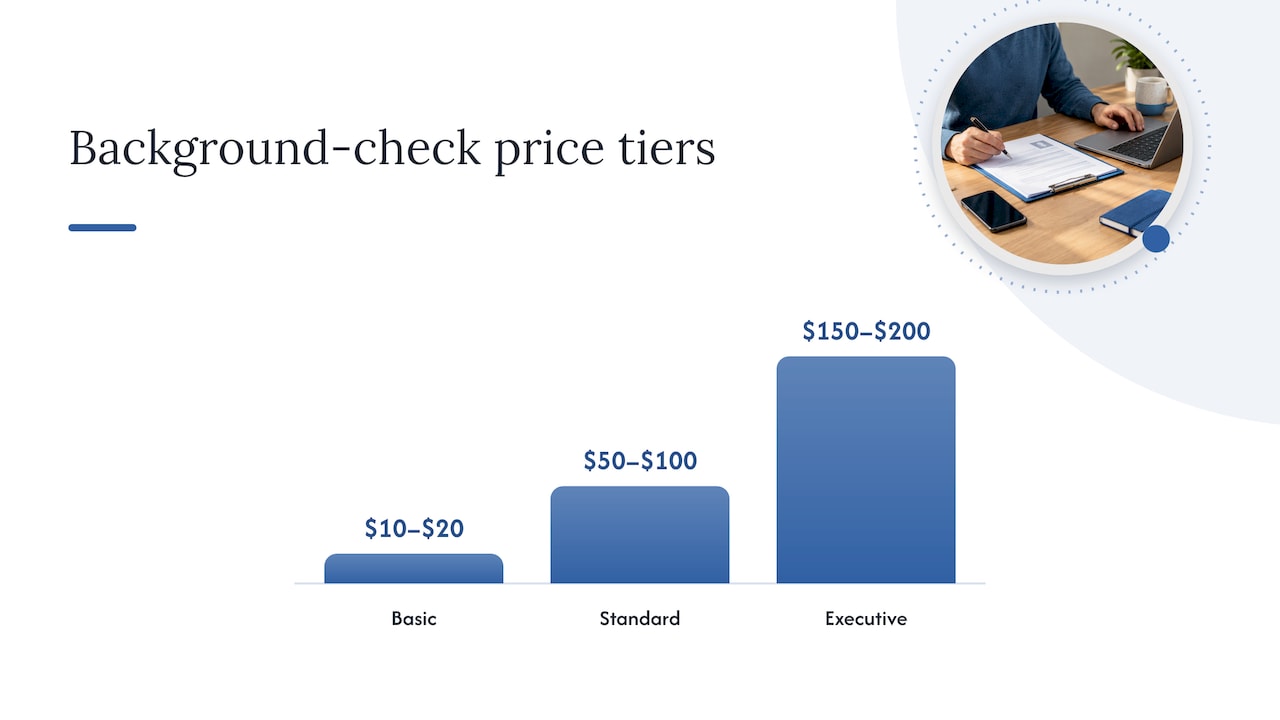
Basic or entry-level checks lean on instant database scans: a Social Security number trace, a national criminal database search, and sometimes a sex offender registry check. These can run as low as $10 to $20, but they skip the courthouse-level work that catches records databases miss.
Standard packages add county criminal searches in jurisdictions where the applicant actually lived or worked, plus identity verification. This is where most employers land, and LegalClarity’s 2026 pricing data puts the typical range at $50 to $100 per person.
Complete or enterprise packages bundle in employment verification, education verification, and sometimes a motor vehicle record (MVR) check, pushing totals higher but closing most of the gaps left by basic tiers.
Executive or international tiers add global database searches, media checks, and cross-border verifications, which is why they commonly exceed $150 to $200.
- Basic: SSN trace, national criminal database, often $10 to $20.
- Standard: adds county criminal records and identity verification, roughly $50 to $100.
- Complete: adds employment and education verification, MVR, and sex offender registry.
- Executive: adds international and media searches, frequently above $150 to $200.
Watch for vendors advertising a low headline price that only covers the basic scope. The real number shows up once county searches and verifications get added back in.
What actually drives background check cost
Quotes vary for predictable reasons, and once you know what’s driving the number, you can push back on an estimate that seems padded.
County and jurisdiction count matters most. Someone who lived in three counties over the past seven years needs three separate county-level searches, and each one adds a line item.
Government pass-through fees are another big factor. Courthouse access fees and state repository charges get collected by the vendor and forwarded along, and these fees vary widely by jurisdiction, which explains a lot of the price swing between candidates with identical job titles.
Manual courthouse research costs more than a database-only scan because it involves actual labor, someone pulling records by hand rather than querying an index. That labor cost is also what makes manual searches more reliable.
- County search count is typically the single biggest cost variable.
- Pass-through government fees can swing the total by a wide margin.
- Manual courthouse research costs more than automated database scans but catches more.
- Complex or international verifications add flat fees for third-party data access.
- Rush turnaround requests often carry an added fee on top of the base price.
Add-ons that get tacked onto a standard package
Drug tests, verifications, and driving records are the most commonly requested extras, and each has a fairly predictable price band.
A standard five-panel urine drug test typically runs $65 to $85 through a third-party administrator. Hair follicle testing, which detects longer-term drug use, runs considerably higher.
Employment and education verification fees are usually billed per inquiry, so a candidate with three past employers and two schools means five separate charges.
| Add-on | Typical cost | Notes |
|---|---|---|
| 5-panel urine drug test | $65 to $85 | Standard panel through third-party administrator |
| Hair follicle drug test | $125 to $200 | Detects longer-term use |
| Employment or education verification | $15 to $40 per inquiry | Billed per employer or school contacted |
| Motor vehicle record (MVR) | Varies by state | Price depends on state DMV access fees |
| International or federal search | Higher than domestic checks | Reflects added access and processing fees |
International and federal searches cost more because they require access to records systems that charge higher fees than domestic county or state databases.
Who pays, and what FCRA and EEOC require of you
Most employers absorb the full cost of screening as a hiring expense, but the process itself carries legal requirements that add work on top of the invoice.
The FTC requires employers to provide written disclosure to the applicant, get their signed consent, and, if you plan to take action based on the report, send a pre-adverse action notice before a final adverse action notice. You also need to give the applicant the reporting agency’s contact information and tell them they have 60 days to dispute anything in the report.
The EEOC advises that criminal history screens be job-related and consistent with business necessity, and it recommends an individualized assessment before rejecting a candidate over a criminal record, to reduce discrimination risk under Title VII.
- Disclosure and written consent must happen before you pull a report.
- Pre-adverse and adverse action notices are required if you act on findings.
- EEOC guidance calls for individualized assessment on criminal history, not blanket exclusions.
- Some states and cities ban charging applicants for their own background check, so confirm local law before billing anyone.
That compliance workload, documenting consent, tracking notice timelines, retaining records, is a real cost even when it never shows up on a vendor invoice. Our guide on running background checks legally walks through the disclosure and consent language in more detail.
Pricing models and how to actually lower your cost per hire
How you pay matters almost as much as what you order. Pay-as-you-go pricing works fine for occasional hiring, but employers running higher volume usually do better on a subscription or enterprise contract, where per-check prices drop as volume commitments go up.
- Ask vendors about volume tiers tied to monthly or annual hiring numbers.
- Bundle verifications into one order instead of requesting them separately.
- Negotiate an annual minimum in exchange for a lower per-check rate.
- Push for applicant self-service data entry to cut administrative handling time.
- Ask whether pass-through fees are itemized or folded into a flat bundled price, since itemized pricing is easier to audit.
A staffing partner managing growth hiring can also help you forecast volume before you lock into a contract tier, which matters if you’re scaling remote hiring and don’t yet know your real annual check count.
Pro Tip: Ask every vendor whether their quote is bundled or itemized pass-through pricing, since two quotes that look identical on paper can differ by $20 or more once county fees are added.
How to budget per hire: a simple calculator approach
Build your per-hire estimate from four parts: the base package price, any add-ons you need, pass-through fees for the jurisdictions involved, and a rough estimate of admin overhead for compliance steps.
For a small business making a one-off hire, a comprehensive standard package covering county searches in two jurisdictions plus identity verification typically lands near $75 to $125 total once pass-through fees are folded in.
A mid-size employer hiring at volume can push that same scope down toward $25 to $50 per hire once an annual contract kicks in volume discounts, a gap worth capturing if you hire more than a handful of people a year.
- Base package + add-ons + pass-through fees + admin time = your real per-hire cost.
- Screening fees are generally deductible as ordinary business expenses, so keep your invoices.
- Compare quotes on total landed cost, not the advertised starting price.
Our small team screening guide breaks these numbers down further for employers hiring under contract minimums.
Why the cheapest check isn’t always the smart check
Our hands-on review process keeps turning up the same pattern: database-only checks miss county-level criminal records that a manual courthouse search would catch. That’s not a knock on any one vendor, it’s a structural limit of instant searches, which industry guidance confirms tend to rely on national databases that can produce false negatives.
Paying more makes sense for safety-sensitive roles, leadership positions, and regulated industries where a missed record carries real liability. For lower-risk, high-volume roles, a standard package is usually enough.
The practical move is matching search depth to role risk and writing that policy down, since a documented, consistent standard protects you under EEOC guidance far better than an ad hoc approach does.
What employers get wrong about screening cost
The biggest mistake isn’t overpaying, it’s anchoring on the lowest advertised price and assuming it covers what you need. A $10 instant search and a $100 standard package aren’t competing products, they’re answering different questions, and treating them as interchangeable is how county-level records get missed.
The conventional advice to “shop around for the best price” skips the more useful question: what scope does this role actually require? A warehouse associate and a finance director shouldn’t get the same depth of search, and pricing them identically either wastes money or leaves a real gap.
Prioritize writing down your screening policy by role tier before you ever request a vendor quote. That single step does more for both your budget and your compliance posture than any negotiation tactic on price alone.
— TechStackTeam
Sources
- Background Checks: What Employers Need to Know | Federal Trade Commission
- Background checks: What employers need to know | U.S. Equal Employment Opportunity Commission
- How Much Is a Background Check? Pricing by Type – LegalClarity
- How Much Should a Reliable Background Check Cost? | SHRM
FAQ
How much does it cost an employer to do a background check?
Most employers pay $50 to $100 per candidate for a standard package covering county criminal searches and identity verification. Basic database-only searches can run as low as $10 to $20, while executive or international checks often exceed $150 to $200.
How much does an employee background verification cost?
Employment and education verification is typically billed per inquiry, usually $15 to $40 per contact. A candidate with multiple past employers or schools will generate several of these charges on one invoice.
Is it normal to pay for your own background check for employment?
Most employers cover the cost of pre-employment screening themselves rather than billing applicants. Some states and cities also restrict or ban charging applicants directly, so check your local law before deciding who pays.
How much does Checkr cost?
Checkr’s pricing is not publicly listed in a fixed rate card and varies by package and volume. For current pricing, check directly with the provider, since published third-party estimates don’t reliably reflect negotiated or current rates.