A typical U.S. employment background check shows your identity and address history, criminal records, employment and education verification, and, depending on the job, motor vehicle records, credit history, and drug test results. Exactly what appears depends on the employer, the role, and your state’s laws. Federal rules under the FCRA limit how far back some information can go, and the FTC recommends knowing your report before an employer does.
TL;DR:
- Criminal record searches include county, state, and federal levels, with each offering different and sometimes outdated data, especially for non-conviction records.
- Employment and education verifications focus on dates, titles, and institutions, but discrepancies can flag your file even if they do not lead to rejection.
- Motor vehicle records for driving roles typically cover three to seven years, with stricter rules applying to commercial driving under Department of Transportation regulations.
- Credit reports are role-specific and show payment and liability histories, while civil records such as bankruptcies are often limited in reporting duration by law.
- Employers must give written notice and your report before adverse decisions, and you are entitled to dispute inaccuracies and request copies within 60 days.
Table of Contents
- At-a-glance: what’s typically on your background check
- Identity verification and SSN trace: how it works
- Criminal records: county, state, and federal searches
- Employment and education verification: what gets confirmed
- Motor vehicle records: when driving history matters
- Credit and civil records: when they show up and their limits
- Drug testing and the legal limits on medical information
- Social media, watchlists, and ongoing monitoring
- How reports are structured and what rights protect you
- How to check your own report and fix errors
- A quick word on staying ahead of your own report
- Where TechStackToday fits alongside your dispute process
- Sources
- FAQ
At-a-glance: what’s typically on your background check
Before you get a job offer pulled or a report flagged, it helps to know exactly what employers are looking at. Most standard employment checks include the same core pieces, with a few extras added based on the role.
- Identity and SSN trace: confirms your name, aliases, and address history.
- Criminal records: county, state, and federal searches, plus registry checks.
- Employment verification: dates, job titles, and sometimes rehire eligibility.
- Education verification: degrees, dates of attendance, and institutions.
- Motor vehicle records: required for driving roles.
- Credit and civil records: used for finance, management, or fiduciary roles.
- Drug test results: common for safety-sensitive and regulated positions.
Some employers add watchlist screening or ongoing monitoring for higher-risk roles. Coverage varies by state law, so two candidates applying for similar jobs in different states can see different reports. For a broader look at how these packages get assembled, a guide to types of employee background checks walks through common combinations.
Identity verification and SSN trace: how it works
An SSN trace pulls your name, known aliases, and address history tied to your Social Security number. It doesn’t check your credit. Its real job is to tell the background check company where you’ve lived, which then determines which county and state courts get searched for criminal records.
This is also where errors creep in. A name variant, a maiden name, or an address you forgot you had can send searchers to the wrong county or attach someone else’s record to your file. If you’ve moved recently or use a nickname on some applications, double check that your report reflects your actual history. A breakdown of background check categories covers how each search type builds on the last.
Criminal records: county, state, and federal searches
Criminal history searches aren’t one lookup, they’re several, and they don’t all cover the same ground. County searches pull directly from courthouse records and are considered the most current source for local convictions. State repositories aggregate records across a state but can lag behind courthouse filings. Federal searches cover crimes prosecuted in federal court, like fraud or drug trafficking across state lines, which won’t show up in county or state databases at all.
Each entry that surfaces typically lists the case number, the charge, the disposition (convicted, dismissed, acquitted), and the sentence if one was handed down. Sex-offender registry checks and active-warrant searches run separately and are usually reported as their own line items rather than folded into general criminal history.
Sealed and expunged records generally aren’t supposed to appear, and many states restrict reporting old non-conviction cases entirely. Rules on this vary significantly by state, so what gets suppressed in one place might still show up in another.
Employment and education verification: what gets confirmed
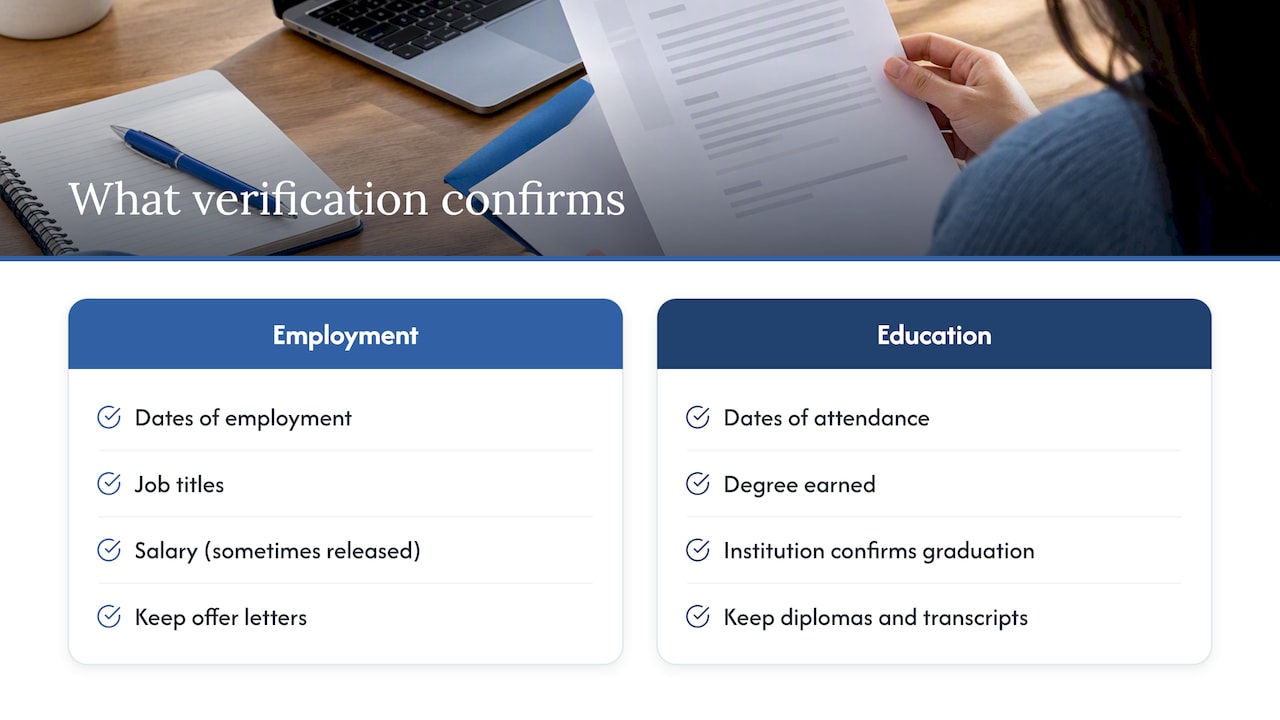
Employers use third-party verification to confirm what’s on your resume matches reality. For jobs, this usually means dates of employment, job titles, and sometimes salary if your former employer will release it. For education, its degree earned, dates of attendance, and the institution’s confirmation that you actually graduated.
When something doesn’t line up, like a title that doesn’t match company records or graduation dates that are off by a year, it shows up as a discrepancy flag rather than an outright rejection. Some employers also ask former workplaces about rehire eligibility, which can hint at how your departure went even without explicit performance comments. Keeping old offer letters, diplomas, and transcripts on hand makes it easier to clear up any mismatch quickly.
Motor vehicle records: when driving history matters
If the job involves driving, whether that’s a delivery route or an executive with a company car, expect an MVR check. These reports show moving violations, license suspensions, and current license status. Lookback windows commonly run three to seven years, but the exact range depends on the state issuing the record.
Commercial driving roles regulated by the Department of Transportation follow stricter rules, and any drug test tied to those roles goes through Medical Review Officer review before results are finalized, a process detailed further in the LegalClarity explainer on report structure.
Credit and civil records: when they show up and their limits
Employment purpose credit reports look different from the credit score you’d see applying for a loan. They typically show payment history, debt load, and account status rather than a three digit score, and they’re generally reserved for roles handling money or sensitive financial access.
Civil records like bankruptcies, tax liens, and civil judgments can also appear, though the FCRA caps how long certain items can be reported. Several states, including California and Illinois, restrict or outright ban employers from pulling credit reports except for specific finance-related roles, so this section of a report doesn’t apply to most jobs.
Drug testing and the legal limits on medical information
Standard drug screens report a pass, fail, or inconclusive result, with confirmation testing typically run on any initial positive before it’s finalized. For DOT-regulated positions, a Medical Review Officer reviews positive results and confirms whether a legitimate prescription explains it, a step that can change how a positive gets reported.
Separately, EEOC guidance makes clear that GINA and the ADA restrict employers from asking about genetic information or medical history before a job offer is extended. Medical inquiries generally have to wait until after a conditional offer, and even then, they’re limited to what’s job-related.
Social media, watchlists, and ongoing monitoring
Some employers review publicly available social media, generally looking for red flags like discriminatory statements or evidence of workplace misconduct rather than combing through your entire online history. This isn’t standardized across the industry, so what gets reviewed varies by company.
Watchlist and sanctions checks are more consistent. These typically screen against government lists like OFAC and various terrorism or sanctions databases, mostly relevant for finance, government contracting, or international roles. Continuous monitoring services, when used, flag new arrests or court filings between the initial hire and future renewal periods.
How reports are structured and what rights protect you
Most background check reports open with a summary or scorecard, flagging items that need a closer look, before moving into detailed sections organized by search type, according to LegalClarity’s breakdown of typical report layouts. That structure helps both you and the hiring manager spot problems fast instead of digging through pages of raw data.
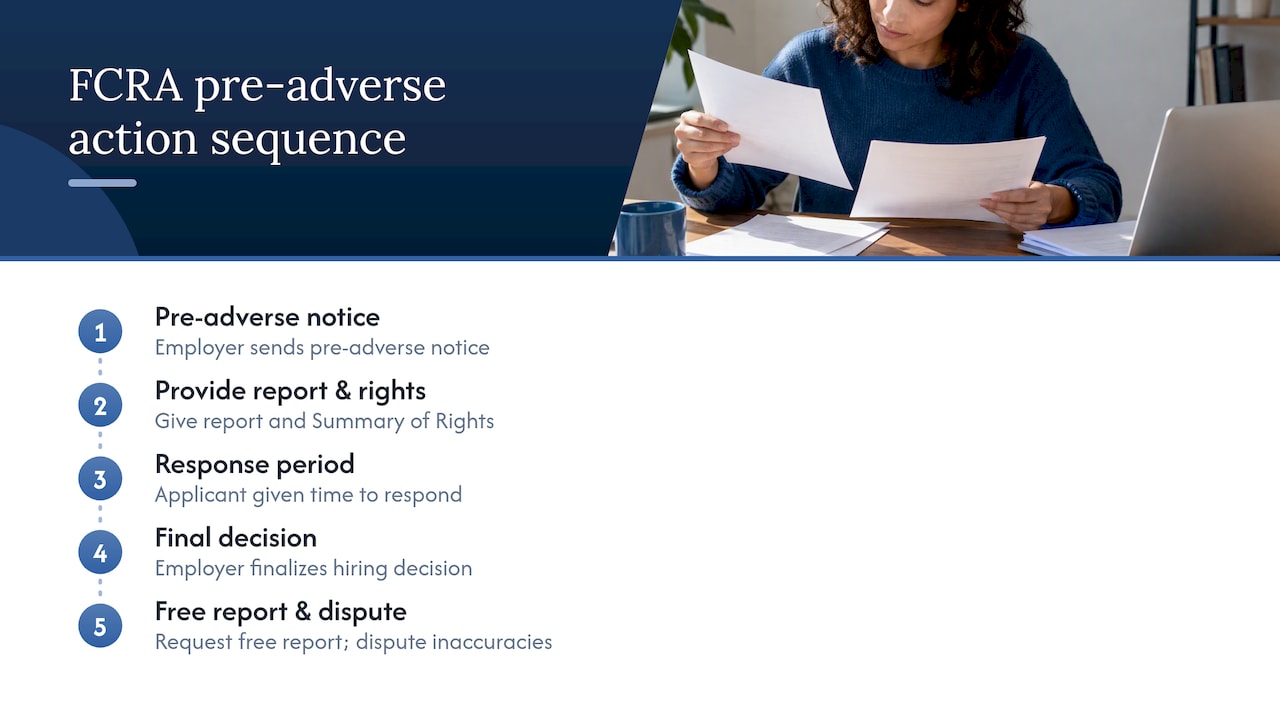
The FTC requires employers to give you written notice, get your consent, and hand over a copy of your report along with a Summary of Rights before taking any adverse action based on it. That’s not a courtesy, it’s federal law.
The FCRA also limits how long certain non-conviction and bankruptcy items can be reported, though some states apply stricter caps. If an employer decides not to hire you because of your report, they have to follow a specific sequence: send a pre-adverse action notice, give you the report and your rights summary, and give you time to respond before finalizing the decision. If that happens to you, you can request a free copy of the report within 60 days and dispute anything inaccurate directly with the reporting company.
How to check your own report and fix errors
You don’t have to wait for a job offer to fall through to find out what’s on your file. Here’s the practical sequence:
- Request your report directly from the consumer reporting agency the employer used, or run a check on yourself through a service built for that purpose.
- If you’ve already received an adverse action notice, request your free copy within the 60 day window the FTC guarantees.
- Dispute inaccuracies with both the screening company and the original source of the error, since CFPB guidance notes that fixing only one side often leaves the flawed record in place.
- Gather supporting documents, court dismissals, corrected transcripts, old pay stubs, before you file the dispute.
- Follow up until you get written confirmation the correction reached the employer’s copy of the report.
Pro Tip: Keep a simple dispute log with dates, names, and reference numbers. It’s the fastest way to prove you followed up if a correction gets lost in the shuffle.
A step-by-step guide on how to run an employer grade background check on yourself is available for those who want to walk through this before applying.
A quick word on staying ahead of your own report
Checking your report before an employer does isn’t paranoia, it’s just good practice. Old addresses, data broker profiles, and outdated records tend to surface at the worst possible time. Reducing your public footprint won’t erase a court record, but it can cut down on the noise that causes false flags in the first place.
— TechStackTeam
Where TechStackToday fits alongside your dispute process
Fixing an inaccurate report means working directly with the reporting agency and the furnisher, there’s no shortcut around that official process. Instead, there are reviews of privacy and data removal tools that help reduce what’s floating around about you online between now and your next background check.

For comparisons of those services, a guide on removing yourself from the internet breaks down the options and what each one actually does.
This article is general information, not a substitute for advice from a qualified lawyer. Consult a qualified legal professional about your own circumstances before acting on anything here.
Sources
- Employer background checks and your rights | FTC
- Background checks: What employers need to know | EEOC
- Fair Credit Reporting Act (FCRA) — consolidated excerpt (March 2026) | FTC/Bulkorder
- What Does a Background Check Actually Look Like? | LegalClarity
FAQ
What will get flagged on a background check?
Criminal convictions, employment or education discrepancies, license issues on an MVR, and failed drug tests are the most common flags. Civil judgments or credit problems can also get flagged for roles that require a credit check. The exact flags depend on the search types the employer ordered.
What pops up when you do a background check?
Most reports open with identity and address history, then move into criminal records organized by county, state, and federal jurisdiction, followed by employment and education verification. Role-specific items like motor vehicle records, credit history, or drug test results appear when the job calls for them, according to LegalClarity’s report breakdown.
What will disqualify you on a background check?
There’s no universal disqualifying list since it depends on the employer, the role, and applicable state law. Unresolved discrepancies in your work or education history, certain criminal convictions relevant to the job, or a failed drug test are among the most common reasons employers move on from a candidate.
What won’t show up on a background check?
Sealed or expunged records generally shouldn’t appear, and many states limit how long non-conviction records can be reported at all. Genetic information and most medical history are also off limits before a job offer under EEOC guidance on GINA and ADA protections.
How far back do background checks typically look?
Lookback periods vary by the type of record and by state law, with some non-conviction and bankruptcy items capped under the FCRA. Motor vehicle records commonly cover three to seven years, though the exact range depends on the issuing state.