A background check for new hires is a systematic screening process employers use to verify candidate information and assess risk before finalizing a hiring decision. Known formally as pre-employment screening, this process covers criminal history, employment verification, education records, and more. The Fair Credit Reporting Act (FCRA) and Equal Employment Opportunity Commission (EEOC) guidelines set the legal floor for how these checks must be conducted. Get the process wrong and you face lawsuits, bad hires, or both. This background check new hires guide walks you through every step, from policy creation to final hiring decisions, so you stay compliant and protected.
What legal requirements must you meet before running background checks?
Legal compliance starts before you ever order a report. You need a written background check policy that defines the scope of screening, which roles require which checks, and how results will be used. Without this document, your process is inconsistent and legally exposed.
The FCRA sets three non-negotiable requirements:
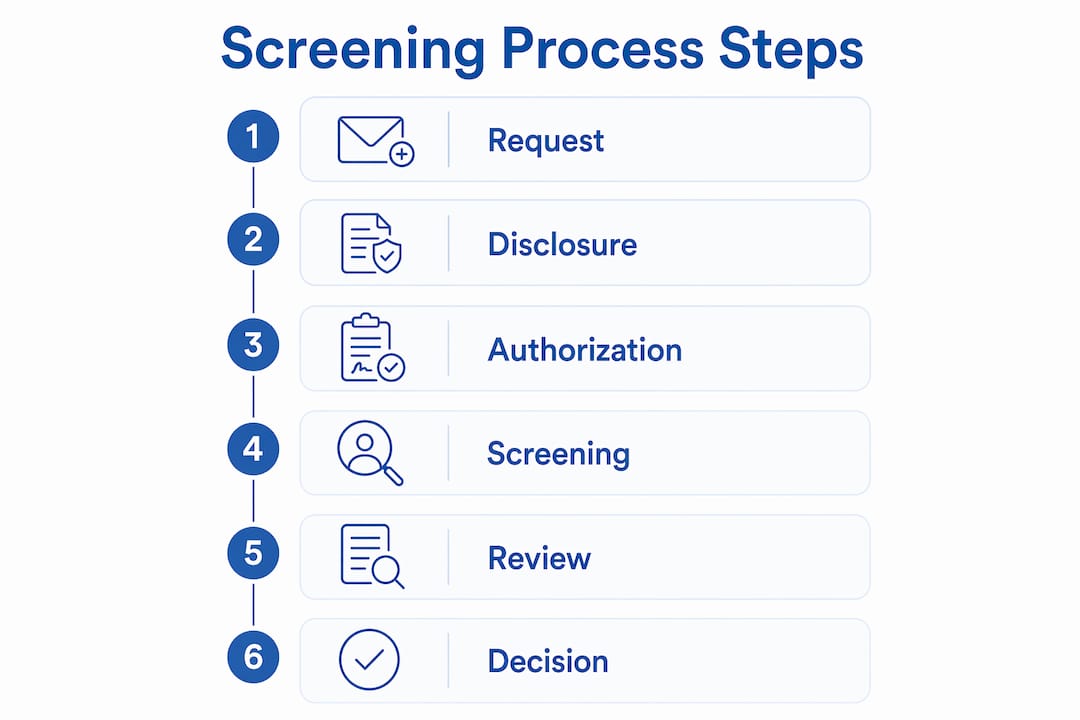
- Standalone disclosure: You must give candidates a separate document explaining that a background check will be conducted. Embedding disclosure in applications or offer letters violates FCRA. This is one of the most common compliance gaps employers overlook.
- Written authorization: FCRA requires written authorization before you order any consumer report. Keep these authorization records separate from personnel files and store them securely.
- Timing: Background checks must begin after a conditional job offer. Running checks earlier increases your risk of discrimination claims and class-action lawsuits.
Beyond federal law, you must also comply with state and local rules. Ban-the-Box laws, for example, restrict when and how you can ask about criminal history. Multi-state hiring requires policies tied to the candidate’s work location, since local laws frequently override federal minimums.
Record retention matters too. Store authorization forms and screening results for at least one year after the hiring decision. Limit access to those with a direct need to know.
Pro Tip: Create a compliance checklist for each new hire file. Include checkboxes for standalone disclosure, signed authorization, conditional offer date, and report receipt. This takes five minutes per hire and protects you during audits.
How do you choose a background check provider and the right screening package?
Choosing the right consumer reporting agency (CRA) is not a minor decision. A compliant, experienced CRA protects you legally and delivers accurate results faster. When evaluating providers, look for these criteria:
- FCRA compliance certification and clear data security practices
- Coverage of the specific check types your roles require
- Turnaround time transparency and dispute resolution support
- Integration with your applicant tracking system (ATS)
Once you have a provider, you need to match the screening package to the role. Not every position requires the same depth of check. Here is a practical framework:
| Role Type | Recommended Checks |
|---|---|
| Office or administrative | Criminal history, employment verification, education verification |
| Financial or accounting | Criminal history, credit report, employment verification |
| Driver or field technician | Criminal history, motor vehicle records (MVR), drug screening |
| Healthcare or childcare | Criminal history, sex offender registry, license verification |
| Executive or senior leadership | Criminal, credit, employment, education, reference checks |

Tailoring your package to the role reduces cost and keeps screening proportionate to actual risk. A blanket approach, applying the same deep check to every position, creates unnecessary delays and may expose you to claims of over-screening.
Pro Tip: Review background check categories before finalizing your screening packages. Knowing what each check type covers helps you build role-appropriate packages rather than defaulting to the most expensive option.
Verify candidate data before you submit the order. Minor errors like a misspelled name or a wrong date of birth cause mismatched background reports that delay onboarding and require rework. A quick data review at submission saves days of back-and-forth.
What is the process for communicating candidate rights and managing adverse actions?
This is where most employers make costly mistakes. If a background check result leads you to consider withdrawing a job offer, you must follow a specific legal process. Skipping steps here exposes you to FCRA lawsuits.
The required sequence works like this:
- Send a pre-adverse action notice. Before making any final decision, give the candidate a copy of the background report and the FCRA Summary of Rights. This gives them a chance to review the findings and dispute any errors.
- Wait at least 5 business days. The FCRA mandates a waiting period between the pre-adverse notice and the final decision. Some states require longer waiting periods, so check local law.
- Send the final adverse action notice. If you proceed with the decision not to hire, send a final notice that includes the name and contact information of the CRA, a statement that the CRA did not make the hiring decision, and the candidate’s right to dispute the report.
- Document everything. Keep copies of all notices, dates sent, and any candidate responses. This documentation is your defense in a compliance audit.
- Handle disputes promptly. If a candidate disputes a finding, pause the process. The CRA has 30 days to investigate and correct any errors.
The two-step adverse action process is not optional. Sending only a final notice, without the pre-adverse step and waiting period, is a direct FCRA violation. Courts have awarded significant damages to candidates in these cases, even when the underlying report was accurate.
Pro Tip: Use a calendar reminder or workflow automation to track the 5-business-day waiting period. Missing this window is one of the most common and expensive compliance errors in pre-employment screening.
How do you review background check results and make fair hiring decisions?
Reviewing results objectively requires a system, not a gut feeling. Role-based adjudication matrices define in advance which findings are relevant to which roles. This approach reduces litigation risk and keeps decisions consistent across hiring managers and locations.
Here is how to build and apply an adjudication framework:
- Define relevant criteria per role before screening begins. A DUI conviction is highly relevant for a delivery driver. It is far less relevant for a software developer. Document this logic in writing.
- Avoid blanket exclusions. Automatically rejecting all candidates with any criminal record violates EEOC guidance. You must conduct an individualized assessment that considers the nature of the offense, how long ago it occurred, and its relevance to the job.
- Separate relevant from irrelevant findings. Arrests without convictions, expunged records, and offenses unrelated to job duties generally should not factor into your decision.
- Incorporate results into the full candidate picture. A background check result is one data point, not the entire evaluation. Weigh it alongside interview performance, references, and skills assessment.
- Document your reasoning. If you decline a candidate based on a background finding, write down the specific job-related reason. Vague reasoning creates legal exposure.
The shift from manual, instinct-driven review to documented, role-based adjudication is the single biggest improvement most small businesses can make to their hiring process. It protects you legally and produces better, more consistent hiring outcomes.
What common pitfalls should you watch for in the new hire screening process?
Even well-intentioned employers run into problems. Knowing the most common failure points helps you avoid them before they become legal or operational crises.
- Inaccurate candidate data: A wrong middle name or transposed birth year causes mismatched reports. Always verify candidate information before submitting to your CRA.
- Screening too early: Running checks before a conditional offer is made increases your legal exposure significantly. Sequence matters.
- Incomplete documentation: Missing authorization forms, unsigned disclosures, or undated notices create compliance gaps that surface during audits.
- Ignoring local law variations: A process that works in Texas may violate law in California or New York City. Local jurisdictions often impose stricter rules than federal law, including longer waiting periods and expanded Ban-the-Box protections.
- Inconsistent application across teams: If one hiring manager follows the process and another does not, you face disparate treatment claims. Standardize your workflow and train every person involved in hiring.
- Failing to update policies: Laws change. A policy written in 2022 may not reflect 2026 requirements. Review your background check policy at least once a year.
Technology helps here. Applicant tracking systems with built-in background check integrations enforce sequencing, store documents automatically, and flag missing steps. For small businesses without dedicated HR staff, this kind of workflow automation is worth the investment. You can also review how turnaround timing works to set realistic expectations with candidates during the process.
Key Takeaways
A compliant, consistent background check process requires written policies, FCRA-mandated authorization, role-based screening packages, and a documented two-step adverse action procedure before any hiring decision is finalized.
| Point | Details |
|---|---|
| Legal sequencing matters | Always run background checks after a conditional offer, never before, to reduce discrimination risk. |
| Standalone disclosure is required | FCRA prohibits embedding disclosure or authorization language inside applications or offer letters. |
| Match checks to the role | Tailor screening packages by job type to keep the process proportionate and cost-effective. |
| Follow the two-step adverse action process | Send a pre-adverse notice and wait at least 5 business days before issuing a final adverse decision. |
| Document every step | Keep authorization forms, notices, and adjudication reasoning in a separate, secure file for at least one year. |
What I’ve learned from watching small businesses get this wrong
The most common mistake I see is treating background checks as a checkbox rather than a process. A business owner orders a report, gets a result, and makes a decision, all without a written policy, a standalone disclosure form, or any documentation of the reasoning. That works fine until it doesn’t. One FCRA complaint can cost more than years of proper compliance would have.
The second mistake is assuming federal law is the whole picture. It is not. State and local laws add layers that catch employers off guard, especially when hiring across multiple locations. A hiring workflow that is perfectly legal in one state can expose you to liability in another.
What actually works is simple: write your policy, train your team, use a compliant CRA, and follow the sequence every single time. The businesses that get background checks right are not the ones with the biggest HR departments. They are the ones with the most consistent processes. You do not need complexity. You need documentation, sequencing, and a CRA you trust. Start there, and the rest follows. Techstacktoday covers why background checks matter for hiring safety if you want a deeper look at the risk side of this equation.
— TechStackTeam
Protecting sensitive hiring data starts with the right tools
Background checks generate sensitive personal data: Social Security numbers, criminal records, financial history, and more. How you store and transmit that data matters as much as how you collect it.
Techstacktoday reviews and ranks privacy tools that help businesses handle sensitive information securely. From password managers that protect HR system credentials to data removal tools that reduce your exposure, the resources are practical and tested in real-world scenarios. Check out the Internet Privacy Tools Comparison Checklist to find tools that fit your hiring and data management workflow. You can also explore background check services reviewed and ranked to find a compliant CRA that fits your business size and budget.
FAQ
What is a background check for new hires?
A background check for new hires is a pre-employment screening process that verifies a candidate’s criminal history, employment record, education, and other relevant information before a final hiring decision is made.
When should you run a background check on a candidate?
Background checks should only begin after you extend a conditional job offer. Running checks earlier increases the risk of discrimination claims under EEOC guidelines.
What does FCRA require from employers conducting background checks?
FCRA requires a standalone written disclosure, signed candidate authorization before ordering any report, and a two-step adverse action process with at least a 5-business-day waiting period if you decide not to hire based on results.
How long do you need to keep background check records?
Background check authorization forms and results must be kept for at least one year after the hiring decision, stored separately from general personnel files, and accessible only to those with a direct need to know.
What is Ban-the-Box and does it apply to your business?
Ban-the-Box laws restrict when employers can ask about criminal history during the hiring process. Applicability depends on your location and company size, and local laws often impose stricter rules than federal requirements.