Affordable background checks for small teams are defined as pay-per-check screening services that cost as little as $19.95 per report, require no monthly minimums, and stay fully compliant with the Fair Credit Reporting Act (FCRA). Small business owners and team leaders can run thorough, legally sound checks without paying enterprise prices or signing long-term contracts. The key is choosing the right pricing model and matching the screening scope to each role’s actual risk level. Get those two things right, and you protect your team without draining your budget.
How pay-per-check pricing works for small teams
Pay-per-check pricing is the most cost-effective model for small businesses that hire fewer than 1,200 employees per year. You pay only when you order a check. There are no monthly fees, no unused credits, and no contracts to escape. That flexibility is exactly what a lean team needs.
Entry-level screening packages start between $19.95 and $25.95 per report. Mid-tier options with more searches included run around $45–$55. Comprehensive packages reach up to $84.95. Those price points cover most small business hiring scenarios without requiring a bulk commitment.

The alternative is a subscription model with monthly minimums. Subscriptions make sense at high hiring volume, but they inflate the per-check cost when you hire infrequently. Pay-as-you-go pricing is cheaper than subscriptions for teams under that 1,200-hire threshold. That covers virtually every small business in operation.
One more thing to watch: court fees. Some providers mark up court access fees and bury them in the total. The best budget screening services pass court fees through at cost with no markup. Always confirm this before you sign up.
Pro Tip: Ask any provider directly: “Do you mark up court fees?” If they can’t give you a straight answer, move on.
What a typical per-check price includes
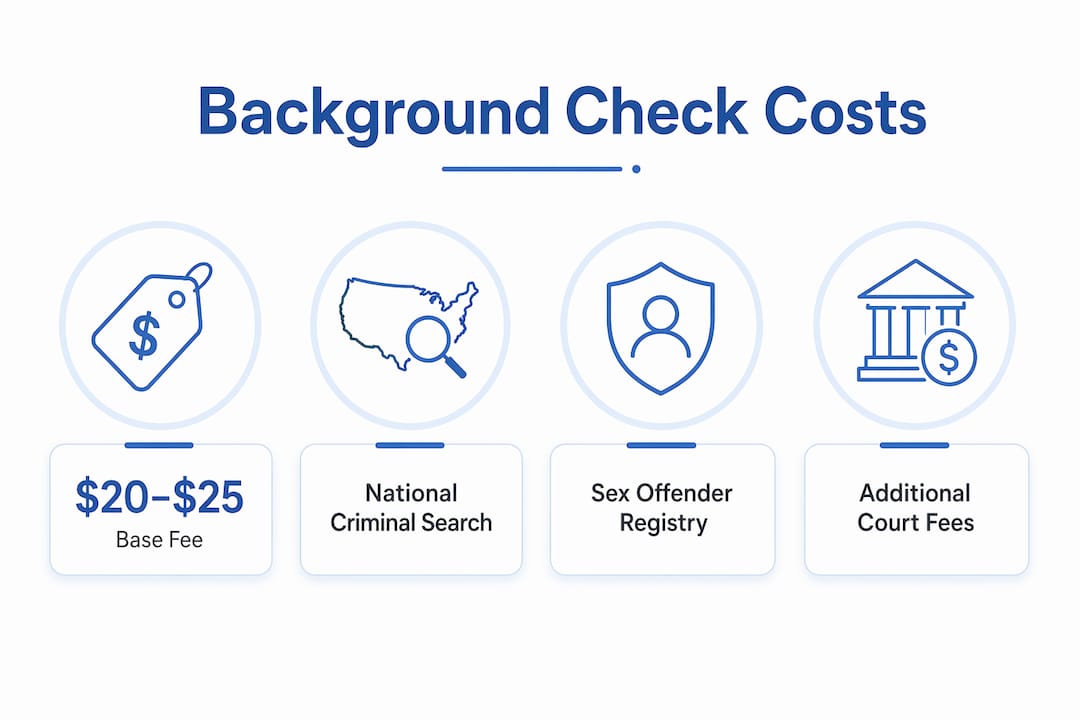
A base fee around $20–$25 typically covers a national criminal database search, a sex offender registry check, and a global watchlist scan. County-level criminal searches and employment verification are usually add-ons. You pay for those only when the role justifies it.
What types of background checks fit small teams?
Matching the screening scope to job risk is the single most effective way to control costs. Not every hire needs the same level of scrutiny. A part-time retail associate carries different risk than a bookkeeper with access to your accounts.
Here is how to think about screening tiers:
- Basic check: National criminal database, sex offender registry, global watchlist. Covers most entry-level and low-risk roles. Starts around $20.
- Standard check: Basic check plus county-level criminal search for the applicant’s counties of residence. Recommended for roles with customer contact or access to company property.
- Thorough check: Standard check plus federal criminal search, employment verification, and education verification. Use this for managerial, financial, or safety-sensitive positions.
National database searches are fast and broad, but they are not a final answer. Database searches act as triggers that flag potential records. County-level validation is required to confirm accuracy and stay FCRA-compliant. Skipping that step means you could act on incomplete or incorrect information, which creates legal exposure.
Pro Tip: Use background check categories as a reference when building your screening tiers. Matching check type to role type prevents both overspending and under-screening.
Customizable packages let you add targeted searches only when a specific role requires them. That keeps your base cost low and your coverage appropriate. Role-based risk assessment is not just a cost-saving tactic. It is also a compliance best practice.
How to order and manage background checks step by step
Running your first background check as a small business owner takes less than 15 minutes once your account is set up. Here is the process from start to finish.
-
Set up your account. Choose a pay-as-you-go provider with no contract requirement. Confirm FCRA compliance tools are included. Most user-friendly platforms require only basic business information to get started.
-
Select your screening package. Match the check type to the role’s risk profile. Start with a basic package for low-risk hires. Add county or federal searches for positions with elevated responsibility.
-
Enter the applicant’s information. You will need the candidate’s full legal name, date of birth, Social Security number, and consent. FCRA requires written consent from the applicant before you run any check. Do not skip this step.
-
Submit and monitor the order. Most standard domestic criminal checks return results within one hour. Manual courthouse retrievals for county-level searches can take 1–3 business days. Some providers reduce time-to-hire by up to 80% through automation. That speed matters when you need to fill a role quickly.
-
Review the results. Read the report carefully. If a database search flags a potential record, confirm it with a county-level search before making any hiring decision.
-
Use the adverse action workflow if needed. If you decide not to hire based on the report, FCRA requires a specific adverse action process. This includes sending a pre-adverse action notice, waiting the required period, and then sending a final notice. Most platforms include these tools at no extra charge.
Pro Tip: Keep a record of every consent form and adverse action notice. If a candidate ever disputes your decision, that documentation is your protection.
Understanding how turnaround times work helps you set realistic expectations with candidates and avoid delays in your hiring timeline.
Common mistakes small business owners make with background checks
The most expensive mistake is buying a bundled package that does not match your actual hiring needs. Paying for employment verification on every hire when only two roles per year require it wastes money fast. Matching scope to risk prevents that waste.
Here are the other mistakes that cost small teams money and legal standing:
- Choosing a provider with monthly minimums. If you hire three people this month and nobody next month, you pay for checks you never use. Pay-as-you-go eliminates that problem entirely.
- Skipping county-level validation. Acting on a database hit without county confirmation is both inaccurate and legally risky. Automatic validation is not optional for FCRA compliance.
- Ignoring adverse action tools. Failing to use adverse action workflows exposes you to legal claims from rejected candidates. These tools are usually included at no extra charge. Use them every time.
- Not planning for growth. A provider that works for three hires a year should also work for thirty. Choose a platform that scales without forcing you into a new contract tier.
“The biggest compliance gap for small employers is not the background check itself. It is the adverse action process that follows a negative result.”
Background check compliance is not just about what you find. It is about how you act on what you find. Understanding data broker risks also helps you recognize where applicant data comes from and how to evaluate its accuracy.
Key Takeaways
Affordable background checks for small teams require pay-per-check pricing, role-based screening scope, and consistent use of FCRA-compliant adverse action workflows to control costs and legal risk.
| Point | Details |
|---|---|
| Pay-per-check saves money | Teams hiring fewer than 1,200 people per year pay less with pay-as-you-go than with subscriptions. |
| Start price around $19.95 | Entry-level packages begin between $19.95 and $25.95 and cover national database, sex offender, and watchlist searches. |
| Match scope to role risk | Basic checks suit low-risk roles; add county or federal searches only for safety-sensitive or managerial positions. |
| Validate database hits | National database results require county-level confirmation to stay accurate and FCRA-compliant. |
| Use adverse action tools | FCRA requires a formal adverse action process when rejecting a candidate based on a background check report. |
What I have learned about affordable screening for small teams
Running background checks for a small team feels straightforward until you get your first invoice and realize you paid for three checks you did not need. That experience is more common than it should be.
The pay-as-you-go model genuinely works. I have seen teams of five people run thorough, compliant checks for under $30 per hire by sticking to a basic package for most roles and adding county searches only when the position justified it. That discipline requires about ten minutes of thought upfront, but it saves real money over a year.
The compliance side surprises most small business owners. The FCRA adverse action process feels bureaucratic until you realize it protects you as much as it protects the applicant. Platforms that include those workflows at no extra cost are worth prioritizing over cheaper options that leave you to manage compliance manually.
My honest advice: start with the simplest pay-per-check plan available, run two or three checks, and evaluate the platform’s ease of use before committing to anything. The best screening service for a small team is the one you will actually use correctly every time.
— TechStackTeam
Background check resources worth bookmarking
Techstacktoday reviews privacy and security tools with the same hands-on approach it applies to background screening services. If you are ready to compare no-contract, pay-as-you-go options for your team, the guides on Techstacktoday break down real-world performance rather than marketing claims.
Protecting your team starts with knowing what tools are worth your time and budget. Techstacktoday’s data removal reviews and privacy tool comparisons give you the same level of tested, unbiased analysis you need when evaluating any screening service. No paid rankings. No filler. Just clear answers for small business owners who need to make fast, confident decisions.
FAQ
What is the cheapest background check for a small business?
Entry-level background screening packages start between $19.95 and $25.95 per report. These typically include a national criminal database search, sex offender registry check, and global watchlist scan.
Is pay-as-you-go better than a subscription for small teams?
Pay-as-you-go pricing is cheaper than subscription plans for businesses hiring fewer than 1,200 people per year. Subscriptions charge monthly minimums that inflate per-check costs when hiring volume is low.
What does FCRA compliance mean for small business background checks?
FCRA (Fair Credit Reporting Act) compliance requires written applicant consent before running a check and a formal adverse action process if you reject a candidate based on the results. Most reputable screening platforms include these compliance tools at no extra charge.
How long does a background check take for a small team?
Standard domestic criminal checks return results within one hour. County-level manual courthouse retrievals take 1–3 business days. Automated platforms can significantly reduce overall time-to-hire.
Do I need county-level searches for every hire?
No. National database searches cover most entry-level roles. County-level searches are recommended for positions with financial responsibility, safety-sensitive duties, or managerial authority, and should always be used to validate any database hit before making a hiring decision.