Child identity theft is widely underreported because victims often don’t discover the crime for years, and when a family member is the perpetrator, most parents never call the police at all.
- The “familiar fraud” problem: Research by Axton Betz-Hamilton shows victims routinely stay silent when a parent or relative is the suspect, fearing family fallout more than financial loss.
- No credit file, no alert: Because children rarely have credit activity, Javelin Strategy & Research confirms misuse of a child’s SSN can stay invisible for a decade or more, meaning it never reaches the National Crime Victimization Survey (NCVS) or FTC databases.
- What you can do now: Freeze your child’s credit at all three bureaus today, then check SSA earnings records. If you suspect fraud, start at IdentityTheft.gov. Techstacktoday’s child identity theft prevention steps walk you through every stage.
Table of Contents
- Why families often don’t report child identity theft
- How underreporting creates a “dark figure” in official statistics
- How can you spot signs that your child’s identity is compromised?
- Step-by-step U.S. reporting and recovery plan
- Practical prevention measures you can start today
- Why law enforcement and financial institutions struggle to act
- Key Takeaways
- Child identity protection deserves a different strategy
- Techstacktoday helps you find the right protection for your family
- Useful sources and further reading
Why families often don’t report child identity theft
The single biggest driver of underreporting is who commits the crime. A large share of child identity theft is perpetrated by parents, stepparents, or close relatives, a pattern researchers call “familiar fraud.” Betz-Hamilton’s pilot study documents how victims face intense psychological pressure not to report: they fear destroying the family, they doubt authorities will believe them, and they often lack the paper trail a bank or police department would require.
Beyond family dynamics, knowledge gaps compound the problem. Many parents assume children can’t be targeted because kids don’t have credit cards or bank accounts. That assumption is exactly what makes children attractive targets: a clean SSN with no existing credit history is more valuable to a fraudster than an adult’s file with existing debts and alerts.
Cultural and socioeconomic factors also shape reporting rates. Families under financial stress may fear that reporting fraud by a relative will trigger legal consequences for the household. Immigrant families, in particular, show lower reporting rates partly due to concerns about interacting with law enforcement and uncertainty about available resources.
- Shame and stigma suppress disclosure, especially when the perpetrator is a parent.
- Families often resolve issues quietly with creditors rather than filing formal reports.
- Many parents simply don’t know that IdentityTheft.gov or the SSA can help.
How underreporting creates a “dark figure” in official statistics
When victims don’t report, they don’t show up in government surveys. The NCVS captures only incidents that victims are aware of and choose to disclose. Analysis of NCVS data shows that victims frequently bypass formal reporting when they resolve losses directly with banks or never detect the fraud at all. The result is a “dark figure” — a gap between true prevalence and what official statistics reflect.
Survey design makes this worse. Studies that interview parents about children under 18 miss cases entirely when the fraud isn’t discovered until the child turns 18 and applies for a first job or loan. According to the 2026 ITRC Trends in Identity Report, fraudulent employment accounted for 40% of misuse cases against children, and most of those crimes surface years after the fact.
The policy consequence is direct: when prevalence appears low, lawmakers allocate fewer resources to child-specific detection and recovery programs. Underreporting doesn’t just hide the problem. It perpetuates it.
How can you spot signs that your child’s identity is compromised?
The top red flag is mail that has no business arriving for a minor. Collection notices, jury duty summons, preapproved credit card offers, or IRS notices addressed to your child are all signals worth treating seriously.
Here’s a prioritized checklist of warning signs:
- Unexpected mail — collection notices, credit offers, or government correspondence in your child’s name.
- SSA earnings record anomalies — create a my Social Security account at SSA.gov and check whether wages are reported under your child’s SSN.
- Tax return rejection — the IRS rejects your child’s return because one was already filed using their SSN.
- Unexplained medical bills or benefits denials — someone may have used your child’s Medicaid or CHIP benefits.
- Employer-related records — W-2s or 1099s arriving for a child who has never worked.
Take these triage steps immediately: place a credit freeze on your child’s file at Equifax, Experian, and TransUnion; check SSA earnings online; and store all original documents (birth certificate, Social Security card) in a locked location.
Pro Tip: Request a manual search from each credit bureau to confirm whether a file exists for your child’s SSN. Minors often have no file at all, so the existence of one is itself a red flag.

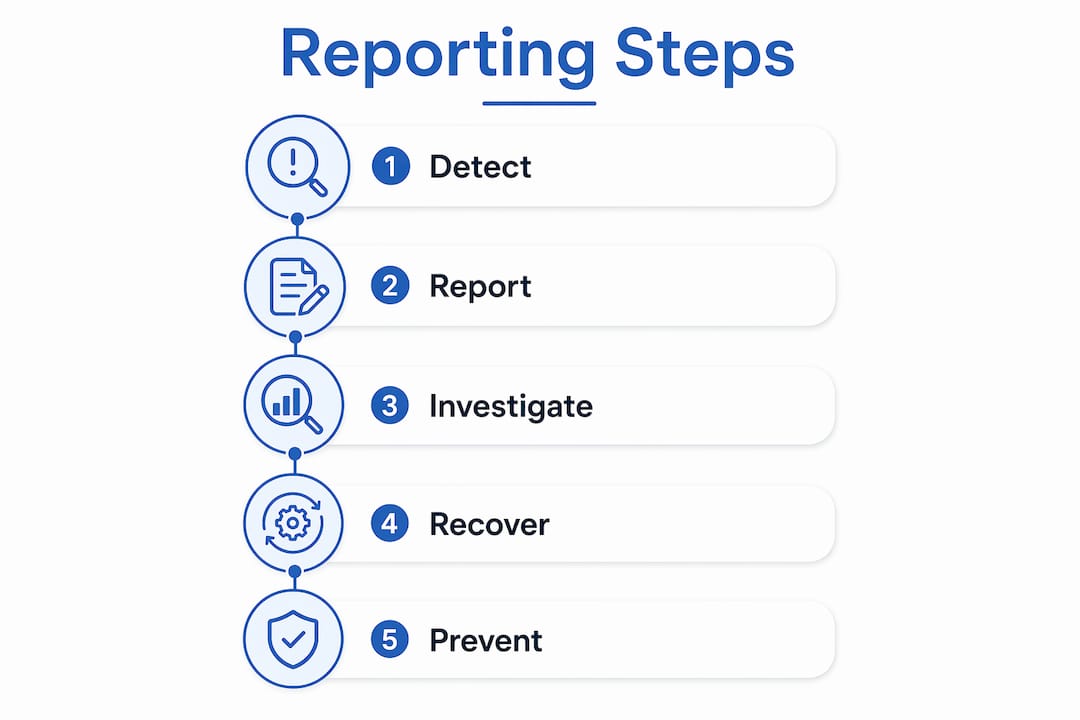
Step-by-step U.S. reporting and recovery plan
Your immediate priority: go to IdentityTheft.gov and create a personalized recovery plan. The FTC’s tool generates pre-filled letters and tracks your steps.
Contact the FTC first
File a report at IdentityTheft.gov. You’ll receive an Identity Theft Report, which is the document creditors and agencies require before they’ll act.
Check SSA and IRS records
Call the SSA at 1-800-772-1213 to report suspicious earnings. For fraudulent tax returns, contact the IRS Identity Protection Specialized Unit at 1-800-908-4490 and submit Form 14039 (Identity Theft Affidavit).
File a police report
Local police reports aren’t always required, but having one strengthens your case with creditors and benefits agencies. Bring your FTC Identity Theft Report and any supporting documents.
Work with creditors and bureaus
Dispute fraudulent accounts in writing. Credit bureaus must investigate within 30 days under the Fair Credit Reporting Act.
| Agency / Resource | What to do | Typical timeline |
|---|---|---|
| FTC / IdentityTheft.gov | File report, get recovery plan | Same day |
| SSA (1-800-772-1213) | Report fraudulent earnings, correct records | 4 weeks |
| IRS (Form 14039) | Report fraudulent return, request IP PIN | 18 months |
| Equifax, Experian, TransUnion | Place freeze, dispute accounts | 1–30 days per dispute |
| Local police | File report for creditor documentation | 1–5 business days |
Child identity theft cases take roughly four hours longer to resolve than adult cases. Budget accordingly, and keep a dated log of every call, letter, and response.
Practical prevention measures you can start today
Javelin data shows 94% of households lacked identity protection when their child’s identity was stolen. Prevention is far less painful than recovery.
High-impact actions you can do right now:
- Freeze your child’s SSN at all three bureaus. It’s free and blocks new account openings.
- Store physical documents (Social Security card, passport, birth certificate) in a locked box, not a filing cabinet.
- Limit sharing your child’s SSN on school, medical, and sports forms. Ask whether it’s legally required before handing it over.
- Remove your child’s personal data from data broker sites, which aggregate PII that fraudsters use to build synthetic identities.
When evaluating identity-protection services for your family, ask these questions:
- Does the service monitor child SSNs specifically, or only adult credit files?
- Will it alert on new employment or earnings records tied to your child’s SSN?
- Does it include data-broker removal, or is that a separate add-on?
- What remediation support does it offer if fraud is detected?
Pro Tip: A credit freeze costs nothing and blocks the most common attack vector. Pair it with an annual SSA earnings check and you’ve covered the two highest-risk exposures without paying for a subscription.
For complex cases involving digital evidence, a specialist cyber investigation service can help trace how a child’s information was obtained and document findings for law enforcement.
Why law enforcement and financial institutions struggle to act
Agencies and banks are often ill-equipped to investigate child identity theft thoroughly, and that gap reduces the incentive to report. Legal analysis highlights that law enforcement frequently lacks the personnel and technical resources to pursue identity theft cases, especially when the financial loss appears modest or the victim is a minor with no existing financial record.
Banks present a separate problem. Their fraud-detection systems are built around adult account behavior. A child’s SSN used for employment or a rental application doesn’t trigger the same automated alerts as a compromised credit card. Credit bureaus often don’t maintain files for minors at all, which means there’s no existing record to flag as suspicious.
The ITRC’s 2025 Trends in Identity Report notes a broader decline in victims reporting identity crimes, even as financial losses per incident increase. For child victims, that trend is sharper: the crimes are harder to detect, the institutional response is weaker, and the perpetrator is often someone the family won’t report.
Key Takeaways
Child identity theft stays underreported because detection is delayed by years, familiar fraud suppresses reporting, and institutional systems aren’t built to catch it early.
| Point | Details |
|---|---|
| Familiar fraud drives silence | When a parent or relative is the perpetrator, most victims never file a police report. |
| No credit file means no alert | Children’s SSNs can be misused for years before a tax return or job application reveals it. |
| Freeze first, ask questions later | A free credit freeze at all three bureaus is the single highest-impact prevention step. |
| Recovery takes months to years | Budget time for SSA corrections, IRS processes, and creditor disputes before expecting resolution. |
| Techstacktoday helps you choose | Techstacktoday reviews identity-protection services with hands-on testing so you can pick one with real child-SSN monitoring. |
Child identity protection deserves a different strategy
Most privacy advice is written for adults managing their own accounts. Child identity theft operates on a completely different timeline and threat model, and the conventional “monitor your credit” advice misses the point entirely for a seven-year-old.
The cases that concern me most aren’t the data-breach scenarios. They’re the familiar fraud cases where a parent or grandparent quietly opens accounts in a child’s name over several years. By the time the child turns 18 and applies for a student loan, the damage is years deep and the family has no documentation trail. Standard identity-protection services don’t catch this because they’re watching for new account openings on adult credit files, not employment records tied to a minor’s SSN.
The practical implication: parents need tools that monitor SSN-linked employment activity, not just credit inquiries. That’s a specific feature to ask about when comparing services, and it’s one of the criteria Techstacktoday evaluates in its hands-on reviews. With over 50 services tested and no paid rankings influencing the results, the site’s comparisons reflect actual feature coverage rather than marketing claims.
Techstacktoday helps you find the right protection for your family
Choosing an identity-protection service for your child isn’t the same as picking one for yourself. Child-specific SSN monitoring, earnings-record alerts, and data-broker removal are features that most generic plans skip entirely.

Techstacktoday reviews and ranks privacy subscription services based on real-world testing, not affiliate incentives. Every review checks whether a service covers child SSN monitoring, what its alert triggers are, and whether remediation support is included. You get a clear, honest comparison before you spend a dollar.
- ✅ Hands-on feature testing across 50+ services
- ✅ Child-specific coverage notes in every relevant review
- ✅ No paid rankings — results reflect performance, not partnerships
Start with Techstacktoday’s identity protection checklist to map your family’s current gaps, then use the service reviews to find a plan that actually covers your child.
Useful sources and further reading
This article is general information, not legal or financial advice. Confirm current rules and reporting procedures with the relevant agency or a qualified professional for your specific situation.
| Source | What it covers | Best for |
|---|---|---|
| IdentityTheft.gov (FTC) | Personalized recovery plans, pre-filled dispute letters | First stop for any suspected fraud |
| SSA.gov / my Social Security | Earnings records tied to your child’s SSN | Detecting fraudulent employment |
| IRS Identity Protection | Form 14039, IP PIN program, fraudulent return disputes | Tax-related fraud recovery |
| ITRC 2026 Trends Report | Annual data on identity crime trends, child-specific misuse | Research and context |
| Javelin Child Identity Fraud Study | Detection difficulty, resolution time, familiar fraud patterns | Understanding scope and timelines |
| Betz-Hamilton Pilot Study | Familiar fraud, psychological reporting barriers | Understanding why victims stay silent |
| Techstacktoday Prevention Guide | Step-by-step detection and prevention for parents | Practical next steps |
For complex cases requiring digital forensics or evidence documentation, fraud recovery specialists can provide structured support beyond what self-service reporting covers.
Save your documentation. Every call log, dispute letter, and agency response is evidence. Keep physical and digital copies in a secure location throughout the recovery process.