A data breach doesn’t just expose your information. It immediately changes your personal identity risk profile, and the specific harm you face depends entirely on what was stolen. Don’t panic. Do act fast.
Your three immediate steps:
- ✅ Verify the breach notice is legitimate before clicking any links in it (go directly to the company’s official website).
- Secure your highest-risk vector based on what was exposed: freeze credit if your SSN was taken; rotate passwords and enable MFA if credentials were compromised.
- Document the notice — screenshot it, note the date, and save any reference numbers.
The single most important thing to understand: A breach raises your risk for different identity crimes depending on what was exposed. Matching your response to the specific data type is what separates effective protection from a false sense of security.
Pro Tip: SSN exposed? Your first call is to freeze credit at all three bureaus. Credentials exposed? Your first move is rotating every reused password and turning on multi-factor authentication — a credit freeze won’t stop account takeover.
Table of Contents
- What kinds of personal data get stolen, and why does each type matter?
- How does a breach turn stolen data into real harm?
- What are the short-term and long-term consequences for you?
- What should you actually do? Match your response to the data exposed
- How can you reduce your identity risk going forward?
- How long does recovery take, and what does it cost?
- When should you get professional help, and who do you call?
- Key Takeaways
- Our take on why this guidance matters
- Useful sources and where to go next
What kinds of personal data get stolen, and why does each type matter?
Not all stolen data carries the same risk. Understanding what was taken helps you gauge how serious your exposure actually is.
Common data categories and what criminals do with them:
- Credentials (username + password): Enable account takeover on the breached site and, critically, on any other site where you reused that password.
- Social Security Number (SSN): The most dangerous single piece of data. Criminals use it to open new credit accounts, file fraudulent tax returns, or claim benefits in your name.
- Financial account numbers: Allow direct fraud on existing accounts, wire transfers, or card cloning.
- Health records: Fuel medical identity theft, where someone bills your insurance for procedures you never had.
- Address, phone, and email: Amplify phishing and social engineering attacks, and enable doxxing.
- Passport or driver’s license numbers: Used for impersonation, fake ID creation, and official-document fraud.
The real danger multiplies when criminals get combinations. An SSN paired with your date of birth and home address is enough to open a new credit card, apply for a loan, or file a tax return in your name within hours. Data brokers often already hold aggregated profiles that make this assembly even faster for bad actors.
Key insight: A single exposed field is a risk. A full PII bundle — SSN, DOB, address, and phone — is a master key to your financial identity.
How does a breach turn stolen data into real harm?
Speed is the part most people underestimate. Compromised credentials and personal data often appear in illicit markets within days of a breach, sometimes within hours of the initial intrusion.
The main attack chains:
- Credential stuffing / account takeover: Automated tools test your stolen username and password against hundreds of sites simultaneously.
- New-account fraud: Criminals use your SSN and PII to open credit cards, loans, or utility accounts you never applied for.
- Synthetic identity fraud: Attackers blend your real SSN with a fabricated name and DOB to create a “new” person, then build credit over months before cashing out.
- Medical identity theft: Your health insurance ID gets used to bill for prescriptions, procedures, or equipment.
- Targeted phishing and doxxing: Your address, employer, and phone number make social-engineering attacks far more convincing.
Attackers don’t always act immediately on every piece of data. Some credentials sit dormant for weeks while criminals test them in batches. Others get sold to specialized fraud rings that focus on specific misuse types. That lag can create a false sense of safety.
Stat to know: ITRC 2026 analysis found that among cases with subsequent misuse, many cases with subsequent misuse involved new-account fraud and account takeover — and device-level compromise produced elevated account takeover rates.
For a deeper look at how identity thieves operate, the attack patterns go well beyond simple password theft.

What are the short-term and long-term consequences for you?
The impact of a data breach on your identity isn’t a single event. It’s a cascade that can run for years.
Short-term (days to weeks):
- Unauthorized charges on existing accounts
- Increased phishing emails and spam calls
- Attempted account takeovers
- Immediate stress and anxiety
Long-term (months to years):
- Credit damage from fraudulently opened accounts
- Repeated victimization as your data circulates through multiple criminal networks
- IRS tax fraud or Social Security benefit misuse
- Employment consequences if criminal identity theft occurs
- Psychological harm, including anxiety, depression, and strained relationships
The ITRC’s 2025 Data Breach Report found that 88% of breach victims experienced at least one negative consequence. The most common follow-ons: increased phishing (53.7%), increased spam and robocalls (49.2%), and attempted account takeover (40.3%).
The financial picture is equally sobering. Among victims surveyed in ITRC’s 2026 analysis, 55% reported ongoing financial consequences, and those with financial harm had significantly lower resolution rates than those without.
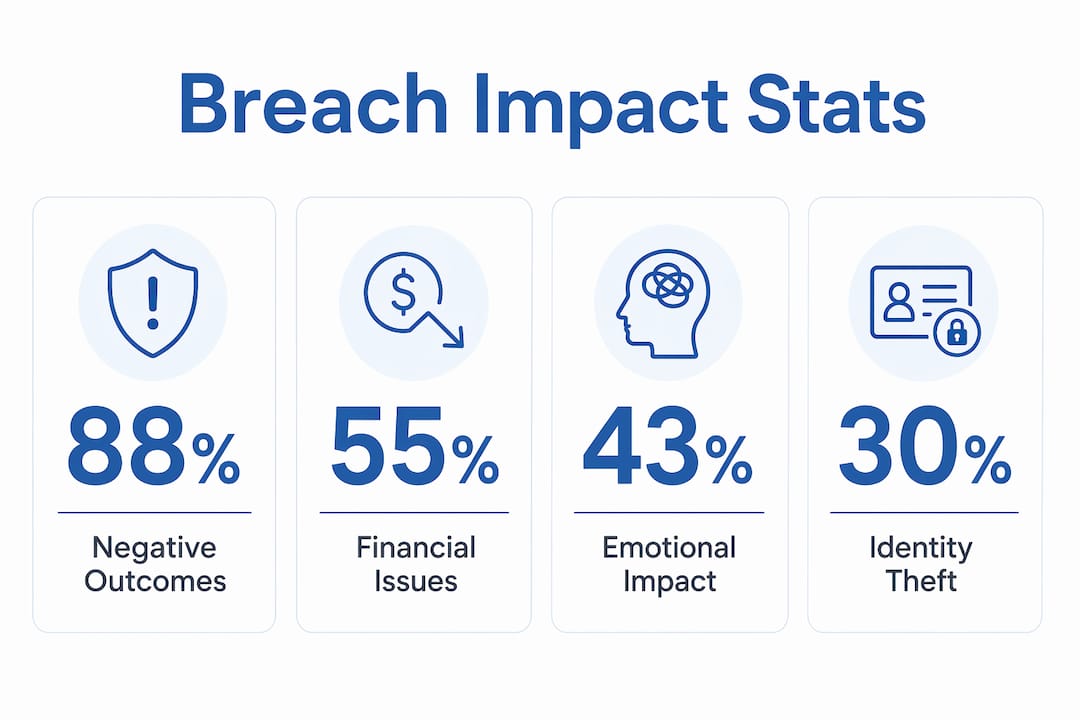
| Consequence Type | Reported Rate |
|---|---|
| At least one negative outcome | 88% of breach victims |
| Increased phishing attempts | 53.7% |
| Increased spam / robocalls | 49.2% |
| Attempted account takeover | 40.3% |
| Ongoing financial consequences | 55% of victims with financial harm |
The psychological dimension is real and often overlooked. A study of 552 breach victims found measurable emotional and health harms extending well beyond financial fraud. ITRC analysis noted that some victims experienced suicidal ideation, yet only a minority sought emotional support. If you’re struggling, reaching out to a counselor or the ITRC’s victim assistance line is a legitimate and important step.
What should you actually do? Match your response to the data exposed
The most common mistake after a breach is taking the wrong protective action. A credit freeze won’t stop credential stuffing. Rotating passwords won’t prevent new-account fraud if your SSN is already circulating. Matching defensive steps to the type of data exposed is the core principle here.
If your SSN or full PII was exposed
- Freeze your credit at all three bureaus: Equifax, Experian, and TransUnion. It’s free and blocks new accounts from being opened.
- Place a fraud alert as a backup layer if you can’t freeze immediately.
- Pull your free credit reports at AnnualCreditReport.com and scan for unfamiliar accounts.
- Check with the IRS by creating an account at IRS.gov and reviewing your filing history for fraudulent returns.
- Contact the Social Security Administration if you suspect SSN misuse for employment or benefits.
- Keep a proof-of-identity file — copies of your ID, a signed statement of the breach, and any dispute correspondence.
If credentials or device access was compromised
- Rotate the exposed password immediately and change it on every site where you reused it.
- End all active sessions on the breached platform.
- Enable MFA on every important account. Passkeys are the strongest option where available. See how MFA works and why it stops most account takeover attempts cold.
- Audit your email account — it’s the recovery key to everything else.
- Use a password manager to generate and store unique credentials for every site going forward.
If health or medical records were exposed
- Contact your health insurer and ask for a list of recent claims.
- Request your medical records from providers and review for procedures you didn’t receive.
- Ask your insurer to place a fraud flag on your account.
- Consider a medical identity monitoring service.
If IDs or passport data was exposed
- Report to the issuing authority (DMV for driver’s license, State Department for passport).
- Consider requesting a replacement document with a new number.
- Monitor for doxxing or impersonation attempts online.
Expert guidance from the ITRC: “Using the wrong tool leaves gaps.” A credit freeze protects against new-account fraud but does nothing for an attacker who already has your login. Align every action to the specific data that was taken.
Your 48-hour checklist:
- [ ] Verify the breach notice is real (check the company’s official site directly)
- [ ] Take the immediate protective step that matches your exposed data type
- [ ] Enroll in any free monitoring the breached company offers
- [ ] Document everything: screenshots, dates, reference numbers
- [ ] Check your identity theft warning signs for early indicators of misuse
Pro Tip: When time is short, prioritize in this order: secure your email account first (it unlocks everything else), then freeze credit if SSN was exposed, then rotate reused passwords. Don’t try to do everything at once.

How can you reduce your identity risk going forward?
Preventing repeat harm means shrinking your attack surface. These are the highest-impact steps, ordered by effort and payoff.
Do these first (quick wins):
- Freeze your credit if you haven’t already. Free at all three bureaus, takes minutes, and blocks new-account fraud completely.
- Enable MFA on email, banking, and social accounts. An authenticator app beats SMS.
- Use a password manager to eliminate reused passwords. Techstacktoday’s reviewed and ranked list covers the top options with real-world testing.
- Remove your data from brokers. The less of your PII that’s publicly aggregated, the harder it is for criminals to build a profile on you. Start with Techstacktoday’s guide on how to remove yourself from the internet.
Longer-term projects:
- Audit which services hold your SSN and minimize unnecessary sharing.
- Set up account alerts on all financial accounts so you catch unauthorized activity within minutes.
- Review your public social media profiles and remove address, phone, and employer details.
Pro Tip: If you only have 20 minutes, spend it on your email account: change the password, enable MFA, and review recovery options. Your email is the single point of failure for every other account.
How long does recovery take, and what does it cost?
Recovery timelines vary widely, but you should plan for months, not days, especially if financial fraud occurred.
| Recovery Milestone | Typical Timeframe |
|---|---|
| Discover and report the fraud | Days to weeks after breach notice |
| Dispute unauthorized accounts or charges | 2 weeks or more per dispute |
| Credit report corrections confirmed | 1–3 months |
| Full credit restoration | 6–24 months (longer if criminal ID theft) |
| Ongoing monitoring period | 1–5 years recommended |
Out-of-pocket costs depend heavily on severity. Credit freezes and fraud alerts are free. Disputing charges through your bank or the FTC’s IdentityTheft.gov costs nothing. Where costs climb is when you need professional recovery services for complex cases: criminal identity theft, IRS fraud, or employment misuse can require legal help, which runs into hundreds or thousands of dollars.
Ways to keep costs down:
- Use IdentityTheft.gov first. It generates a personal recovery plan, pre-fills dispute letters, and tracks your progress at no cost.
- File disputes directly with credit bureaus before paying anyone to do it for you.
- Accept free monitoring services offered by the breached company — they’re a legitimate starting point.
- Escalate to paid professional recovery only when self-help has stalled and financial harm is ongoing.
When should you get professional help, and who do you call?
Most breach responses start with self-help. But some situations call for escalation.
Contact these immediately after a breach:
- The breached company — confirm what was exposed and what they’re offering.
- Your bank or credit card issuer — report any unauthorized transactions and request new account numbers.
- Equifax, Experian, and TransUnion — freeze credit or place fraud alerts.
- FTC at IdentityTheft.gov — file a report and get a personalized recovery plan.
- Local police — file a report if you have documented financial losses or if someone is impersonating you.
- Social Security Administration — if your SSN is being used for employment or benefits fraud.
Escalate to paid help when:
- You’ve filed disputes and the fraud keeps recurring.
- Criminal identity theft has occurred (someone was arrested or cited using your identity).
- IRS or employment misuse is unresolved after 90 days of self-help.
- The financial harm is large enough that legal recovery is worth the cost.
From the FTC: IdentityTheft.gov “can help you report and recover from identity theft… walk you through each recovery step, update your plan as needed, track your progress, and pre-fill forms and letters for you.” Start there before spending money on a recovery service.
For a full identity theft recovery action plan, Techstacktoday’s step-by-step guide covers each phase from initial report through long-term monitoring.
Key Takeaways
A breach raises your identity risk immediately, and the right response depends entirely on what type of data was exposed.
| Point | Details |
|---|---|
| Match response to data type | SSN exposed: freeze credit. Credentials exposed: rotate passwords and enable MFA. Wrong tool = protection gap. |
| Act within 48 hours | Stolen data often reaches illicit markets within days; early action cuts misuse risk significantly. |
| 88% of victims face consequences | ITRC data shows most breach victims experience phishing, spam, or account takeover attempts. |
| Recovery takes months, not days | Credit disputes and full restoration commonly take 6–24 months; document everything from day one. |
| Use free resources first | IdentityTheft.gov and credit bureau freezes cost nothing and cover the most critical recovery steps. |
Pro Tip: Screenshot this checklist and save it somewhere accessible — you’ll want it the moment a breach notice lands in your inbox.
Our take on why this guidance matters
The standard advice after a breach is frustratingly generic: “change your passwords and monitor your credit.” That’s not wrong, but it’s incomplete in a way that leaves real gaps.
The research is clear that the impact of a data breach on your identity isn’t uniform. A credential breach and an SSN breach are fundamentally different threats requiring fundamentally different responses. Treating them the same is like putting a smoke detector in a room that’s flooding. The tool isn’t wrong, it just doesn’t match the problem.
What the ITRC’s 2026 data makes plain is that most victims don’t resolve their harm quickly, and those with financial consequences have the hardest time getting back to baseline. The psychological toll compounds that. Victims who don’t seek support tend to be dealing with more complex, unresolved situations. That’s not a coincidence.
Techstacktoday’s approach to testing identity protection services is built around exactly this principle: does the tool actually address the threat it’s supposed to address? A service that monitors credit but ignores credential exposure isn’t a complete solution. Neither is a VPN that protects your traffic but doesn’t alert you when your email appears in a breach database. The reviews and comparisons on this site are designed to help you match the right tool to your actual risk, not just buy something that sounds reassuring.
The most underrated step in this entire process is reducing your data surface before a breach happens. Removing your information from data brokers, using unique passwords, and freezing credit proactively costs almost nothing and dramatically limits what an attacker can do with whatever they eventually get.
Useful sources and where to go next
These are the primary references used in this article. Each one is worth bookmarking for your own recovery or research.
- IdentityTheft.gov — The FTC’s official recovery portal. Generates a personalized plan, pre-fills dispute letters, and tracks your progress. Start here for any breach response.
- IdentityTheft.gov/databreach — Specific guidance for data breach victims, including step-by-step actions by data type.
- FTC Consumer Advice: What to Know About Identity Theft — Practical recovery steps including credit freezes, fraud alerts, and bureau contacts.
- ITRC 2025 Annual Data Breach Report — Victim impact statistics and breach trend data. Consult for understanding how common your experience is.
- ITRC 2026 Trends in Identity Report — Misuse conversion rates by breach type and guidance on matching defenses to exposure. Essential for understanding which protections actually work.
- Beyond Fraud and Identity Theft (Tandfonline, 2025) — Academic study of 552 breach victims documenting emotional, health, and relationship harms. Consult if you’re experiencing non-financial impacts and need validation or support resources.
- NHIMG: Why Leaked Identity Records Create Risks Beyond Privacy Compliance — Guidance on classifying leaked records by misuse potential rather than data category alone.