Background checks are defined as structured verifications of a candidate’s criminal history, employment record, education, credit, and identity before hiring. The role of background checks in compliance is to protect organizations by meeting federal and state legal requirements, defending against negligent hiring claims, and reducing workplace risk. Laws like the Fair Credit Reporting Act (FCRA) and sector-specific mandates make screening a legal obligation, not just a best practice. About 92% of employers conduct at least one type of background screening in 2026. That near-universal adoption reflects how central verification has become to responsible hiring.
What is the role of background checks in compliance?

Background screening, the industry term for the full verification process, covers multiple data points. Each component ties directly to a specific compliance requirement or risk category. Employment background checks include criminal record screenings, employment and education verification, credit reports, driving records, and drug screenings.
Here is how each element maps to compliance:
- Criminal record screening: Identifies violent or theft-related histories. Required or recommended under workplace safety laws and sector mandates in healthcare, education, and finance.
- Employment and education verification: Confirms that candidates hold the credentials they claim. Prevents resume fraud and protects organizations from liability tied to unqualified hires.
- Credit checks: Relevant for roles with financial authority or access to sensitive accounts. Regulated under FCRA and state credit check laws.
- Driving record checks: Required for positions involving company vehicles or transportation duties under Department of Transportation rules.
- Drug screening: Supports compliance in safety-sensitive industries such as aviation, trucking, and federal contracting.
- Social media and identity verification: Increasingly reviewed for conduct risk. Identity verification is a separate, critical step that precedes all other checks.
The FCRA and Equal Employment Opportunity Commission (EEOC) guidance govern what employers may legally request and how they may use results. The EEOC, for example, prohibits blanket criminal history bans because they can create disparate impact on protected classes. Knowing which checks apply to which roles is the first compliance decision you make.
How do background checks fulfill legal and regulatory obligations?
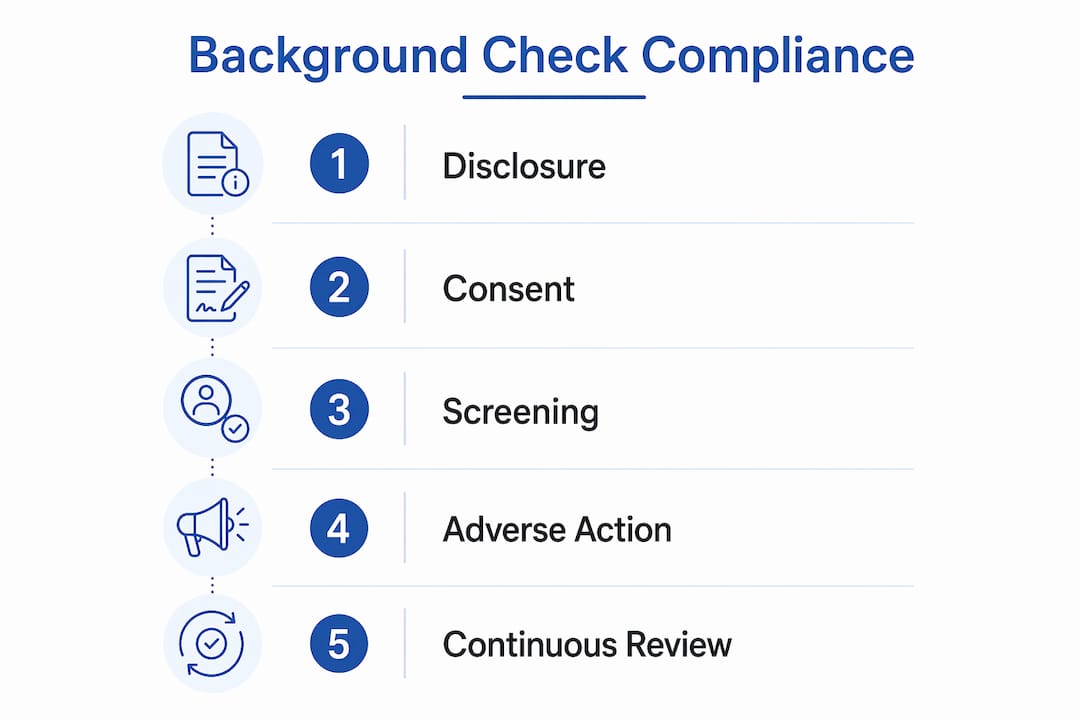
The legal framework for background screening is built primarily around the FCRA, with layers of state and local law on top. FCRA compliance requires employers to follow a specific sequence before, during, and after every check.
- Provide a clear disclosure. Give the candidate a standalone written notice that a background check will be conducted. This document cannot be buried in an employment application.
- Obtain written authorization. Get a signed consent form before ordering any report from a consumer reporting agency (CRA).
- Review results and assess relevance. Evaluate findings against the specific job duties. A blanket rejection based on any criminal record creates EEOC liability.
- Send a pre-adverse action notice. If you plan to reject a candidate based on the report, send them a copy of the report and a summary of their rights first.
- Wait the required period. Give the candidate time to dispute inaccurate information before making a final decision.
- Send a final adverse action notice. Confirm the decision in writing with required disclosures.
Employers remain fully liable under FCRA for all these steps, even when they outsource screening to a CRA. Delegation does not transfer legal responsibility.
Beyond FCRA, Ban the Box and Fair Chance laws in cities like New York, Los Angeles, and Chicago restrict when employers can ask about criminal history. Many states prohibit asking about convictions until after a conditional offer. Healthcare employers must check the Office of Inspector General (OIG) exclusion list. Financial services firms must comply with FINRA background check rules. Transportation companies follow Department of Transportation drug and alcohol testing mandates.
Statutory damages under FCRA reach up to $1,000 per violation, plus punitive damages and class action exposure. A single missed disclosure form across a large hiring cohort can generate millions in liability. Documented audit trails are your primary defense.
Pro Tip: Build your adverse action process as a checklist with timestamps. Regulators and plaintiffs’ attorneys look for proof that each step happened in the correct order and within required timeframes.
What are the most common compliance pitfalls in background screening?
Most compliance failures do not come from ignorance of the law. They come from execution gaps. 56% of organizations report full confidence in their compliance policies, yet 42% experienced at least one compliance error in the past year. That gap between confidence and performance is the real risk.
The leading causes of failure include:
- Missing or incomplete consent forms. Missing authorization documents are the top compliance violation. A candidate who was never asked to sign a consent form can challenge the entire screening process.
- Inconsistent adjudication criteria. Applying different standards to similar candidates across locations or business units creates disparate treatment claims. You need written, role-specific criteria applied uniformly.
- Multi-state complexity. A company hiring in 10 states faces 10 different sets of rules on timing, permissible checks, and adverse action procedures. Manual tracking fails at scale.
- Improper adverse action procedures. Skipping the pre-adverse action notice or shortening the waiting period are frequent errors that trigger FCRA claims.
- Scope creep in screening. Ordering checks that are not relevant to the job role can backfire legally. Negligent hiring defense requires linking check scope directly to job duties.
89% of organizations confirm they send correct authorization documents, yet administrative execution gaps remain the main driver of compliance failures. Awareness of the rules is not the same as executing them correctly every time.
The problem compounds with organizational size. A company with 50 hiring managers across five states has 50 potential points of failure on every single hire. Without a centralized, automated process, errors are inevitable.
What are the best practices for a compliant background check program?
Compliance does not happen by accident. It requires treating background screening as a documented, repeatable process rather than a one-off administrative task. Here is what that looks like in practice.
Define role-based screening packages
Not every role needs every check. A warehouse associate does not need a credit check. A CFO does. Map your screening scope to job duties and document that mapping. This protects you under both FCRA and EEOC standards, and it prevents the scope creep that creates legal exposure.
Verify identity before screening
Identity verification before background checks reduces the risk of false identities, prevents invalid reports, and keeps you compliant under FCRA. Run identity verification as a separate, mandatory first step. A report run on the wrong person is a compliance failure regardless of what it contains.
Automate multi-jurisdictional compliance
The compliance rules for background checks change frequently. Ban the Box laws expand. State credit check restrictions tighten. Doing this manually across multiple states is a full-time job. Compliance workflow platforms automatically apply the correct rules based on the candidate’s work location, flag required waiting periods, and generate compliant disclosure and consent documents.
| Screening approach | Compliance strength | Risk level |
|---|---|---|
| Manual, paper-based process | Low: prone to missing forms and inconsistent steps | High |
| Standardized digital workflow, single state | Medium: consistent but limited jurisdictional coverage | Medium |
| Automated platform, multi-jurisdictional | High: rules update automatically, audit trail built in | Low |
Build continuous screening into your program
One-time pre-hire checks miss post-hire risk. Employees in regulated industries, such as healthcare and finance, should be subject to recurring checks against exclusion lists and criminal databases. Continuous screening programs catch disqualifying events that occur after the hire date.
Pro Tip: Run a compliance audit on your background check program at least once per year. Pull a sample of recent files and verify that every required document is present, dated, and in the correct order. This is exactly what a regulator or plaintiff’s attorney will do.
You can find a detailed breakdown of background check service options reviewed and ranked by Techstacktoday to help you choose a platform that fits your compliance requirements.
Key Takeaways
Background check compliance requires documented processes, role-relevant screening scope, and consistent adverse action procedures to protect organizations from FCRA liability and negligent hiring claims.
| Point | Details |
|---|---|
| FCRA governs every step | Disclosure, consent, and adverse action procedures are legally required before and after every check. |
| Execution gaps cause most failures | 42% of organizations had a compliance error last year, mostly from missing forms, not missing policies. |
| Role-based scope is non-negotiable | Linking check types to specific job duties protects against both EEOC disparate impact claims and negligent hiring suits. |
| Automation reduces multi-state risk | Compliance platforms apply jurisdiction-specific rules automatically, cutting manual error across locations. |
| Identity verification comes first | Verifying a candidate’s identity before screening prevents invalid reports and FCRA violations. |
The compliance checkbox is the wrong mental model
Here is what I have observed after reviewing dozens of background check programs: most HR teams treat screening as a box to check before onboarding, not as a risk management system that runs throughout the employment relationship.
That framing creates blind spots. When you think of a background check as a one-time task, you stop asking whether your adjudication criteria are consistent, whether your adverse action notices are going out on time, or whether a new state law changed your disclosure requirements last quarter. The compliance landscape is growing more complex with multi-state regulations and evolving AI risks. HR leaders who treat screening as a living program, not a form to file, are the ones who avoid the expensive surprises.
There is also a fairness dimension that gets underweighted. Individualized assessment, the EEOC-recommended practice of evaluating criminal history in context rather than applying blanket bans, is both the ethical and the legally safer approach. It takes more time. It is worth it.
The organizations that do this well share one trait: they have embedded background screening into their broader hiring and compliance governance structure. It is not owned by a single recruiter. It has documented owners, audit schedules, and escalation paths. That is the standard worth building toward.
— TechStackTeam
How Techstacktoday helps you stay on top of hiring compliance
Background check compliance touches data privacy, identity verification, and digital security at every step. Techstacktoday reviews and ranks the tools that HR teams and compliance officers rely on to protect candidate data and manage secure hiring workflows.
When candidate personal data moves through screening platforms, the risk of exposure is real. Techstacktoday’s tested reviews of data removal services and privacy tools give you a clear picture of which solutions actually protect sensitive information. You can also explore Techstacktoday’s full guide on running background checks legally to build a compliant, documented process your team can follow every time.
FAQ
What is the role of background checks in compliance?
Background checks fulfill compliance by verifying candidate information against legal requirements, including FCRA disclosure and consent rules, EEOC guidance, and sector-specific mandates. They also create the documented record organizations need to defend against negligent hiring claims.
What does FCRA require from employers during background screening?
FCRA requires employers to provide a standalone disclosure, obtain written authorization, and follow a two-step adverse action process before rejecting a candidate based on a background report. Employers remain liable for these steps even when using a third-party screening provider.
What are the most common background check compliance violations?
Missing or incomplete consent and disclosure forms are the leading cause of compliance violations. 42% of organizations reported at least one compliance error in the past year despite high policy confidence.
How do Ban the Box laws affect background screening?
Ban the Box and Fair Chance laws restrict when employers can ask about criminal history, typically prohibiting the question until after a conditional job offer. Requirements vary by city and state, making automated compliance workflows necessary for multi-location employers.
Why should background checks be role-specific rather than uniform?
Applying the same checks to every role creates EEOC disparate impact risk and can undermine a negligent hiring defense. Linking each check type to specific job duties is both the legally required and the practically sound approach.