TruthFinder is a legitimate people-search business, not a scam, but it is not a certified background-check service. It disclaims Fair Credit Reporting Act (FCRA) compliance outright, which means you cannot legally use it for employment, tenant, credit, or insurance decisions. Reports can contain outdated or mismatched records. Verify anything critical through a primary source before you act on it.
TL;DR:
- TruthFinder offers legally permissible people-search services but disclaims FCRA compliance, limiting its use for employment or housing decisions.
- Its data accuracy depends on aggregation from multiple sources, leading to common errors like mismatches, outdated records, and incomplete incident details.
- Verifying critical information via official county or government records is essential before acting on any report from TruthFinder.
- The subscription model often results in recurring charges, with many complaints about billing issues and difficulty canceling memberships.
- For legally binding background checks, using a certified FCRA-compliant service is necessary, as TruthFinder’s reports are not reliable for formal decision-making.
Table of Contents
- Is TruthFinder Legit for Background Checks?
- How Accurate Is TruthFinder, and How Do You Verify It?
- Is TruthFinder Legal, and What Did the FTC Find?
- What Privacy and Billing Risks Come With TruthFinder?
- When Should You Avoid TruthFinder, and What’s Safer?
- How We Validated TruthFinder’s Track Record
- Should You Trust TruthFinder? Our Take
- Protect What TruthFinder Exposes
- Sources
- FAQ
Is TruthFinder Legit for Background Checks?
Yes, with a real caveat. TruthFinder pulls together public records, court filings, and third-party data broker files into a single searchable report, and that basic function is legal and widely used across the people-search industry. The company itself acknowledges that the reports it generates may be incomplete or out-of-date, which is a meaningful admission for a service people sometimes treat as authoritative.
Here’s what actually happens behind the scenes when you run a search:
- TruthFinder aggregates data from county clerks, state licensing boards, court dockets, and commercial data brokers.
- None of that raw data gets independently verified by a human researcher before it lands in your report.
- Identity matching relies on algorithms tying names, addresses, and birth dates together, which is exactly where errors creep in when two people share a common name.
- Access runs on a subscription model. You cannot buy one isolated report; you pay a recurring monthly fee for ongoing access instead.
That subscription structure matters more than it first appears. A person running a single curiosity search ends up locked into a recurring charge, which is one of the biggest sources of the billing complaints covered later in this article. TruthFinder is honest about being a data aggregator. It is far less upfront about what that aggregation model costs you in accuracy and in your wallet.
How Accurate Is TruthFinder, and How Do You Verify It?
Accuracy is the real weak point, and it is a structural one, not a bug the company can easily patch. Public records live in thousands of separate county and state systems, each with different release schedules, redaction rules, and digitization timelines. TruthFinder’s own review from a competing background-check provider warns that treating this kind of aggregated report like a professional background check invites serious consequences, precisely because no single data feed updates on the same clock.
Three error patterns show up constantly in people-search reports like these:
- Wrong-person matches. Common names, shared addresses, and family members with similar identifiers get merged into one profile.
- Stale records. An old eviction, dismissed charge, or resolved lien can surface years after it stopped being relevant.
- Minor incidents inflated by omission. A report might list an arrest without noting the case was dropped, because dismissal records update slower than arrest records in most county systems.
Before you rely on anything in a TruthFinder report, run it through a quick verification pass: pull the actual case number and search it on the relevant county clerk’s public docket portal, cross-check the address against a second source, and confirm dates against an official record where one exists.
Pro Tip: Most county court websites let you search criminal and civil dockets by name for free. Before paying for a deeper background check anywhere, spend ten minutes on the clerk’s site for the county where the person actually lives or lived. It catches a surprising share of the mismatches.
Is TruthFinder Legal, and What Did the FTC Find?
TruthFinder is legal to operate, but it is explicitly not built for the decisions people most often want a background check for. The company states plainly that it is not a consumer reporting agency under the FCRA, and it disclaims use of its reports for employment screening, tenant applications, credit decisions, or insurance underwriting.
That distinction became a federal matter. In September 2023, the FTC announced an enforcement action against TruthFinder and a related company, Instant Checkmate, alleging both misrepresented the accuracy of their background reports and violated the FCRA. The companies settled through a stipulated order that included civil penalties and required changes to how they represent report accuracy to consumers.
The FTC’s action targeted deceptive accuracy claims and unauthorized FCRA-regulated use, not the underlying practice of aggregating public records.
Here is what that non-FCRA status forbids in practice:
- Using a TruthFinder report to reject a job applicant, screen a rental application, or set loan or insurance terms.
- Relying on it as your sole basis for any decision covered by federal consumer protection law.
- Assuming the company carries the same accuracy obligations a certified consumer reporting agency does.
If you need a check that will hold up for hiring or housing decisions, you need a provider built for FCRA compliance from the ground up. Techstacktoday’s guide to background check services reviewed and ranked breaks down which categories of providers meet that bar.
What Privacy and Billing Risks Come With TruthFinder?
TruthFinder does not notify the person being searched, and that silent-lookup design is standard across the people-search industry, but it still surprises people who assume there is some kind of alert system. Anyone can search your name, address history, relatives, and available public records without you ever knowing, which is the core privacy tradeoff of having a public profile on any of these sites, making managing your digital footprint essential to protect your visibility and reputation.

Billing generates the loudest consumer complaints. The BBB profile for TruthFinder lists recurring themes: difficulty canceling, charges continuing after a cancellation attempt, and disputes over what a “free” preview actually includes before the paywall hits. Pricing runs on a subscription-only model with no option to buy a single report outright, which is exactly the structure that produces surprise renewal charges.
If you already have a billing problem, move through these steps in order:
- Log into your TruthFinder account and cancel through the account settings page directly, then screenshot the confirmation.
- Check your card statement for the exact billing descriptor and date of the charge you are disputing.
- Contact TruthFinder support in writing to request a refund and get a written cancellation confirmation.
- If support doesn’t resolve it, dispute the charge with your card issuer and file a complaint with the FTC.
Repeated searches on yourself or others also build a profile of search behavior over time, which is worth remembering if you’re using the service frequently.
When Should You Avoid TruthFinder, and What’s Safer?
TruthFinder is reasonable for informal, personal curiosity: reconnecting with a lost relative, doing a light gut-check before a first date, or confirming an old address. It is the wrong tool the moment a decision has legal weight.
Skip it entirely for:
- Screening a job candidate.
- Approving or denying a rental application.
- Any decision where the FCRA requires a certified consumer report.
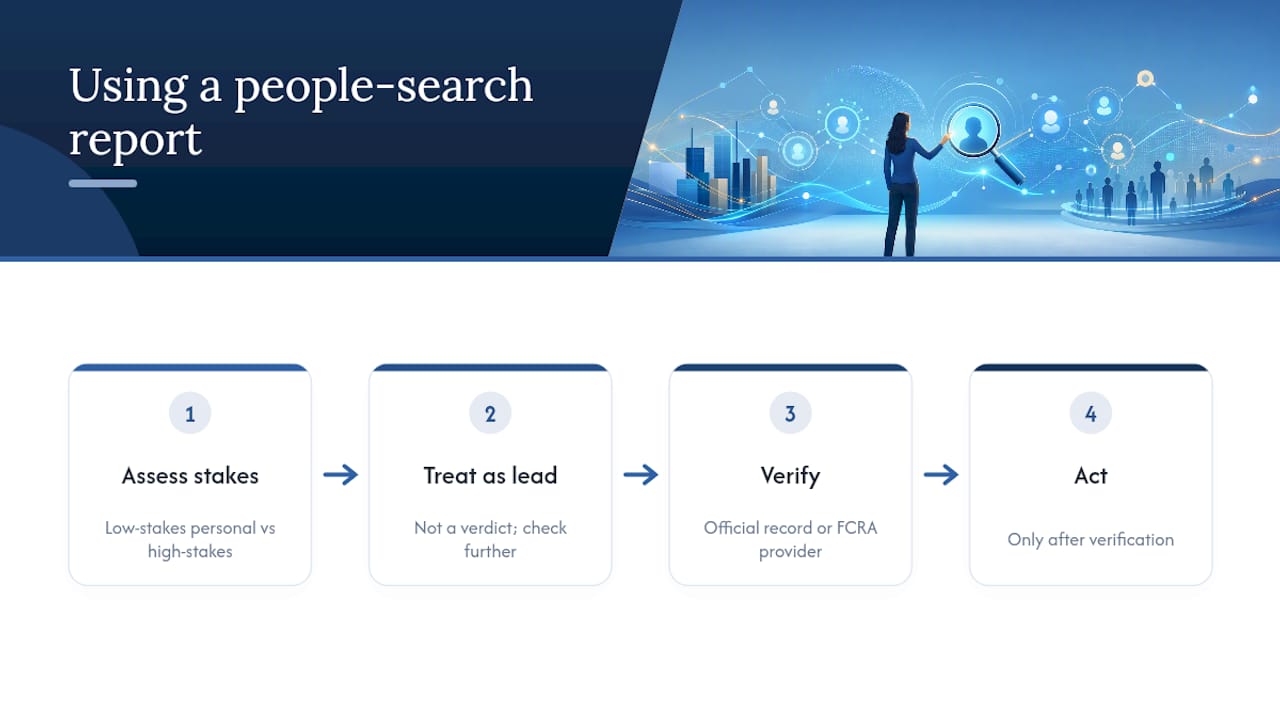
Before acting on anything you find, run it through a short mental checklist: What’s the purpose of this search? Where did this specific fact originate? How recent is it? Can I confirm it through an independent, official source? If you can’t answer all four, don’t act on the information yet.
For anything regulated, use an FCRA-compliant consumer reporting agency or go straight to the official government record source, whether that’s a county clerk’s docket search or a state licensing board lookup.
How We Validated TruthFinder’s Track Record
Privacy and identity tools are tested using real accounts, real cancellation attempts, and a close read of receipts and account pages that show up after signup, not just the marketing pages. That is how billing patterns like recurring charges after a cancellation click get documented instead of just rumored.
If you decide to remove your own listing from a people-search database rather than just monitor it, the process generally runs in a few steps:
- Locate your specific profile URL on the site.
- Submit the opt-out request through the site’s designated removal form.
- Confirm removal and recheck periodically, since new records can repopulate your listing.
Our TruePeopleSearch opt-out guide walks through the same mechanics for one of the largest data brokers in this space.
Pro Tip: Keep every cancellation confirmation email and screenshot for at least 90 days. If a disputed charge later needs a chargeback, your bank will ask for exactly that paper trail.
Should You Trust TruthFinder? Our Take
TruthFinder makes sense for exactly one category of user: someone running a low-stakes, personal, informational search where being wrong costs nothing more than mild embarrassment. It does not make sense the second a decision touches someone’s job, housing, credit, or insurance.
The FTC’s action didn’t ban the business model. It punished the accuracy claims layered on top of it. That’s the real lesson here: treat every report as a lead worth checking, never as a verdict. If you need something that holds up legally, use a certified FCRA-compliant provider or go straight to the official record. Verify first. Act second.
Protect What TruthFinder Exposes
TruthFinder’s business depends on your information being scattered across public and broker databases in the first place, and that same exposure is what Techstacktoday’s data-removal and privacy tool reviews are built to address. These services are tested with real accounts and real removal requests, then ranked on what actually gets taken down, not what the marketing page promises.

If a people-search result on TruthFinder or a similar site is following you around and you’d rather it disappear than keep disputing it, our guide on removing yourself from the internet walks through the removal process step by step, including which categories of listings actually come down and which tend to resurface. Start there, and see the current data-removal deals we’ve verified through hands-on testing.
This article is general information, not a substitute for advice from a qualified lawyer. Consult a qualified legal professional about your own circumstances before acting on anything here.
Sources
- FTC: Truthfinder and Instant Checkmate deceived users about background-report accuracy, violated FCRA
- TruthFinder review: the real risks of using people-search sites
- Truthfinder | BBB Business Profile | Better Business Bureau
FAQ
How Safe Is It to Use TruthFinder?
Running a search on TruthFinder is generally safe from a technical standpoint, but the reports themselves can contain outdated or mismatched information you should never treat as final. The bigger safety concern is billing: read the subscription terms carefully before entering payment details, since the BBB has logged multiple complaints about charges continuing after cancellation.
Is TruthFinder Actually Free?
No. TruthFinder operates on a paid subscription model with no free full-report option, and any “free” preview typically shows only limited teaser information before requiring payment. Independent guides confirm pricing runs on recurring monthly access rather than a one-time report purchase.
What Is the Most Trusted Background Check Site?
There is no single site that fits every situation, since the right choice depends on whether you need an informal personal search or an FCRA-compliant report for hiring or housing decisions. Techstacktoday’s ranked comparison of background check services separates providers by which use case they actually qualify for.
Can People Tell if You Looked Them Up on TruthFinder?
No. TruthFinder does not notify anyone that their name or profile has been searched, and the person you look up will not receive an alert or record of your search. That silent-lookup design is standard for people-search sites, not unique to TruthFinder.