Background check categories are specialized groups of screening components that serve distinct purposes, from verifying a job candidate’s identity to confirming a tenant’s rental history. Understanding the main check types helps you order exactly what you need and nothing more. Platforms like Checkr and HireRight build their packages around these categories, and knowing the difference between them saves you time, money, and legal risk. This guide covers the full background check categories list, from common employment checks to specialized screens like NICS gun purchase checks.
What are the main examples of background check categories?
Background check categories are generally classified by purpose: employment, tenant screening, and specialized checks. Each category pulls from different databases and follows different legal rules. The right category depends entirely on what decision you are trying to make.
Employment screening is the most common use case. Tenant screening is the second most common. Specialized checks, such as gun purchase verification or volunteer screening, serve narrower but equally important purposes.

1. Identity verification
Identity verification is the foundation of every background check. It uses a Social Security Number (SSN) trace to confirm that a person is who they claim to be. Without this step, every other check in the package is unreliable.
An SSN trace pulls address history, aliases, and date of birth from credit bureau records. It flags mismatches that could indicate fraud or identity theft. Platforms like Checkr run this automatically before any other component executes.
2. Criminal history checks
Criminal history checks search county, state, and federal databases for convictions, pending charges, and sex offender registry listings. The scope of the search determines how thorough the result is. A county-only search misses records filed in other jurisdictions.
A multi-state criminal search covers a broader geographic area and is standard in comprehensive screening packages. Federal criminal checks add another layer by searching U.S. District Court records. Most employers run at least a county and multi-state combination.
3. Employment verification
Employment verification confirms job titles, dates of employment, and sometimes reasons for leaving. Resume fraud detection is the primary reason employers run this check. Fabricated employers and exaggerated titles are the two most common lies uncovered.
84% of employers uncovered resume lies in 2023. That number shows how common misrepresentation is, even among candidates who appear credible on paper. Employment verification is non-negotiable for any role with significant responsibility.
4. Education verification
Education verification confirms degrees, certifications, and the institutions that issued them. Candidates frequently inflate credentials, especially for roles that require specific academic qualifications. A claimed MBA from a real university is easy to fabricate without verification.
This check contacts institutions directly or uses third-party databases like the National Student Clearinghouse. It is standard in comprehensive packages and critical for licensed professions such as medicine, law, and engineering.
Pro Tip: If you are hiring for a role that requires a professional license, run both education verification and professional license verification together. A degree alone does not confirm active licensure.
5. Credit history checks
Credit checks review a candidate’s credit report, including debt levels, payment history, bankruptcies, and collections. Credit checks are legal only on roles with direct financial responsibility. Running them on unrelated roles risks violating EEOC guidance.
Roles that justify a credit check include CFOs, controllers, bank tellers, and anyone with access to company funds. Applying credit checks broadly across all hires is one of the most common compliance mistakes employers make. Scope this check tightly to the role.
6. Motor vehicle records (MVR)
Motor vehicle records checks pull a candidate’s driving history, including license status, violations, DUIs, and suspensions. This check is required for any role that involves operating a vehicle. Delivery drivers, field technicians, and transportation workers all fall into this category.
DOT compliance requires special checks for transportation roles, including MVR reviews and drug screening. Skipping an MVR for a driving role creates direct liability for the employer. Run it every time a role involves a company or personal vehicle.
7. Drug screening
Drug screening tests for controlled substances and is separate from a standard background check, though it is often bundled into comprehensive packages. Safety-sensitive industries like construction, healthcare, and transportation require it most. A positive result can disqualify a candidate depending on the role and state law.
Testing methods include urine, hair, saliva, and blood panels. Urine testing is the most common and the least expensive. Some states restrict which substances employers can test for, so check local law before ordering.
8. Professional license verification
Professional license verification confirms that a candidate holds a current, active license in their claimed field. Expired or revoked licenses are a real risk in healthcare, finance, and legal services. A nurse with a revoked license is a liability no employer wants to discover after hiring.
This check queries state licensing boards and national databases. It is fast, typically returning results within one business day. Pair it with education verification for any regulated profession.
9. Tenant screening categories
Tenant screening focuses on financial reliability and safety rather than employment history. Tenant checks prioritize credit score, eviction records, rental payment history, and criminal background. The goal is to assess whether a person will pay rent on time and respect the property.
Key components of a tenant background check include:
- Credit score and credit history: Assesses debt load, payment patterns, and financial stability
- Eviction history: Searches a seven-year lookback period for prior eviction filings
- Rental payment history: Confirms on-time payments through landlord references or reporting services
- Income verification: Confirms the applicant earns enough to cover rent, typically 2.5x to 3x monthly rent
- Criminal background search: Flags convictions relevant to tenant safety
- Sex offender registry check: Required by many property managers for community safety
- Identity verification: Confirms the applicant is who they claim to be
Apartment checks differ from employment checks in the databases they prioritize. Eviction databases and rental payment histories are specific to tenant screening and do not appear in standard employment packages.
10. Specialized background check categories
Specialized checks go beyond employment and tenant screening. They serve specific legal, regulatory, or safety purposes that standard packages do not cover.
- Gun purchase checks (NICS): The FBI’s National Instant Criminal Background Check System searches for federal disqualifiers including felony convictions, restraining orders, and mental health commitments. NICS does not include credit or employment data.
- Volunteer screening: Focuses on criminal history and sex offender registry checks for organizations working with children or vulnerable adults. Nonprofits like the Boy Scouts of America and youth sports leagues use these checks as a baseline requirement.
- Business partner due diligence: Includes civil court searches, asset checks, and litigation history. This category protects companies from entering contracts with financially unstable or legally compromised partners.
- Security clearance checks: Used by government contractors and federal agencies. These go far deeper than standard employment checks, including financial history, foreign contacts, and personal interviews.
- Social media screening: An emerging component that reviews publicly available online behavior. Relevance varies by industry and role, and it is not included in most standard packages.
Pro Tip: For volunteer roles involving minors, always run a sex offender registry check as a standalone component, even if the organization uses a basic screening package. It is fast, inexpensive, and non-negotiable for child safety.
11. How to compare and choose the right background check categories
Choosing the right checks means matching the category to the risk level of the role or decision. Screening packages are modular, which means you can customize them by role type, industry, and compliance requirements.
Background check turnaround times vary significantly by package depth. Basic packages return in 1–2 days. Standard packages take 2–4 days. Comprehensive packages take 3–7 business days.
| Category | Primary use | Key components | Typical turnaround |
|---|---|---|---|
| Employment (basic) | Low-risk roles | Identity, county criminal | 1–2 days |
| Employment (standard) | Mid-level roles | Criminal, employment, education | 2–4 days |
| Employment (comprehensive) | Senior or financial roles | Credit, drug, MVR, license | 3–7 days |
| Tenant screening | Rental decisions | Credit, eviction, criminal | 1–3 days |
| Volunteer screening | Nonprofits, youth orgs | Criminal, sex offender registry | 1–2 days |
| Specialized (NICS) | Gun purchases | FBI federal disqualifiers only | Minutes |
| Business due diligence | Partnerships, contracts | Civil court, assets, litigation | 3–5 days |
All background checks require written consent and must comply with the Fair Credit Reporting Act (FCRA). Skipping consent is a federal violation, not just a policy gap. Always get written authorization before ordering any check.
Key takeaways
The most effective background check strategy matches each category precisely to the role’s risk level, legal requirements, and decision context.
| Point | Details |
|---|---|
| Categories serve distinct purposes | Employment, tenant, and specialized checks pull from different databases and follow different legal rules. |
| Scope checks to the role | Credit checks are only legal for roles with direct financial responsibility; overbroad use risks EEOC violations. |
| Packages are modular | Basic, standard, and comprehensive packages differ in depth, components, and turnaround time. |
| Tenant checks differ from employment | Eviction history and rental payment records are unique to tenant screening and absent from employment packages. |
| Consent is mandatory | FCRA requires written authorization before any background check is ordered, regardless of category. |
The uncomfortable truth about background check misuse
The biggest mistake I see is not skipping checks. It is running the wrong checks for the wrong reasons.
Credit checks on warehouse workers. Criminal searches with no geographic scope. Education verification on roles that never required a degree. These are not just inefficiencies. They are legal liabilities. The EEOC has been clear: indiscriminate credit checks on non-financial roles create discrimination risk, full stop.
The modular approach exists for a reason. A delivery driver needs an MVR and a drug screen. A CFO needs a credit check and a comprehensive criminal search. A youth soccer coach needs a sex offender registry check above everything else. Matching the check to the role is not just good practice. It is the only defensible approach.
Turnaround time matters more than most people admit. A comprehensive package that takes seven days can stall a hiring decision by two weeks when you factor in candidate scheduling and consent processing. Know your timeline before you order.
The background check data broker ecosystem also deserves attention. Some data sources are outdated or inaccurate. Candidates have the right to dispute errors under the FCRA, and employers have the obligation to follow adverse action procedures before rejecting someone based on a report. Most compliance failures happen at this step, not during the check itself.
Run the right check. Scope it correctly. Follow the process. That is the whole framework.
— TechStackTeam
Your privacy matters during the screening process too
Background checks expose sensitive personal data, including Social Security Numbers, financial records, and address histories. That data moves through multiple systems, and protecting it matters on both sides of the process.
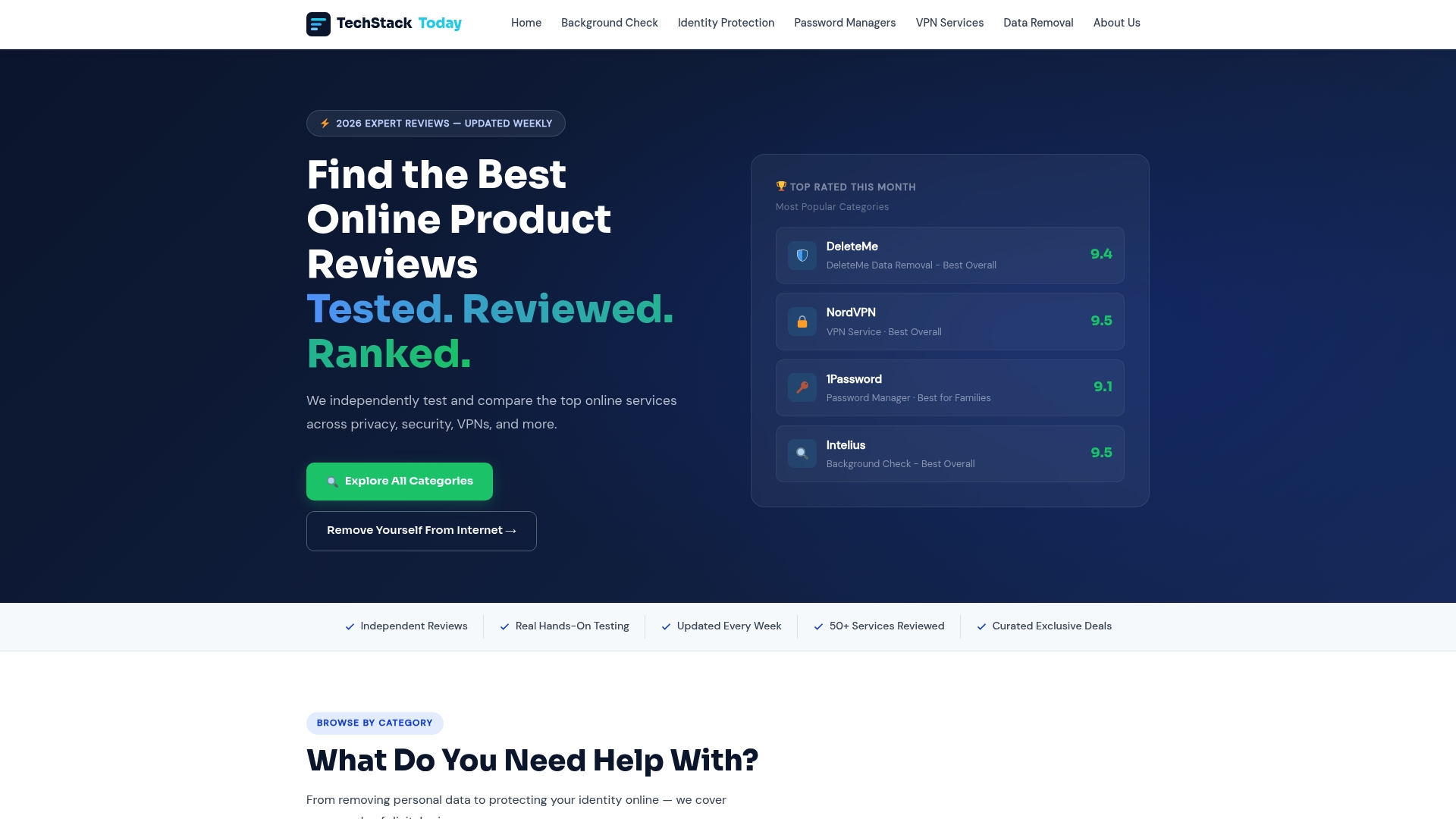
Techstacktoday reviews and ranks privacy tools that help you stay protected while your information is in circulation. Whether you are a job seeker concerned about where your data goes or an employer managing candidate records, a reliable VPN adds a critical layer of protection. Check out Techstacktoday’s ranked VPN services to find a tested option that fits your needs. For a broader look at your digital exposure, the data removal guide covers how to pull your personal information from public databases before it shows up somewhere you did not expect.
FAQ
What are the main types of background checks?
The main types are employment checks, tenant screening checks, and specialized checks such as NICS gun purchase verification or volunteer screening. Each type pulls from different databases and serves a distinct legal purpose.
What is included in a standard employment background check?
A standard employment check typically includes identity verification, a criminal history search, and employment verification. Comprehensive packages add credit reports, drug screening, motor vehicle records, and professional license verification.
How long does a background check take?
Basic packages return results in 1–2 days. Standard packages take 2–4 days. Comprehensive packages with credit, drug, and multi-state criminal searches take 3–7 business days.
Can an employer run a credit check on any job applicant?
No. Credit checks are legally justified only for roles with direct financial responsibility. Applying them broadly to unrelated roles risks violating EEOC guidance and creating discrimination liability.
How does tenant screening differ from employment screening?
Tenant screening prioritizes credit score, eviction history, and rental payment records. Employment screening focuses on criminal history, resume verification, and professional credentials. The two categories use different databases and follow different legal frameworks.