Yes, in most cases it does. A misdemeanor conviction is part of your official criminal history, so it will usually appear on a criminal background check unless a court has sealed or expunged it. Don’t panic, though. Showing up is not the same as being disqualified, and you have more control than you think. ⏱️ Reading time: about 10 minutes.
TL;DR
- ✅ Misdemeanor convictions generally appear on criminal background checks and have no automatic expiration date.
- ⚠️ Pending charges and arrests without a final outcome can show up too, and that can slow down a hire or a rental application.
- 🔒 Sealed or expunged records usually should not appear, but background check companies sometimes get this wrong.
- 📝 There is no universal pass or fail. Each employer, landlord or licensing board sets its own standard.
- 🛠️ Request your own report and dispute errors. Do it before someone else runs the check.
Table of Contents
- What a background check actually shows
- Does it show up forever?
- What about pending charges and arrests?
- Will a misdemeanor from another state show up?
- Which misdemeanors cause the most trouble?
- Government jobs and security clearances
- What you have to disclose on an application
- How to check your own record first
- When the report is wrong
- Expunged or sealed: will it still appear?
- Why the same record may appear on people-search sites
- Wrong record, identity theft or account takeover?
- Our perspective: control what you can
- Take your data off the open web
- FAQ
- Sources
What a background check actually shows
A “background check” is not one single thing. Employers, landlords and licensing boards each order different reports, from different sources, covering different time periods. A county court search sees one courthouse. A national database search sees many. A fingerprint check run through the FBI sees what state and local agencies have sent in.
For a misdemeanor, here is what typically appears:
- The charge. The offense name, such as petty theft, simple assault or DUI.
- The court and date. Where the case was filed and when.
- The disposition. The result: convicted, dismissed, acquitted or still pending.
- The sentence. Fines, probation or jail time, depending on the source.
The FBI explains that a disposition is the result of an arrest, whether the person was charged, convicted or acquitted. That one field often decides how a record reads to the person reviewing it.
Want the full picture of how these searches work? Our guide to criminal record screening walks through the sources and the process. For the different report types an employer can order, see types of employee background checks.
Does it show up forever?
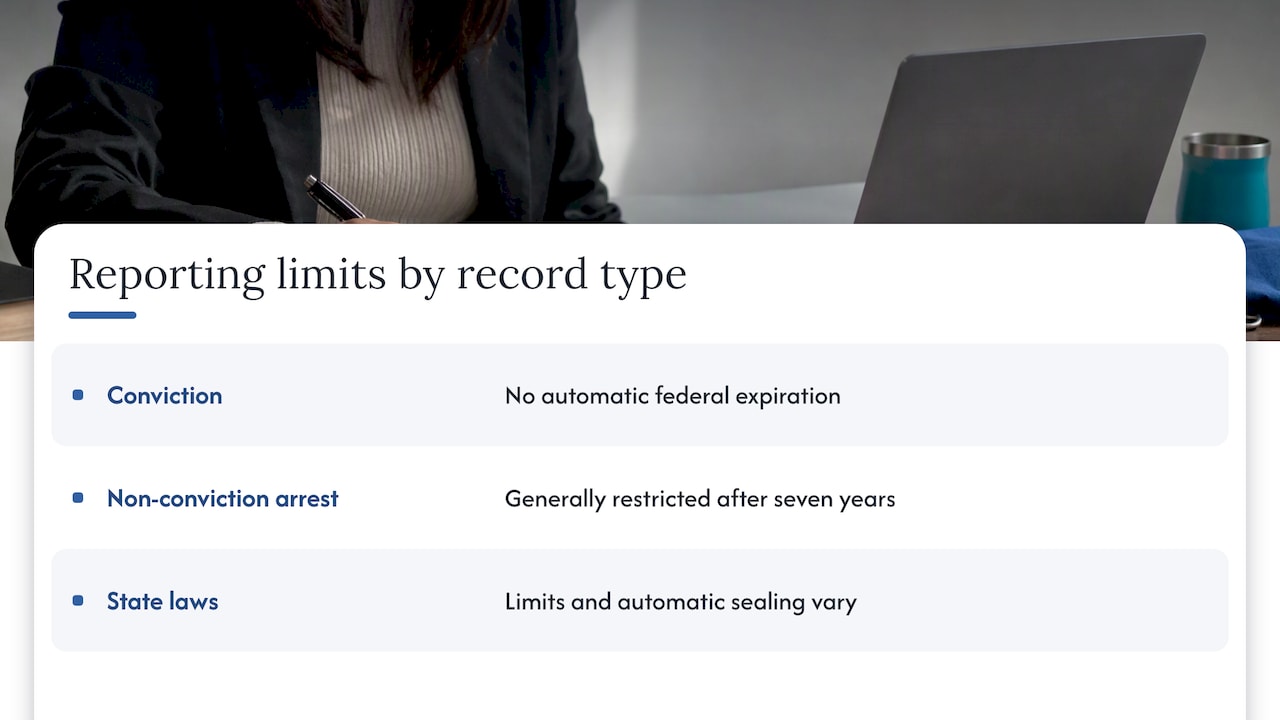
There is no federal time limit on reporting a conviction. Texas State Law Library’s guide notes that convictions have no automatic expiration date, so they typically stay on your record until you take legal action to have them expunged or sealed.
The seven-year rule people talk about is narrower than it sounds. The Fair Credit Reporting Act generally restricts consumer reporting agencies from including arrest records older than seven years if they did not result in a conviction. That is the same source’s summary. It does not say a conviction drops off after seven years.
Some states have their own limits or automatic sealing laws. Rules vary widely, so check your state’s current law or ask a legal aid office. Don’t assume a rule from one state applies in yours.
What about pending charges and arrests?
Pending charges are public court records. If a case is active, a check will often flag it even though there is no conviction yet.
Arrests that ended without a conviction are trickier. The FBI says criminal justice agencies are expected to report final dispositions, usually within 120 days of the court action. When that does not happen, a report can show an arrest with no outcome. A reviewer then sees something that looks unresolved.
If your case was dismissed or you were acquitted:
- Get a certified copy of the disposition from the court clerk. ⏱️ Usually a short visit or a request by mail.
- Confirm the arresting agency and the court both sent the outcome to the state repository.
- Pull your own record and check that the final result is listed.
- Keep your copy of the disposition handy for applications.
A gap in reporting is common, and it can cause unnecessary delays during employment or security clearance checks when the applicant’s record lacks a disposition.
Will a misdemeanor from another state show up?
Often, yes. A check that uses a national database or searches multiple jurisdictions can find an out-of-state conviction. A narrow check that searches only your current county will not. That is why two employers can run “a background check” on you and get different results.
If you have lived in several states, assume a thorough employer will search all of them. Know what each record says before you apply.
Which misdemeanors cause the most trouble?
There is no universal pass or fail. Each employer, landlord or licensing board sets its own criteria, based on the nature of the offense, how recent it was and how it relates to the position or housing. A few patterns hold up:
| Situation | What reviewers usually weigh |
|---|---|
| Offense is unrelated to the job (a minor traffic-related misdemeanor and an office role) | Often less concern, especially if it is old |
| Offense relates to the job (theft and a cash-handling role) | Much more scrutiny |
| Recent conviction | More weight than one from many years ago |
| Pattern of offenses | More weight than a single incident |
| Licensed or regulated field (health care, education, finance) | Licensing board rules may apply |
| Government clearance or suitability | Reviewed under federal guidelines |
BackgroundChecks.com also notes that employers are often more willing to overlook a past misdemeanor than a felony when the candidate is upfront and the offense is not tied to the duties of the job. Treat that as a general tendency, not a promise.
Government jobs and security clearances
Federal background investigations are a different process from a standard pre-employment check. The Office of Personnel Management’s decision-making guide treats criminal conduct, including misdemeanors, as a potential risk to judgment, reliability and trustworthiness. Adjudicators look at the whole person and at patterns, and a single serious offense or a pattern of conduct is evaluated case by case.
Some offenses carry hard bars. A misdemeanor crime of domestic violence, for example, may trigger statutory or regulatory limits on certain types of employment or access. If you are applying for a clearance, list everything the form asks for and be accurate. Do not guess. For specific questions, talk to a criminal defense or employment attorney who handles federal suitability matters.
What you have to disclose on an application
Employers can generally ask about convictions, but state and local rules limit when and how. “Ban the box” laws, for example, restrict when in the hiring process an employer can ask. A Michigan federal court’s employer guide notes that employers there may ask whether an applicant has been convicted of a crime and when, where and what the offense was. It is a Michigan resource, so check your own state’s rules.
Two practical points from the same guide’s framework:
- You are not typically required to disclose sealed or expunged records.
- If the form asks about convictions in a set window, such as the last five years, you generally do not need to list older ones, even if a deep search would find them.
Read every question word by word. Answer only what is asked, and answer it truthfully. A lie on an application can cost you a job offer faster than the misdemeanor itself. The State Bar of Michigan’s employment rights fact sheet is a good example of the kind of plain-language guidance many state bars publish. Look for your state’s equivalent.
How to check your own record first
Don’t wait for an employer or landlord to surprise you. 🛠️ Here is a simple order of operations:
- Get your court records. Start with the clerk of court in each county where you were charged. ⏱️ 15 to 30 minutes per county, depending on the court.
- Request your background screening report. Under the FCRA you can ask the screening company that produced a report about you for a copy. The CFPB has a tool for reviewing your background screening report that explains what to look for.
- Compare line by line. Check names, birth dates, case numbers, charge levels and dispositions.
- Flag problems. Wrong person, wrong charge level, missing dismissal, expunged record still listed.
- Dispute in writing. Keep copies of everything you send.
The FTC says consumers should take an active role by periodically reviewing their own reports and that the dispute process exists for exactly this reason.
When the report is wrong
Background checks make mistakes. Common ones include a misdemeanor labeled as a felony, a record attached to someone with a similar name or birth date, and an expunged case that was never removed. The FTC’s case against a tenant screening company involved failure to follow reasonable procedures to match identifiers in criminal and eviction records. In an earlier action, an employment screening company agreed to pay a $2.6 million penalty for multiple FCRA violations, including not taking reasonable steps to make sure its reports were accurate.
If you find an error, you have a legal right to dispute it with the reporting company. The FTC’s tenant report guidance says the company must take reasonable steps to ensure accuracy, and investigations generally take 30 to 45 days. Send your dispute in writing and attach proof, such as the court’s disposition or expungement order.
We break the process down in 5 steps to dispute background check errors. For the bigger accuracy picture, see our look at background check accuracy.
Expunged or sealed: will it still appear?
It should not. A sealed or expunged record is generally not supposed to be reported or disclosed. In practice, data can linger. Background check companies buy and resell data, and an old copy can survive after a court order.
To see if your record was cleared:
- Ask the court clerk for confirmation that the order was entered.
- Request your state criminal history report if your state offers one.
- Order a screening report on yourself and look for the old case.
- If it appears, dispute it and attach the order.
Expungement eligibility depends on the state, the offense and the time since the case ended. A legal aid organization or a criminal defense attorney in your state can tell you if you qualify.
Why the same record may appear on people-search sites
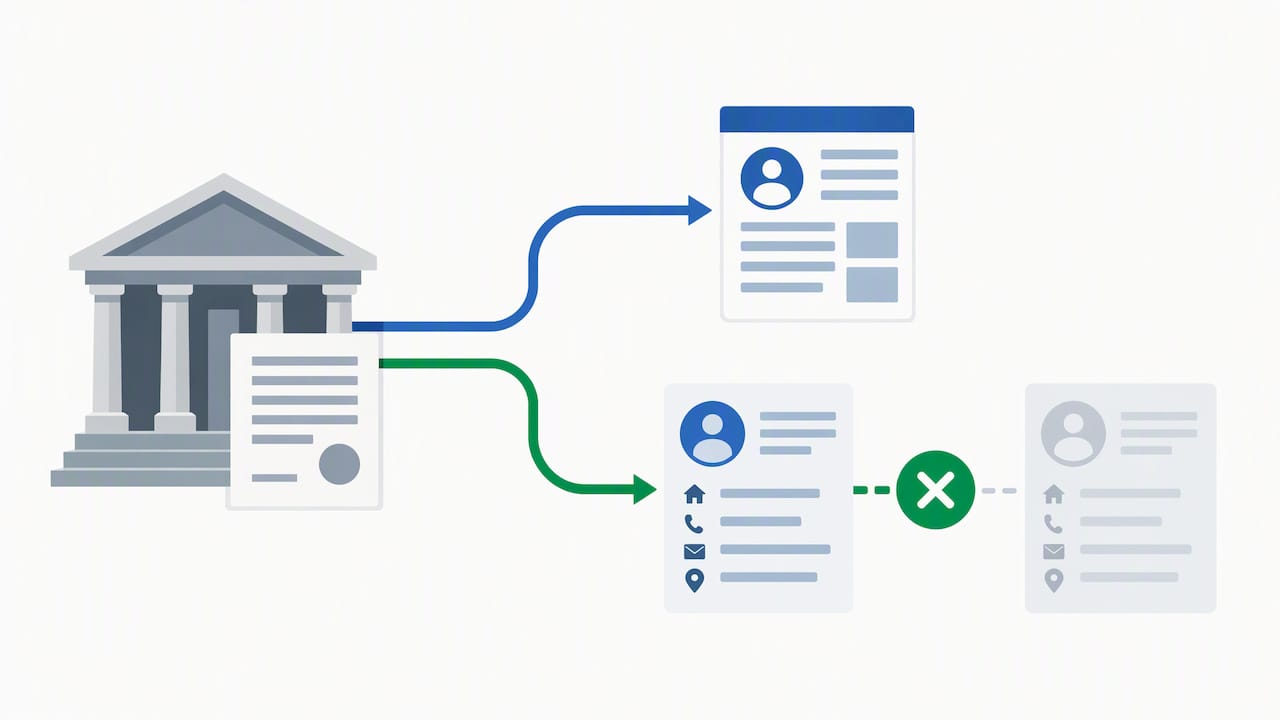
Court records are public. Many people-search sites collect them and display them with your name, address and age. These are not the same as the formal screening reports employers order, and they are not always accurate. They are still easy for a landlord, neighbor or stranger to find.
If you want your information off those sites, see our guide on how to remove yourself from the internet. Removing a listing from a data broker does not erase the court record itself. It only makes it harder to find through casual searching.
Wrong record, identity theft or account takeover?
If a record on your report is not yours at all, it may be a mix-up with someone who has a similar name. It can also be a sign someone used your identity. Identity theft means someone uses your personal information, such as your name or Social Security number, to open accounts or commit fraud. Account takeover is narrower: someone gets into an account you already have, such as a bank, email or shopping login, and uses it as you.
A criminal record you don’t recognize points to the first, or to a records error. If you see one:
- Get the case details from the court.
- Dispute it with the screening company.
- Review your credit reports for accounts you didn’t open.
- Lock down your email and financial logins with unique passwords.
Our identity protection checklist for adults covers the steps in order.
Our perspective: control what you can
We test and rank privacy services hands-on, and we don’t take payment to change rankings. That experience shapes how we see this topic. Most people only learn what their record says when a job or apartment is on the line, and by then the clock is ticking.
Our view is simple. You can’t change a conviction, but you can control the accuracy of what gets reported. Pull your own records first. Fix what is wrong. Know what you have to disclose. Then decide how visible your personal data should be online.
For small business owners and HR teams reading this from the other side, accuracy matters just as much. A wrong match can cost you a good hire and expose you to compliance risk. Our guides on running employee background checks legally and background check compliance requirements cover that side.
— TechStackTeam
Take your data off the open web
A misdemeanor in a court file is one thing. The same record, plus your address, phone number and relatives, sitting on dozens of people-search sites is another. If you want to shrink that exposure, start with our review of whether a data removal service is worth it. We test these services with real accounts, so you can compare what they actually remove and what they don’t.
FAQ
Does a pending misdemeanor show up on a background check?
Often, yes. Pending charges are public court records, so a check that searches the right court can flag them even without a conviction. Some states and some employers treat pending matters differently, so check your local rules.
How long does a misdemeanor stay on a background check?
There is no automatic federal expiration date for a conviction. It usually stays until a court expunges or seals it, or until a state law does so automatically. Non-conviction arrest records older than seven years are generally restricted under the FCRA.
Can you pass a background check with a misdemeanor?
Yes, many people do. There is no universal pass or fail, since each employer or landlord sets its own standard. The type of offense, how recent it was and how it relates to the role usually matter most.
Does a misdemeanor show up on a fingerprint background check?
It can. A fingerprint check reads your FBI Identity History Summary, which relies on arrests and dispositions reported by state and local agencies. If a final outcome was never reported, the arrest may appear without it, so confirm your disposition was sent.
What if my expunged misdemeanor still appears?
Dispute it in writing with the screening company and attach the expungement order. The company must investigate, and the process generally takes 30 to 45 days. If it is not fixed, speak with a consumer rights or criminal defense attorney.
Sources
- Texas State Law Library: Background Checks and Criminal Conviction Restrictions
- FBI: Arrest Dispositions
- FBI: Criminal History Reporting Guide for Tribal Agencies
- OPM: Suitability Decision-Making Guide
- BackgroundChecks.com: Misdemeanors
- U.S. District Court, Western District of Michigan: Employers’ Guide
- State Bar of Michigan: Employment Rights
- CFPB: Review Your Background Screening Report
- FTC: The AppFolio case and the Fair Credit Reporting Act
- FTC: $2.6 Million Penalty for FCRA Violations
- FTC Consumer Advice: Disputing Errors on Your Tenant Background Check Report