If you suspect child identity theft, do these three things right now: call the companies, freeze your child’s credit, and file an FTC Identity Theft Report. Don’t panic. Every minute you act counts, but the steps are clear and manageable.
Here’s your immediate action list:
- 📞 Call the fraud department of any company where a fraudulent account was opened. Ask them to close it and send written confirmation that your child is not liable.
- 🔒 Request a protected-consumer credit freeze with all three bureaus: Equifax, Experian, and TransUnion. Each requires a separate request.
- 📋 File an FTC Identity Theft Report at Identitytheft. This report is your legal tool for disputing accounts and getting companies to act.
- 🗂️ Start a documentation log right now. Write down every call: the date, the company, the rep’s name, and what was said.
- 🔍 Request a manual SSN search at all three credit bureaus to confirm whether a credit file exists in your child’s name.
A sample call script: “My child is a minor and I believe their Social Security number has been used to open a fraudulent account. I need to speak with your fraud department to close this account and receive written confirmation that my child is not liable.”
The full recovery checklist, bureau contact details, and printable templates are all below. Keep reading, or jump to the section you need most.
Key Takeaways
Freezing your child’s credit at all three bureaus, filing an FTC Identity Theft Report at IdentityTheft.gov, and treating your child’s SSN as strictly need-to-know are the three actions that prevent and contain child identity theft most effectively.
| Point | Details |
|---|---|
| Freeze credit proactively | Place a protected-consumer freeze at Equifax, Experian, and TransUnion before fraud occurs; it costs nothing. |
| File the FTC report first | An FTC Identity Theft Report from IdentityTheft.gov gives you legal standing to close fraudulent accounts. |
| Get written confirmation | Every company that closes a fraudulent account must send a letter confirming the child is not liable. |
| Check credit at key ages | Run a manual SSN search at 16, before college enrollment, and before any major credit application. |
| Techstacktoday for ongoing tools | Techstacktoday’s tested reviews of password managers, VPNs, and data removal services support long-term family protection. |
Table of Contents
- What does a child identity protection checklist cover in the first 72 hours?
- How do you check whether your child’s identity is already being used?
- How does a protected-consumer (child) credit freeze work?
- How do you handle tax, medical, school, and other special-case identity problems?
- What are the best everyday practices for protecting your child’s personal information?
- How to use a printable emergency checklist and family response plan
- Why the checklist-first approach to child identity theft matters most
- How Techstacktoday helps you protect your family’s digital identity long-term
- Official resources and forms you will need
- Sources
What does a child identity protection checklist cover in the first 72 hours?
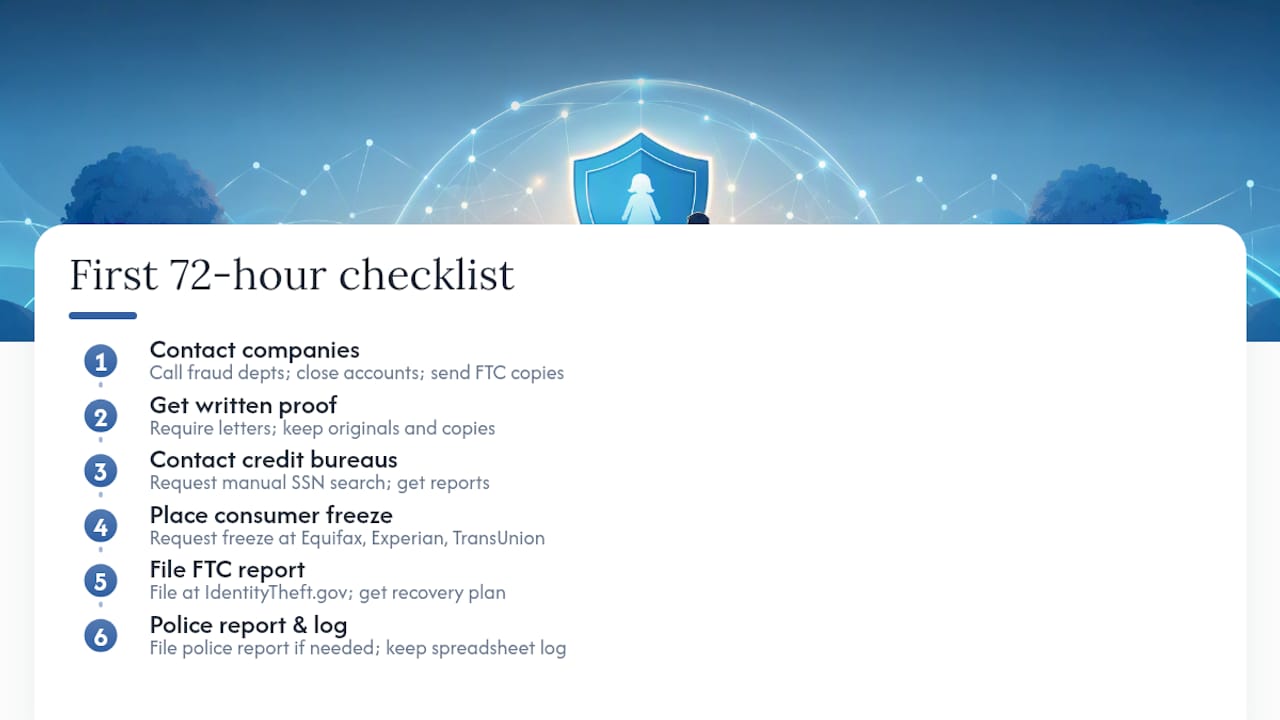
The first 72 hours are the most critical window for limiting damage. Work through these steps in order.
1. Call every affected company’s fraud department. Ask them to close the fraudulent account immediately. Request a written letter confirming the account is closed and that your child bears no liability. Send them a copy of your child’s FTC Identity Theft Report along with proof of your child’s identity and your own.
2. Get everything in writing. Verbal confirmations disappear. Every company you contact must send you a letter. Keep originals; make copies.
3. Contact all three credit bureaus. Request a manual SSN search at Equifax, Experian, and TransUnion. If a credit file exists, ask for a copy of the report. Review every account listed.
4. Place a protected-consumer freeze. Even if no file exists yet, request a freeze at each bureau. A bureau can create a file solely to apply the freeze. Full instructions are in the freeze section below.
5. File your FTC Identity Theft Report. Go to IdentityTheft.gov. The report generates a recovery plan and gives you legal standing to dispute fraudulent accounts. You can also report broader fraud at Reportfraud.
6. File a police report if needed. If the theft involved a known person or if a company requires it, file a local police report. Bring your FTC report and all documentation.
7. Build your documentation log. Create a simple spreadsheet or notebook with these columns: Date, Company/Agency, Contact Name, Phone Number, What Was Discussed, Follow-Up Required, and Date Resolved.
Pro Tip: When contacting debt collectors about a fraudulent account in your child’s name, send your dispute letter via certified mail with return receipt. This creates a paper trail and legally requires them to stop collection activity while they investigate.
For a deeper look at why child identity theft often goes undetected for years, see Techstacktoday’s guide on why child identity theft is underreported.
How do you check whether your child’s identity is already being used?
Children generally should not have credit reports. If a file exists in your child’s name, treat it as a red flag for identity theft.
Red flags to watch for
- Unexpected bills, collection notices, or credit card offers arriving in your child’s name
- IRS notices stating that your child’s SSN was used on a tax return
- Denial of government benefits because a record already exists under your child’s SSN
- Calls from debt collectors about accounts you never opened
- A school or medical provider flagging that your child’s SSN is already on file under a different name
The California Attorney General’s office and state agencies identify suspicious mail and unexpected IRS notices as the most reliable early warning signs parents encounter.
How to request a manual SSN search
Contact each bureau individually. Ask them to conduct a manual search of your child’s Social Security number. If a file exists, they will send you a copy of the report. If no file exists, ask them to confirm that in writing.
Sample wording: “I am the parent/guardian of a minor child. I am requesting a manual search of my child’s Social Security number to determine whether a credit file exists in their name. If a file exists, please send me a copy. If no file exists, please confirm that in writing.”
The Social Security Administration also provides guidance on protecting SSNs and can supply forms such as SSA-89 that bureaus may require when verifying a child’s identity during a dispute.
Bureau contact options for a child SSN inquiry
All three bureaus handle child inquiries by mail. Phone inquiries can start the process, but written documentation is required to complete it.
How does a protected-consumer (child) credit freeze work?
A protected-consumer freeze is a security freeze placed on a minor’s credit file by a parent or legal guardian. Unlike an adult freeze, which you can lift and reapply yourself online, a child freeze stays in place until you remove it or until your child takes action at the appropriate age. Critically, if no credit file exists for your child, the bureau will create one solely to apply the freeze. This makes it a valid preemptive defense, not just a reactive one.
Per FTC guidance, you must submit a separate request to each bureau. A single request does not carry over. Per TransUnion’s child identity theft resources, the freeze remains in place until the parent removes it or the minor acts after reaching the appropriate age.
Step-by-step: placing the freeze with each bureau
1. Gather your documents first. You will need the same core set for all three bureaus:
- Child’s birth certificate
- Child’s Social Security card
- Your government-issued photo ID
- Proof of your current address (utility bill or bank statement)
- Proof of guardianship or legal authority (if you are not the biological parent)
2. Submit to Equifax. Mail your request and document copies to: Equifax Information Services, P.O. Box 105788, Atlanta, GA 30348. Equifax calls this a “Minor Child Credit Freeze.”
3. Submit to Experian. Mail your request to: Experian, P.O. Box 9701, Allen, TX 75013. Include a cover letter stating you are requesting a protected-consumer freeze for a minor.
4. Submit to TransUnion. Visit TransUnion.com or mail your request to TransUnion LLC, P.O. Box 380, Woodlyn, PA 19094.
5. Wait for confirmation. Processing times can vary depending on the bureau and mail volume. Each bureau will send written confirmation.
6. Store your confirmation letters. Keep them in a secure location. You will need them to lift the freeze later.
What to expect after submitting
- Cost: Free for identity theft victims. Free for all minors under federal law.
- Timeline: Allow up to 30 days for mail-in requests, though many are processed faster.
- Lifting the freeze: When your child turns 16, they can begin the process of managing their own credit. At 18, they can lift the freeze themselves.
- Conversion: Some bureaus allow the protected-consumer freeze to convert to a standard security freeze when the child reaches adulthood.
State-level sample letters and step-by-step checklists are available from the New York Department of State, which publishes detailed guidance parents can adapt for their own requests.
How do you handle tax, medical, school, and other special-case identity problems?
Credit fraud is the most common form of child identity theft, but it is not the only one. Tax fraud, medical billing errors, and school enrollment problems each require a different response path.
Tax-related identity theft
If you receive an IRS notice stating that your child’s SSN was already used on a tax return, act quickly:
- File IRS Form 14039 (Identity Theft Affidavit) as soon as possible. This flags your child’s SSN with the IRS and initiates their investigation process.
- Call the IRS Identity Protection Specialized Unit. The number is on the notice you received.
- Attach a copy of your child’s FTC Identity Theft Report to the Form 14039 submission.
- Continue filing your own tax return on time, even while the investigation is open. Include a paper copy of Form 14039 with the return.
Per IdentityTheft.gov guidance, the IRS has a specific affidavit and dedicated process for tax-related identity theft cases involving minors.
Medical billing errors
If a medical provider has records or bills under your child’s SSN that belong to someone else:
- Request an itemized bill from the provider and identify every charge that is not your child’s.
- Send the provider a written dispute letter with a copy of your FTC Identity Theft Report and your child’s proof of identity.
- Contact your health insurer to flag the fraudulent claims and request a correction to your child’s records.
- Ask the provider to send written confirmation that the fraudulent records have been removed.
School and benefits problems
If a school or benefits agency flags that your child’s SSN is already tied to an existing account or enrollment:
- Bring your FTC Identity Theft Report and your child’s birth certificate to the school or agency in person.
- Request that they update their records and document the correction in writing.
- Ask whether they use alternative student identifiers. Research on identity-safe school practices shows that schools can reduce unnecessary SSN exposure by adopting alternative ID systems and clear data-retention policies.
If the usual channels stall
Escalate to your state Attorney General’s consumer protection office. File a complaint with the FTC at reportfraud.ftc.gov. For medical billing disputes, the Consumer Financial Protection Bureau (CFPB) accepts complaints about debt collectors and medical billing agencies.
What are the best everyday practices for protecting your child’s personal information?
Prevention is far less stressful than recovery. These habits, applied consistently, reduce your child’s exposure to identity theft significantly.

1. Treat your child’s SSN as a master key. Before giving it out, ask four specific questions per FTC guidance: Why is it needed? How will it be protected? Can an alternative identifier be used instead? Will only the last four digits suffice? Many schools and medical offices ask for an SSN out of habit, not necessity. You can often substitute a different ID number.
2. Secure physical documents. Store your child’s Social Security card, birth certificate, and passport in a locked fireproof box at home. Never carry the SSN card in a wallet or purse. Shred any document containing your child’s SSN before disposal.
3. Apply digital hygiene to family accounts. Use a password manager for family accounts to generate and store strong, unique passwords. Enable two-factor authentication on every account that holds your child’s personal data, including school portals, medical patient portals, and insurance accounts. For practical guidance on why children need password protection, Techstacktoday’s dedicated guide covers the specifics.
4. Enable parental controls and safe browsing. Use your router’s built-in parental controls or a dedicated DNS filtering service to limit the sites your child can access. Teach children never to enter their full name, birthdate, address, or school name on any website without your approval.
5. Teach age-appropriate privacy habits. Young children (ages 5–10) need simple rules: “Never tell anyone your birthday or home address online.” Teenagers need more nuance: explain what phishing looks like, why social media oversharing creates risk, and how to recognize a suspicious request for personal information.
6. Dispose of old devices securely. Before donating or recycling a phone, tablet, or laptop, perform a factory reset and confirm that all accounts are signed out and all data is wiped. A device that still holds your child’s school login credentials is a liability.
Pro Tip: You do not need to wait for fraud to place a protected-consumer freeze. Placing a preemptive freeze on your child’s credit file right now costs nothing and blocks anyone from opening credit in their name. The bureau will create a file to apply the freeze if none exists, which is exactly what you want.
How to use a printable emergency checklist and family response plan
Having a printed checklist in a physical binder means you can act immediately, even if your phone is dead or your internet is down. Here are the three core templates every family should prepare:
- Single-page emergency checklist: A one-page version of the first-72-hours steps above. Print it, laminate it if possible, and keep it in your family emergency binder alongside your child’s birth certificate and SSN card copies.
- Documentation log template: A table with columns for Date, Company/Agency, Contact Name, Phone Number, Action Taken, Documents Sent, and Follow-Up Date. Start filling it in the moment you suspect fraud. Every call, every letter, every email goes in this log.
- Family privacy policy template: A one-page document listing which family members have access to your child’s SSN, where physical documents are stored, who to call first in an emergency, and a schedule for annual credit checks (at age 16, before college enrollment, and before any major credit application).
To use these templates effectively during the first 72 hours: open the emergency checklist first and work through it in order. Use the documentation log in parallel, logging every action as you take it. After the immediate crisis is resolved, transfer the documentation log entries to a secure digital backup.
Store printed copies in a locked fireproof box. Give a trusted adult (co-parent, grandparent, or designated emergency contact) access to the box location. Review and update the family privacy policy template annually.
Pro Tip: Take photos of your completed documentation log pages every few days during an active fraud case. If the physical binder is lost or damaged, you still have a digital record of every action you took.
Why the checklist-first approach to child identity theft matters most
Most guides on children’s identity safety bury the action steps under pages of background. That approach fails parents at the worst possible moment. When you discover that someone has been using your child’s Social Security number, you do not need a history lesson. You need to know what to call, what to say, and what to send.
The FTC and IdentityTheft.gov are the two authoritative sources for every step in this guide. Every action item here traces back to one of those primary sources or to the official bureau procedures. Techstacktoday’s related resources on identity theft prevention steps for parents and post-breach protection extend this guidance for families who want to go deeper.
One thing most parents underestimate: the preemptive freeze. Placing a protected-consumer freeze before any fraud occurs is the single highest-leverage action on this entire checklist. It costs nothing, takes about 30 minutes across three bureaus, and makes it nearly impossible for anyone to open credit in your child’s name. Yet most parents only learn it exists after fraud has already happened. Print this checklist. Share it with every caregiver in your child’s life. The parents who act before a problem occurs are the ones who never have to spend 18 months resolving one.
How Techstacktoday helps you protect your family’s digital identity long-term
Freezing credit and filing an FTC report handles the immediate crisis. Long-term protection requires the right tools, and choosing them without a trusted source wastes time and money.
Techstacktoday reviews and ranks password managers, VPN services, data removal services, and identity monitoring tools based on real-world performance, not paid placements. For families, that means you get honest comparisons of tools that actually work for protecting children’s accounts, securing home networks, and removing your family’s personal data from data broker databases.

If your child’s data was exposed in a breach, a data removal service can scrub their information from the public databases that fraudsters use to build profiles. A VPN protects your family’s connection on public Wi-Fi, where credentials are most vulnerable. Techstacktoday’s VPN reviews and deals cut through the noise so you can pick a service that fits your household without overpaying.
Start with the password manager reviews and the data removal guide to build the two most important layers of ongoing protection for your family.
Official resources and forms you will need
Before visiting any of these sites, have your child’s full name, date of birth, Social Security number, and your own government-issued ID ready. For bureau contacts, also prepare proof of address and your child’s birth certificate.
| Resource | What It’s Used For | Primary URL |
|---|---|---|
| IdentityTheft.gov | File the FTC Identity Theft Report and receive a step-by-step recovery plan | identitytheft.gov |
| reportfraud.ftc.gov | Report fraud beyond identity theft (scams, debt collectors, billing fraud) | reportfraud.ftc.gov |
| Equifax child freeze | Request a minor child credit freeze or manual SSN search | equifax.com |
| Experian child freeze | Request a protected-consumer freeze or child credit file inquiry | experian.com |
| TransUnion child freeze | Place a child security freeze or request a manual SSN search | transunion.com |
| AnnualCreditReport.com | Request free annual credit reports for adults; use as a reference for adult accounts | annualcreditreport.com |
| Social Security Administration | Guidance on protecting SSNs; obtain SSA-89 and related forms for identity verification | ssa.gov/ssnumber |
| IRS Identity Theft | File Form 14039 (Identity Theft Affidavit) for tax-related SSN misuse | irs.gov/identity-theft-central |
| FTC Consumer Advice | Full FTC guidance on protecting your child’s identity, including SSN sharing rules | consumer.ftc.gov |
| NY Department of State | Sample letters and state-level checklists for child identity theft disputes | dos.ny.gov |
Save or print this table and keep it with your family emergency binder. When you contact any of these agencies, note the date, the representative’s name, and any case or confirmation number you receive.
This article is general information, not a substitute for advice from a qualified financial advisor. Consult a qualified financial professional about your own circumstances before acting on anything here.
Sources
- Identitytheft
- How To Protect Your Child From Identity Theft | Consumer Advice (FTC)
- Reportfraud
- Social Security — SSN guidance
- What You Should Know About Child Identity Theft | Department of State