Yes, you can run a background check on someone you’re dating, and you have three practical routes: instant automated services, in-app verification tools, or a licensed private investigator. Pick based on risk level and how much detail you need. Match the tool to the stakes, respect legal limits, and verify anything concerning before you act on it.
TL;DR:
- Automated background checks provide rapid, affordable insights, but their results can be incomplete or outdated due to jurisdictional database gaps.
- License-based investigator services deliver thorough, court-level research when automated reports yield inconsistencies or serious red flags.
- Common checks include SSN verification, criminal history, sex offender registry, civil records, and social-media scans, each with varying depth and reliability.
- Running your own background check first builds trust and helps identify outdated or incorrect data before asking a partner for theirs.
- Use background checks as part of a broader safety strategy, complemented by personal judgment and direct conversations, not as the sole decision-making tool.
Table of Contents
- Best Background Check for Dating: Top U.S. Services Compared
- What Shows Up on a Dating Background Check?
- Is It Legal to Background Check Someone You’re Dating?
- How Do You Safely Run a Background Check Before a Date?
- Check Yourself First: Run Your Own Report Before Requesting Theirs
- Reading the Results: What’s a Red Flag vs. Noise?
- What Techstacktoday Checks When Reviewing Dating Background Check Services
- How Much Does a Dating Background Check Cost?
- How Do You Choose a Reputable Background Check Service?
- Our Take: Why Balance Beats Paranoia
- Take the Next Step With Vetted Privacy Tools
- Verify It Yourself: Official U.S. Resources
- Sources
Best Background Check for Dating: Top U.S. Services Compared
Not every situation calls for the same tool. A first date at a coffee shop needs less scrutiny than a match who’s already asking to move in. Here’s how the leading options break down, and when each one earns its keep.
Checkr built its reputation on employment screening, and that pedigree shows in its dating-focused reports. It pulls national criminal history, sex offender registry status, and civil records with clear explanations of what each search type actually covers. If you want a mainstream provider with transparent methodology rather than a black-box report, Checkr’s approach to dating background checks is worth understanding before you order anything.
SafeDate takes a different angle entirely. Instead of a one-time report, it bundles instant searches with an ongoing safety dashboard, check-in scheduling, and panic-button features. It’s built for people who want continuous peace of mind through several dates, not just a single verification before meeting.

DateSafe strips things down to speed. You type in a name, get public-record results back fast, and move on with your evening. It won’t replace a deeper dive if something looks off, but for a confidential, no-frills check before an early date, it does the job without friction.
Encyphir sits at the other end of the spectrum. This is a licensed-investigator service, meaning an actual human researches court records, cross-references OSINT sources, and runs reverse-image searches on profile photos. Encyphir’s online match investigation service exists for situations where an automated database dump isn’t enough, like conflicting information, a gut feeling that won’t quiet down, or a relationship that’s moved fast and serious.
WhoAmIDating rounds out the shortlist as a consumer-friendly instant search tool. It leans on public records and social-media cross-referencing, with built-in guidance to help you refine searches when a common name returns too many matches.
| Service | What it checks | Method | Turnaround | Price model |
|---|---|---|---|---|
| Checkr | Criminal history, sex offender registry, civil records, ID verification | Automated database | Minutes to hours | Per-report pricing |
| SafeDate | Instant search plus ongoing safety monitoring | Automated, with safety dashboard | Minutes | Subscription |
| DateSafe | Identity and public-record search | Automated | Minutes | Per-search fee |
| Encyphir | Court-level records, OSINT, reverse-image verification | Licensed human investigator | Days | Custom quote |
| WhoAmIDating | Public records, social-media cross-check | Automated | Minutes | Per-report or subscription |
Pro Tip: Run a quick automated check first. If anything comes back inconsistent, unclear, or missing entirely, that’s your signal to escalate to an investigator rather than assume the record is simply incomplete.
Choose automated services when you need a fast baseline and the relationship is still casual. Bring in a licensed investigator when something doesn’t add up, when the person is evasive about basic details, or when you’re about to make a real commitment and want court-level confidence in what you’re finding.
What Shows Up on a Dating Background Check?
A comprehensive dating background check in the U.S. typically pulls five categories of information, and each one answers a different question about the person you’re meeting.
- SSN trace and identity verification confirms the name someone gave you matches the identity tied to their Social Security number, catching aliases or fabricated identities early.
- National criminal history searches databases across jurisdictions, though results vary by depth. A national search can miss records that only exist at the county courthouse level, so a clean automated report isn’t an absolute guarantee.
- Sex offender registry status checks against registered offenders. The National Sex Offender Public Website aggregates data across all fifty states, territories, and tribal jurisdictions, making it the official free portal for this specific check.
- Civil records, including restraining orders and protective orders, reveal patterns that criminal records alone won’t show, since many domestic situations are handled in civil rather than criminal court.
- Social-media and digital-footprint scans cross-reference photos, usernames, and public posts to confirm the person is who their profile claims.
Some services also verify marital status and address history, which helps flag romance fraud patterns where someone’s story doesn’t match their documented life. The FBI’s Internet Crime Complaint Center publishes annual reports documenting exactly how common these fraud patterns are, and romance scams show up as a recurring category year after year.
No report is complete on its own. A national criminal search and a county courthouse search can return different results for the same person, simply because databases don’t sync perfectly across jurisdictions.
Is It Legal to Background Check Someone You’re Dating?
Yes, running a background check on a dating match is legal in the U.S., with one major caveat: the Fair Credit Reporting Act (FCRA) governs how “consumer reports” can be obtained and used. FCRA rules apply most strictly to employment, housing, and lending decisions. Using a background check purely for personal dating safety generally falls outside those regulated categories, but the line isn’t always clean.
- Never use a dating background check report to make employment, housing, or credit decisions about someone. That’s a regulated use requiring specific consent procedures under FCRA.
- State laws on public-record access and consent vary, so check your state’s specific rules before ordering an investigator-led report that pulls court documents directly.
- Consent isn’t always legally required for a personal safety check, but asking first, or at least disclosing that you checked, builds trust rather than eroding it.
- Avoid using someone’s SSN or financial identifiers for anything beyond identity confirmation.
Pro Tip: If a service asks you to certify the report is for employment or tenant screening purposes and it isn’t, stop. That’s a compliance mismatch that could expose both you and the provider to liability.
Most reputable providers, including Checkr, build consent language and permissible-use disclosures directly into their platforms specifically because FCRA violations carry real penalties. When in doubt about your state’s specific requirements, a quick search of your state attorney general’s consumer-protection page usually clarifies local rules faster than guessing.
How Do You Safely Run a Background Check Before a Date?
Five steps take you from curious to confident, whether you’re using an app’s built-in tools or hiring a professional.
- Gather precise identifiers first. Full name, city, approximate age, and any name variants (nicknames, maiden names, common misspellings) dramatically cut down false positives before you even start searching.
- Check in-app verification tools first. Several mainstream platforms now partner with background-check providers or offer built-in verification badges. This is the lowest-friction first step and often free.
- Run an automated check for a quick baseline. Look for reports that clearly label their data sources and search scope. A report that doesn’t explain what it searched is harder to trust than one that does.
- Escalate to a licensed investigator if something’s unclear. Ask what court records they’ll pull, how they verify photos, and what their typical turnaround looks like before you pay.
- Verify anything concerning through a second source. A red flag from one report deserves confirmation, not immediate panic.
Keep these boundaries in mind throughout:
- Don’t share someone else’s report with people outside the relationship without a real reason.
- Don’t use a background check as a substitute for actually talking to the person about their history.
- Don’t assume silence in a database means a clean record. Absence of data isn’t the same as absence of risk.
Check Yourself First: Run Your Own Report Before Requesting Theirs
Running your own report first does two things: it shows you what a match will see if they check you, and it builds a foundation of trust when you eventually ask them to do the same.
Order a personal report through any of the automated services above, then review it the way a stranger would. Look for outdated addresses, name spelling inconsistencies, or old records that no longer reflect who you are. If something looks wrong, you can often dispute or update it before it becomes an awkward conversation on a second date.
- Pull your own SSN trace and identity report to confirm nothing outdated or incorrect is attached to your name.
- Review civil and criminal sections for anything that needs context or correction.
- Share only the relevant summary, not the full raw report, if a match asks to see it.
- If your report surfaces old data-broker listings you’d rather not have public, opt-out and removal services can clean that up before it resurfaces in someone else’s search.
Offering to share your own clean report first, before asking a match to submit to one, tends to lower defensiveness and speed up mutual trust.
Reading the Results: What’s a Red Flag vs. Noise?
Not every hit on a background report deserves the same reaction. Learning the difference between a genuine warning sign and a database glitch keeps you from either overreacting to nothing or underreacting to something real.
Name collisions cause more false alarms than any other single issue. A common name paired with a wrong middle initial or an incorrect birth year can attach a stranger’s record to your match. Always cross-reference at least two identifiers, like name plus city plus age range, before treating a hit as confirmed.
- Immediate red flags: recent violent convictions, active warrants, or a valid current restraining order. These warrant caution regardless of context.
- Contextual items: older, non-violent misdemeanors or civil disputes from years ago deserve a conversation, not automatic disqualification.
- Noise to verify, not fear: address mismatches, minor spelling variants, or records with no date attached often just mean the database is stale.
Confirm anything serious through a second channel before acting on it. A PACER search of federal court dockets can verify federal filings directly, and county courthouse portals do the same at the local level.
Pro Tip: If a report shows a serious flag and the automated service can’t tell you which court the record came from, that’s exactly the gap a licensed investigator is built to close.
If a genuine red flag surfaces, the safest next step is distance, not confrontation. Cancel the meeting, block contact if needed, and report anything threatening to local authorities.
What Techstacktoday Checks When Reviewing Dating Background Check Services
Techstacktoday tests privacy and identity tools the same way regardless of category: hands-on, without paid placement influencing the ranking.
- Data-source coverage. Does the service disclose which databases and jurisdictions it searches, or does it hide behind vague marketing language?
- Investigator credentials. For services claiming human verification, we confirm actual licensing rather than taking the claim at face value.
- Privacy policy clarity. How long is data retained, and who can access a report after it’s generated?
- Turnaround accuracy. Does the promised delivery window match what actually happens when you place an order?
A transparent, reviewed service beats an anonymous instant-lookup site every time you’re trusting a report with someone’s safety on the line.
How Much Does a Dating Background Check Cost?
Automated instant checks typically run cheapest, often priced per single-name search or bundled into a subscription that covers unlimited searches for a monthly fee. That subscription model makes sense if you’re actively dating and checking multiple matches, while a one-time per-report fee suits someone running an occasional single search.
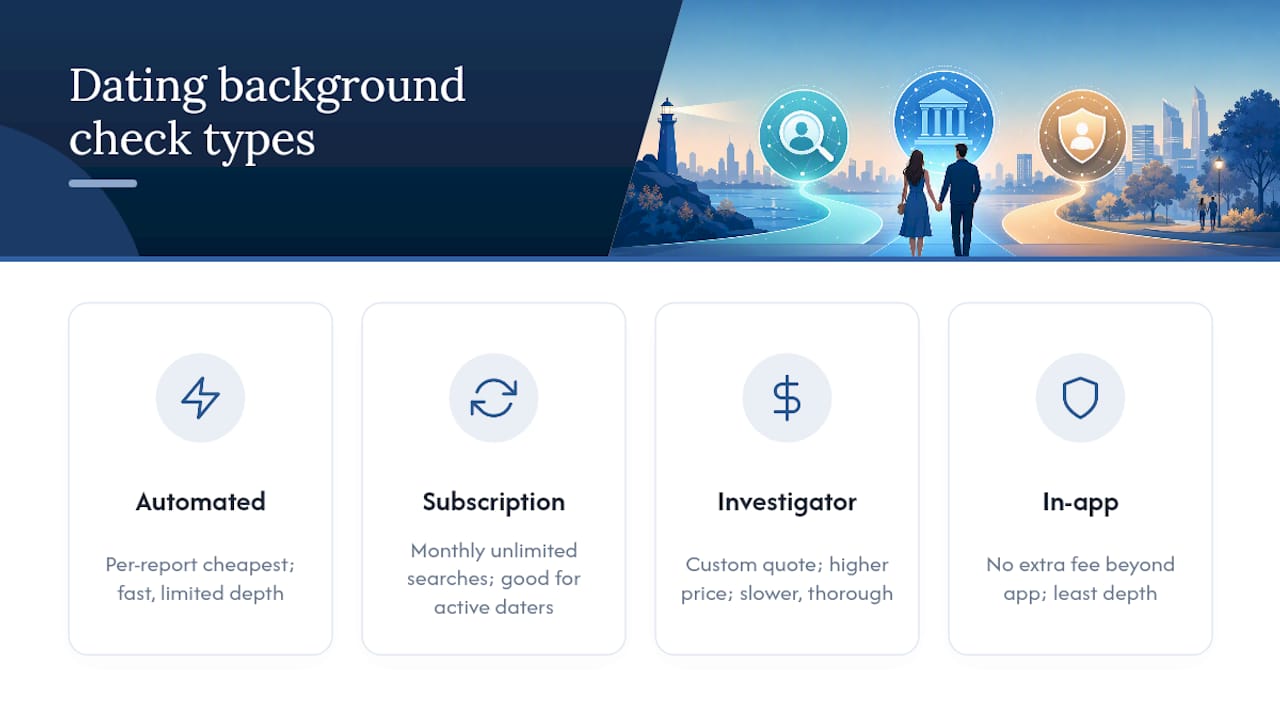
Licensed investigator services like Encyphir price differently, usually through a custom quote based on the scope of work. Court-level research, OSINT cross-referencing, and reverse-image photo verification all take real human hours, so expect a meaningfully higher price than an automated report, often reflecting a flat project fee rather than a subscription.
Some in-app verification features, where a dating platform partners with a background-check provider directly, cost nothing beyond your existing subscription to the app itself. That’s the cheapest entry point, though it typically offers the least depth.
The general pattern across the industry: automated equals fast and affordable, investigator equals slower and pricier but far more thorough. Neither is universally right. A low-stakes first date rarely justifies investigator fees, while a serious relationship moving toward cohabitation or shared finances often does.
How Do You Choose a Reputable Background Check Service?
A few concrete questions separate a trustworthy provider from a data-scraping site dressed up to look official.
Ask what data sources the service actually searches, and expect a specific answer, not a vague “comprehensive nationwide database” claim. Ask how the company handles FCRA compliance and permissible-use certification, since a provider that skips this entirely is cutting corners that could expose you legally. Ask about turnaround time in writing, then compare that promise against real user reviews to see if it holds up.
Red flags to walk away from: no visible privacy policy, no way to contact a real support team, pricing that only appears after you’ve entered payment information, and reports that present unverified social-media matches as confirmed identity. A service that can’t clearly explain its own methodology is not one you want handling anything sensitive about you or your date.
Techstacktoday’s background check services review hub walks through this evaluation process against actual providers if you want a side-by-side before committing to one.
Our Take: Why Balance Beats Paranoia
Background checks work best as a safety net, not a filter that eliminates anyone with an imperfect past. We’ve seen too many guides frame this as detective work, when really it’s closer to due diligence you’d do before any other significant decision involving a stranger.
The biggest mistake we see isn’t skipping a check. It’s over-relying on one. A clean automated report doesn’t mean someone is safe, and a single old misdemeanor doesn’t mean they’re dangerous. Privacy and safety experts consistently emphasize using these tools as one input among several, alongside your own judgment, mutual conversations, and the pace at which you’re building trust.
Use checks responsibly, respect the limits of what any database can tell you, and lean on official sources like court portals when something genuinely needs confirming.
— TechStackTeam
Take the Next Step With Vetted Privacy Tools
Choosing a background-check service is really a privacy decision in disguise, since you’re deciding who gets access to your data and how carefully they handle someone else’s. Techstacktoday tests these tools the same hands-on way we test VPNs and password managers: no paid placements, just real performance evaluated side by side.

If a check on yourself or a match turns up outdated data-broker listings, old addresses, or information you’d rather not have circulating publicly, that’s worth addressing before it resurfaces in someone else’s search. Our guide on removing yourself from data broker sites walks through exactly how to clean that up. And if you’re building out a broader privacy routine beyond dating safety, from securing your accounts to locking down your search history, our best password managers ranking and reviewed background check services are both good places to start comparing your options directly.
Verify It Yourself: Official U.S. Resources
- NSOPW: free, official sex offender registry search across all states
- FBI IC3: annual reports on online fraud, including romance scams
- PACER: federal court docket search for verifying filings
- Pew Research: data on online dating trends and safety concerns
Sources
- Dating Background Checks for Safer Connections — Checkr
- FBI releases annual Internet Crime Report
- National Sex Offender Public Website (NSOPW)
- Key findings about online dating in the U.S. — Pew Research
- 9 Dating Sites That Do Background Checks