An adverse action is any negative decision an employer makes because of a background check report: rejecting you, firing you, reassigning you or denying a promotion. Under the Fair Credit Reporting Act (FCRA), the employer must send a pre-adverse action notice first, give you a chance to respond, and only then send a final adverse action notice. 🛑 Don’t panic if you got one. A pre-adverse letter is a warning, not a final answer.
This guide covers both sides: the process an employer must follow, and what you can do if you are the person who received the letter.
TL;DR
- ✅ Adverse action means a negative job decision based in whole or part on a consumer report, including a rejection, termination, reassignment or denied promotion.
- ✅ Step one is the pre-adverse notice, with a copy of the report and the FCRA rights summary. Step two is the final notice, only after a fair waiting period.
- ✅ The FCRA sets no exact waiting time. Five business days is generally treated as reasonable, and some local laws require longer.
- ✅ If you are the applicant: read the report, dispute errors with the reporting agency, and respond to the employer in writing.
- ✅ Employers should log every notice and keep dates consistent for every candidate.
Table of Contents
- What adverse action means in a background check
- The adverse action process step by step
- Pre-adverse vs. final adverse action at a glance
- Federal, state and local rules that change the process
- Common employer mistakes
- If you received a pre-adverse action letter
- Our perspective
- Know what is out there before an employer does
- FAQ
- Sources
What adverse action means in a background check
The term sounds like legal jargon, but it is simple. The FTC lists rejecting a job application, reassigning or terminating an employee, and denying a promotion as adverse employment actions when they rest on information in a consumer report. California’s statute uses similar wording: a denial of employment or another employment-purpose decision that adversely affects a current or prospective employee.
Two details trip people up:
- It is not only about hiring. A current employee who loses a promotion over a new report triggers the same process as a new applicant.
- The report does not have to be the only reason. If the report influenced the decision, treat it as adverse action.
The FCRA applies when an employer gets a report from a screening company. The EEOC notes that state and local laws may also regulate how employers use background information, so the federal steps are a floor, not always the whole rulebook.
The adverse action process step by step
⏱️ Plan on at least a week from first notice to final decision. Here is the sequence.
Step 1: Review the report against the job
Before sending anything, the employer should look at what the report actually says and whether it relates to the role. The EEOC warns that using background information can be illegal discrimination when a policy has a disparate impact on protected groups and is not job-related and consistent with business necessity. A blanket “any record means no” rule is the risky version.
Useful questions to ask:
- What is the record, and is it accurate and current?
- How does it relate to the duties of this job?
- How much time has passed? Our guide to how far back background checks go explains the common seven-year limit and where convictions differ.
Step 2: Send the pre-adverse action notice
The FTC says that before taking adverse action, the employer must give the person a pre-adverse action notice that includes a copy of the report and a copy of “A Summary of Your Rights Under the Fair Credit Reporting Act”. The point is simple: you get to see what the employer saw before the door closes.
A good pre-adverse letter contains:
- The name of the screening company that produced the report.
- A copy of the report.
- The rights summary.
- A clear statement that a decision has not been made yet.
- A deadline and a contact for responding.
Step 3: Wait and listen
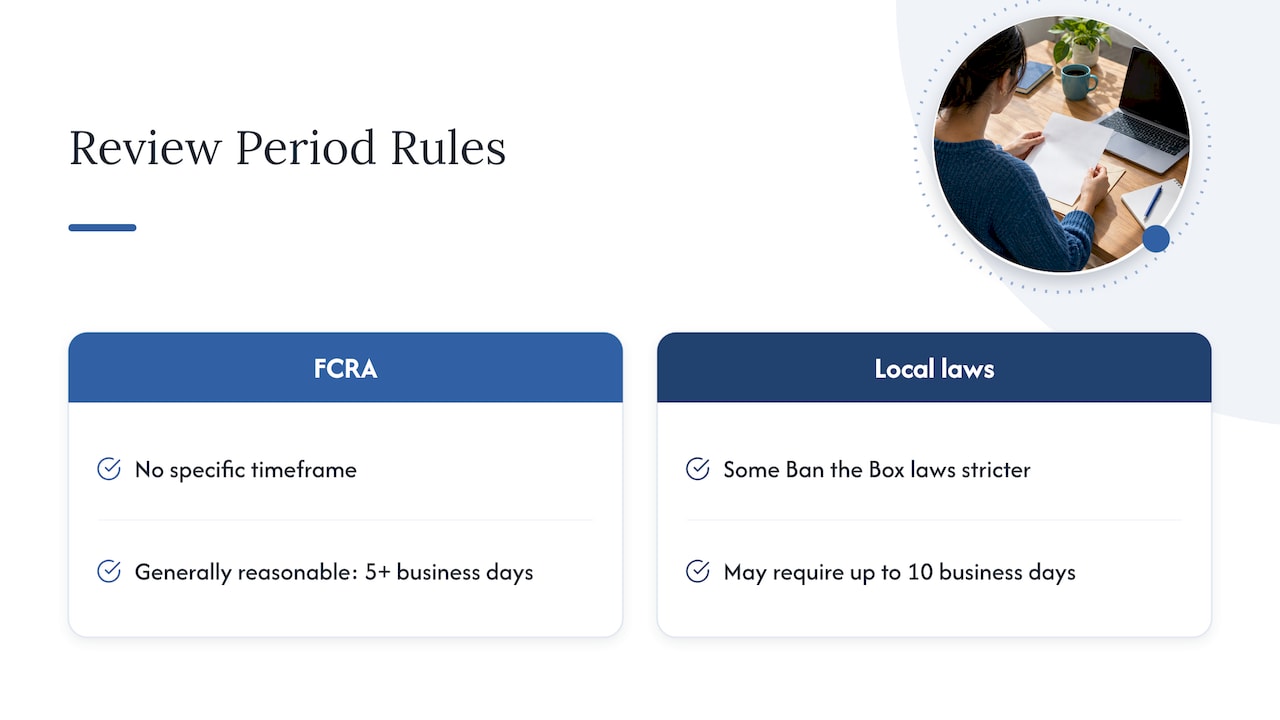
This is the step most often rushed. The FCRA sets no specific timeframe, but at least five business days is generally considered reasonable for the applicant to review, dispute and respond. Some local fair-chance laws are stricter: a few Ban the Box laws require up to 10 business days.
If the candidate disputes the report, industry guidance says to pause the hiring process while the screening company investigates. Deciding while a dispute is open invites trouble.
Step 4: Reconsider with what you learned
Read the response. If the report was wrong, or the explanation changes the picture, the employer can reverse course. In New York City, the Fair Chance Act bars rejection based on criminal history unless it prevents job duties or poses an unreasonable risk, and gives applicants an opportunity to respond. Reconsidering is not a courtesy there. It is the law.
Step 5: Send the final adverse action notice
If the decision stands, the final notice must include the name, address and phone number of the reporting agency, a statement that the agency did not make the decision, and notice of the person’s right to dispute the information and get a free copy of the report within 60 days.
Step 6: Document and dispose
Keep a log of each notice, date and response. One screening-industry white paper recommends detailed logs of every notice-related event to help show compliance. Sensitive report data must also be disposed of properly under the Disposal Rule, on paper and electronically.
Pre-adverse vs. final adverse action at a glance
| Pre-adverse action notice | Final adverse action notice | |
|---|---|---|
| When | Before any decision is made | After the waiting period, if the decision stands |
| Purpose | Let the person see and challenge the report | Confirm the decision and explain their rights |
| Must include | Copy of the report and the FCRA rights summary | Agency name, address and phone; statement that the agency did not decide; right to dispute and a free report copy within 60 days |
| Result for the person | Chance to respond or dispute | Decision is final unless the employer reverses it |
Federal, state and local rules that change the process
The FCRA is the baseline, and many places add to it.
- California. The Civil Code defines employment adverse action in its own wording (linked above). Pending legislation such as SB-1345 would add written notice duties when an employer asks for criminal-history authorization. Check the current status before relying on it.
- New York City. The Fair Chance Act, described above, builds an opportunity to respond into the process.
- New York State. Agencies may require specific state-managed background checks for certain roles, with their own procedures for matching and reporting results.
- Ban the Box jurisdictions. Many delay criminal-history questions until later in hiring and may set longer response windows.
⚠️ If you hire in more than one state, follow the strictest rule that applies to the candidate’s work location. For a wider view, see our guides on running employee background checks legally and background check compliance requirements.
Common employer mistakes
Most adverse action problems come from shortcuts, not bad intent.
- Skipping the pre-adverse notice. Sending only a rejection email after the report arrives breaks the sequence.
- Leaving out the rights summary or the report. The notice is incomplete without both.
- Setting an unreasonable deadline. A 24-hour window is hard to defend when five business days is the commonly cited minimum.
- Ignoring a dispute. Moving forward while the agency investigates undermines the whole point of the waiting period.
- Treating candidates differently. Inconsistent timing or standards can look like discrimination. Write one policy and apply it to everyone.
- Rejecting without a job link. Records that have nothing to do with the role are the weakest grounds.
Our piece on background check red flags employers must act on helps separate serious findings from noise, and the new hire background check guide shows where adverse action fits in a small-business workflow. Turnaround matters too, because slow reports squeeze your notice schedule: see how background check turnaround works.
If you received a pre-adverse action letter
😮💨 Take a breath. You have a window to act, and it is not long. Use it.
Do this now (about 30 minutes)
- Read the whole report. Check your name, birth date, addresses and every record listed. Mismatched identities and outdated entries are common.
- Note the deadline in the letter and put it on your calendar.
- Reply in writing to the employer. Say you received the notice and that you are reviewing the report. This starts a paper trail.
Dispute what is wrong
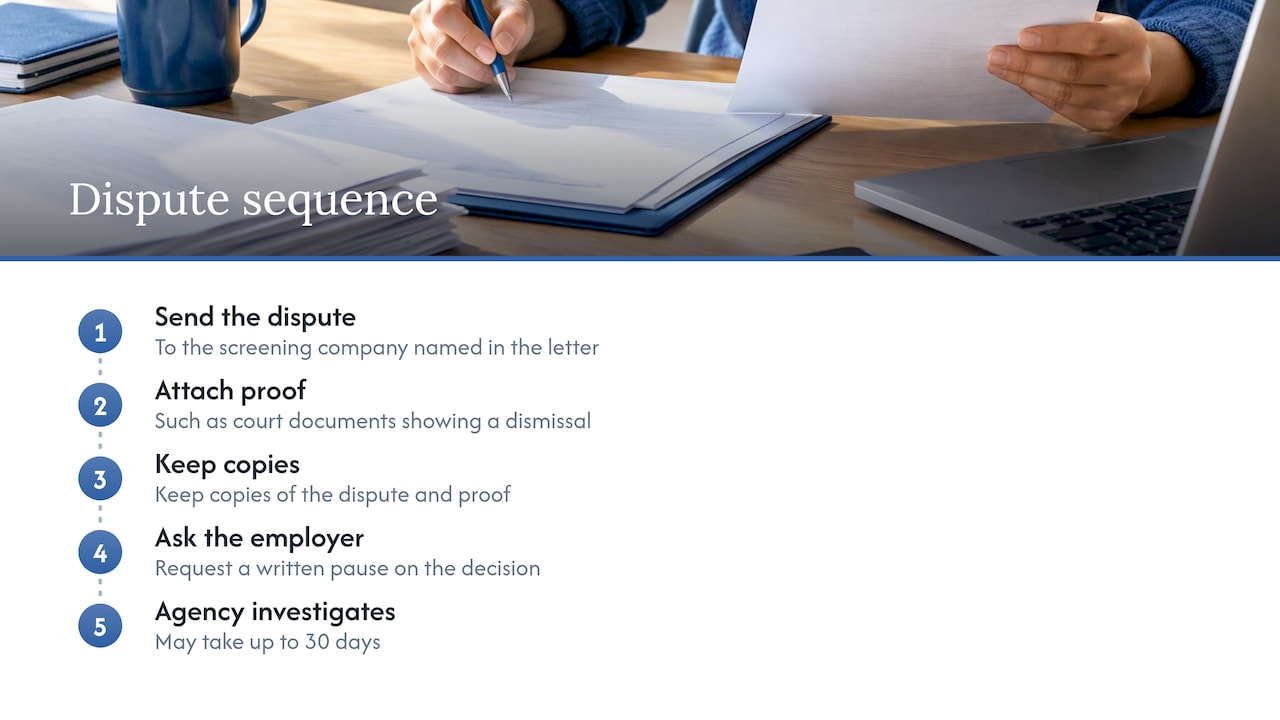
You have the right to dispute incomplete or inaccurate information with the reporting agency. Send the dispute to the screening company named in the letter, attach proof such as court documents showing a dismissal, and keep copies. Industry guidance says the agency generally has up to 30 days to resolve a dispute, so ask the employer in writing to hold the decision until it finishes. Our walkthrough on disputing background check errors lays out the steps.
Check age too. The FCRA generally prohibits reporting outdated negative information.
Explain what is accurate
If the record is correct, send a short, factual note: what happened, when, what has changed since, and why it does not affect the job. Keep it calm and specific. If negative information comes from a medical condition, the EEOC says you can ask for a chance to show you can do the job despite the condition.
Ask who has been checking you
A reporting agency must disclose who has used your report for employment purposes in the two years before your request. That is useful if you suspect a report is following you from job to job. If the offer is already on the line, our guide on keeping your job offer after a background check has a five-step plan.
Our perspective
We test and rank privacy and screening-related services hands-on, and the pattern we see in adverse action is the same pattern we see in data privacy: errors travel quietly until someone looks.
A background report is built from records that live in many databases. When one is wrong, the person it describes usually finds out last. That is why we think the pre-adverse step is the most valuable part of the law, and why employers who treat it as a real review, not a formality, make better hires and take on less risk.
For employers, we recommend choosing screening tools that make notices, logs and dispute handling part of the workflow. For job seekers, we recommend knowing what is public about you before an employer does. Our rankings are not influenced by affiliate payouts, and we update reviews monthly so the advice stays current.
TechStackTeam
Know what is out there before an employer does
Many background report errors start with personal data that data brokers collect and sell. Cleaning that up before you apply is one of the few things you control. Our guide on how to remove yourself from the internet walks through opt-outs, and is a data removal service worth it helps you decide whether to do it yourself or use a service. We tested these services hands-on, and you can compare them on our site at TechStackToday.

If a mix-up has you worried about identity fraud, our identity protection checklist for adults covers freezes, monitoring and the first moves to make.
FAQ
What does adverse action mean in a background check?
It means an employer makes a negative decision, such as not hiring, firing, reassigning or denying a promotion, based on information in a consumer report. The FCRA then requires specific notices before and after the decision.
How long does an employer have to wait before final adverse action?
The FCRA gives no fixed number of days. Five business days is generally seen as reasonable, and some Ban the Box laws require up to 10 business days. Employers should check local rules and use the longer period when unsure.
How do I respond to a pre-adverse action letter?
Read the report, note the deadline and reply in writing. Dispute any error with the reporting agency, attach proof, and send the employer a short explanation of anything accurate. Ask them to wait while a dispute is open.
Does a pre-adverse action notice mean I lost the job?
No. It means the employer is considering adverse action and wants you to see the report first. Some employers reverse course after a correction or explanation, and in places like New York City the law requires a chance to respond.
What should the final adverse action notice include?
The reporting agency’s name, address and phone number, a statement that the agency did not make the decision, and notice of your right to dispute the report and get a free copy within 60 days.
Sources
- Using Consumer Reports: What Employers Need to Know (FTC)
- California Civil Code 1786.53
- Background Checks: What Employers Need to Know (EEOC)
- Background Checks: What Job Applicants and Employees Should Know (EEOC)
- Taking adverse employment actions based on background checks
- A Practical Guide to Adverse Action in Hiring
- Understanding Adverse Action: A Guide for HR Professionals
- Navigating the Adverse Action Process
- New York Attorney General: Fair Chance Act enforcement
- California SB-1345
- NY OMH Pre-Employment Checks
- Federal Register: Consumer reporting rule, November 2024