A Level 2 background check is a fingerprint-based criminal history screening. It searches state and FBI national records, not just a name in a database. Employers and agencies use it for jobs that involve children, older adults, patients or other vulnerable people. ⏱️ Fingerprinting takes minutes. The full result can take days.
Don’t panic if your employer just said “Level 2.” It is routine for many licensed and caregiving roles. This guide explains what the term means, how it differs from Level 1, what can disqualify you, what it costs and what employers must do under federal law.
TL;DR
- ✅ Level 2 screening means fingerprints checked against statewide and FBI national criminal history records, often plus local checks and sex offender registry searches.
- ✅ Level 1 is a lighter, name-based screening. Level 2 goes deeper and is tied to roles with vulnerable people.
- ⚠️ The terms come from Florida law. Other states and employers use “Level 2” loosely, so ask what exactly is included.
- ⏱️ In the Florida Clearinghouse, the process generally takes 7 to 10 business days. New screenings carry a $60.00 fee plus fingerprint provider charges.
- ⚠️ If an employer uses an outside screening company, federal FCRA rules require written disclosure, your authorization and a pre-adverse action notice.
Table of Contents
- What a Level 2 background check is
- What a Level 2 check does not cover
- Level 1 vs. Level 2: the real differences
- Who needs a Level 2 background check
- How the process works, step by step
- How long a Level 2 check takes and what it costs
- What can disqualify you
- FCRA rules when an outside company runs the check
- How to prepare as a job candidate
- Perspective: what we see in hands-on background screening research
- Check what the internet says about you
- FAQ
- Sources
What a Level 2 background check is
There is no single national standard called “Level 2.” The label is most formally defined in Florida, and the way most people use it traces back to that state’s rules. Florida’s Department of Children and Families says Level 2 screening requires fingerprinting for a statewide check through the Florida Department of Law Enforcement (FDLE) and a national check through the FBI. Local law enforcement checks may be added.
Under Florida Statutes section 435.04, Level 2 screening also includes searches of sexual predator and sexual offender registries in the states where the employee lived during the preceding five years, plus local criminal records checks through local law enforcement agencies.
So a typical Level 2 check has these parts:
- Fingerprints taken electronically (Livescan).
- State criminal history from the state’s law enforcement agency.
- FBI national criminal history based on those same prints.
- Sex offender and predator registry searches, including states you lived in recently.
- Local criminal records checks, where required.
The key difference from a typical online search is the fingerprint. A name can be shared, misspelled or changed. A fingerprint ties a record to one person.
What a Level 2 check does not cover
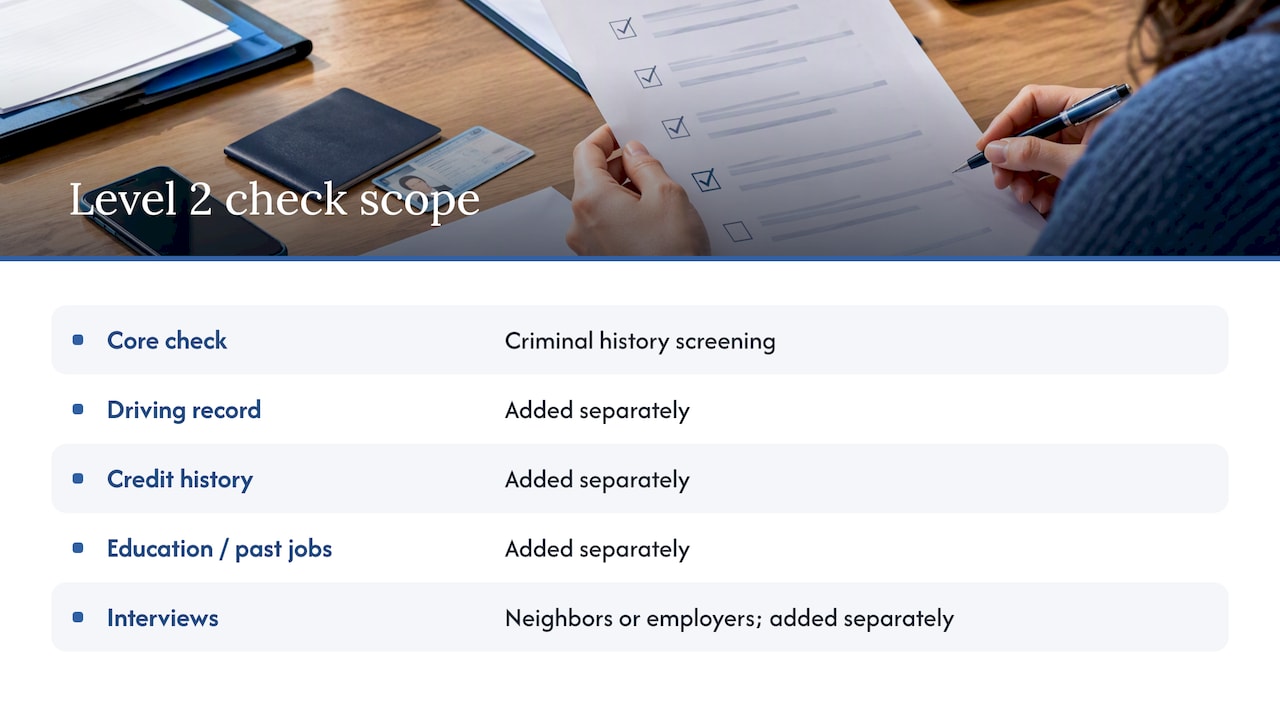
It is a criminal history screening. Florida itself distinguishes criminal history checks from broader background checks that can include driving records, credit history or interviews with neighbors and employers. A Level 2 check does not automatically verify your education, past jobs, credit or driving record. Employers who want those add them separately.
To see how those pieces fit together, read our guide on types of employee background checks and our explainer on criminal record screening.
Level 1 vs. Level 2: the real differences
Florida’s statute spells out the lower tier. Level 1 screening includes employment history checks, statewide criminal correspondence checks through FDLE and a check of the Dru Sjodin national sex offender website. It may include local checks.
| Feature | Level 1 | Level 2 |
|---|---|---|
| Fingerprints | No | Yes |
| Statewide criminal history | Yes, name-based correspondence check | Yes, fingerprint-based |
| FBI national criminal history | No | Yes |
| Sex offender registry | National website check | Registry searches in states of residence over the past five years |
| Employment history check | Yes | Not part of the core definition |
| Typical roles | Lower-risk positions | Roles with children, patients, seniors or the disabled |
The practical gap is reach. A name-based check can miss someone who moved from another state or used a different name. A fingerprint-based FBI search can surface records from anywhere in the country that were submitted to the national system.
When “Level 2” means something else
Outside Florida, you may see “Level 2” on a job posting or a vendor’s price list. Some private screening companies use tiers as marketing packages: Level 1 for a basic criminal search, Level 2 for extra counties, longer lookbacks or added databases. That is not the same as a government fingerprint submission. If an employer says Level 2, ask three questions:
- Are fingerprints required?
- Does the check run through a state agency and the FBI?
- Is it a package from a screening company, and what exactly is in it?
Texas, for example, uses its own Department of Public Safety process for FBI fingerprint-based checks. Your state’s licensing board or the requesting agency will tell you which route applies.
Who needs a Level 2 background check
Florida is the clearest example. The state’s health care licensing rules were widened recently: as of July 1, 2025, licensed health care professionals applying initially or renewing must undergo Level 2 screening. Exceptions include EMTs, paramedics, pharmacy interns and technicians, and radiologic technologists.
Beyond health care, Level 2 screening commonly applies to people who work with:
- Children, such as child care and certain school or youth program roles
- Older adults, such as assisted living and home health
- People with disabilities
- Certain state-regulated programs overseen by agencies like DCF
Universities use it too. At the University of Florida, the requestor uses HireRight for local criminal records and five-year sex offender and predator registry checks, while certain programs require DCF screening instead. That is a good reminder that one institution can run more than one route, depending on the job.
If you are a small business owner, you may never be required to run a government Level 2 check. If you hire for a regulated role, the licensing agency, not you, usually decides. Our guide for HR and small business new hire checks covers the more common situation.
How the process works, step by step
⏱️ Plan for about a week and a half from start to finish in Florida. Other states vary.
- Get the right request from the employer or agency. Under Florida Statutes section 435.05, the employer or agency submits the Level 2 information to FDLE. FDLE runs its own criminal history check and requests the FBI national check.
- Book fingerprinting. Florida’s Agency for Health Care Administration describes fingerprinting through an FDLE-approved Livescan provider. Bring a government photo ID and the agency or employer’s identifying number if you were given one.
- Wait for the state and FBI results. You do not need to do anything while records are searched.
- Eligibility review. The responsible agency reviews any hits against the list of disqualifying offenses and makes a determination.
- Notification. The employer must tell the employee whether disqualifying information was found, according to section 435.05.
Two practical tips. First, use the exact name you are legally using, and list prior names. Second, if your fingerprints are rejected for poor quality, which can happen with worn ridges, retake them rather than assuming anything is wrong.
How long a Level 2 check takes and what it costs
Timing depends on the agency. In the Florida Clearinghouse, the full process generally takes 7 to 10 business days. Fingerprint capture itself is quick. Delays usually come from rejected prints, incomplete forms or records that need a manual review.
For money, Florida publishes official numbers. As of January 1, 2025, a resubmission screening in the Clearinghouse costs $12.00, while new applicant screenings typically involve a $60.00 fee plus additional charges from the Livescan provider. The Clearinghouse FAQ lists renewals at $42.00 and resubmissions for people with a 90-day employment break at $12.00.
| Screening type (Florida Clearinghouse) | Fee |
|---|---|
| New applicant | $60.00 plus Livescan provider charges |
| Renewal | $42.00 |
| Resubmission after a 90-day employment break | $12.00 |
Fees change, so check the Clearinghouse page before you book. Outside Florida, state agencies and private fingerprint vendors set their own prices. For background on timing in the private screening world, see how background check turnaround works.
What can disqualify you
This is the question that worries people most, and the answer is narrower than many expect. Level 2 standards screen for specified disqualifying offenses, not for every blemish on a record.
Under Florida law, disqualification may follow:
- An arrest awaiting final disposition for a listed offense
- A guilty finding, or a guilty or nolo contendere plea, for a listed offense
- An unsealed or unexpunged delinquency adjudication for a listed offense
The Online Sunshine statute text lists offenses including murder, manslaughter and certain felony battery charges. A minor offense that is not on the list does not trigger the same result.
If you get a disqualification notice:
- ⚠️ Read the notice for the exact offense cited and the deadline to respond.
- ✅ Ask whether you can request an exemption from disqualification. Florida’s DCF has a formal exemption process, and the right agency to contact is the one that sent the notice.
- ✅ Pull your own records and check them for errors. Our guide on disputing background check errors walks you through it.
- ✅ For a legal question about a specific charge, talk to a licensed attorney in your state.
FCRA rules when an outside company runs the check
A government fingerprint check runs through state and federal agencies. But when an employer uses a third-party screening company for a background report, the Fair Credit Reporting Act (FCRA) applies. Whatever the employer calls the check, these rules matter.
Before the check. The EEOC explains that under the FCRA, which the FTC enforces, employers using screening companies must disclose their intent in writing, separate from the job application, and get your written authorization.
Before a negative decision. The FTC says that before taking adverse action based on a screening company’s report, the employer must give you a copy of the report and a summary of your FCRA rights. FTC staff has noted that the law is silent on exactly how long employers must wait and suggests procedures that let you discuss the report first. That gap is your window to point out mistakes.
Old records. Under the FCRA, reporting agencies generally may not report arrests that did not lead to conviction if they are more than seven years old, though convictions may be reported indefinitely. Our piece on how far back checks go explains the limits.
Fair use of criminal records. The EEOC advises employers to make individualized assessments of criminal records rather than using blanket exclusions.
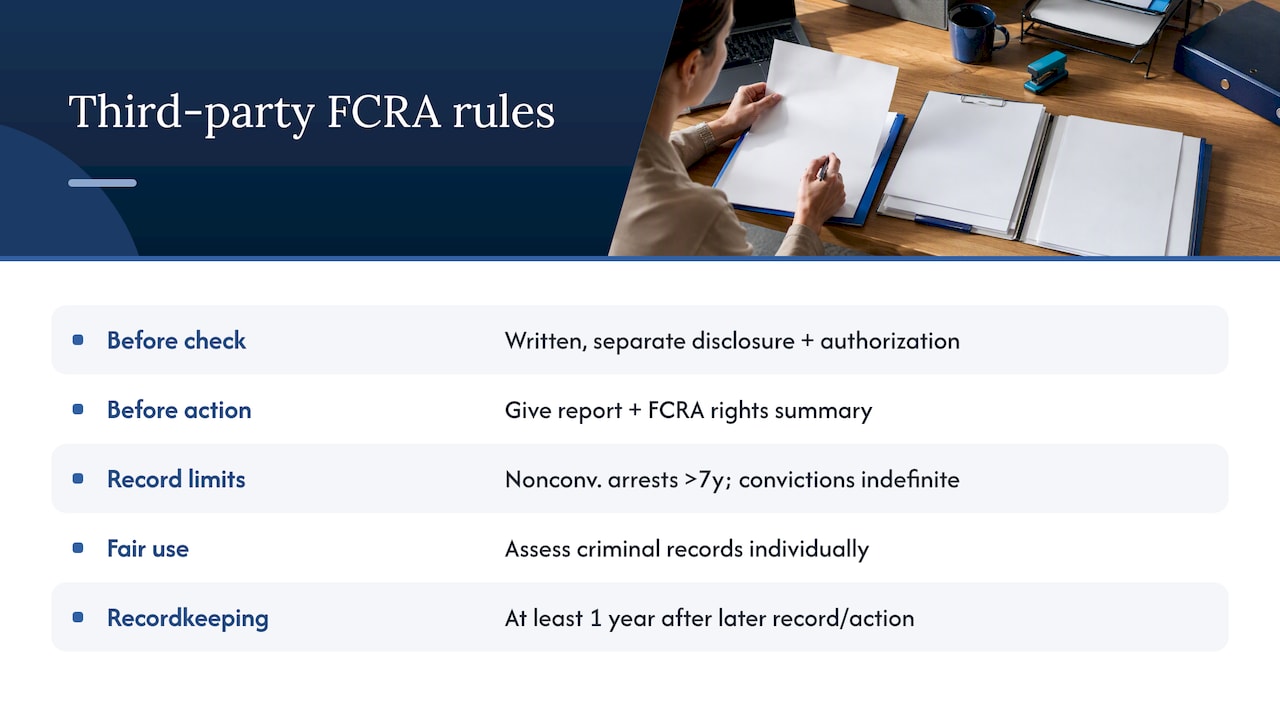
Record keeping. Per EEOC guidance, employers must keep employment records, including applications, for at least one year after the record was made or a personnel action was taken, whichever is later.
An employer checklist
- ✅ Separate written disclosure, not buried in the application
- ✅ Signed authorization before ordering the report
- ✅ Individualized review of any criminal hit
- ✅ Pre-adverse action notice with the report and rights summary
- ✅ Records retained for the required period
For a fuller walkthrough, see our guides on running employee background checks legally and background check compliance requirements. State and local laws, such as fair chance hiring rules, can add duties on top of federal law.
How to prepare as a job candidate
⏱️ Spend 15 minutes on this before your fingerprint appointment.
- ✅ Gather IDs and any prior names or addresses from the last five years. Registry searches cover states where you lived during that period.
- ✅ Know your own record. If you have a past arrest, find out the final disposition. An arrest awaiting disposition can matter under Florida law.
- ✅ Be honest on forms. A record you disclose is easier to explain than one the employer discovers.
- ✅ Check what public data about you is floating around. Old data broker profiles can be wrong and can confuse name-based screening.
Perspective: what we see in hands-on background screening research
We test and rank privacy and screening services hands-on, and rankings are not influenced by affiliate payouts. Here is our view on Level 2 checks.
The label causes more confusion than the process. People hear “Level 2” and assume a national standard. It is really a Florida-defined tier that other states and vendors borrow. Before you pay or sign anything, find out whether the check is a government fingerprint submission or a vendor package.
We also think candidates under-use their rights. Federal law gives you a path to see and challenge a report before a job is lost. Use it. Ask for the report, mark every error and respond in writing.
Finally, accuracy matters as much as depth. A deeper check that matches the wrong person does more harm than a shallow one. That is why fingerprints exist, and why you should treat any name-based record with caution.
— TechStackTeam
Check what the internet says about you
A Level 2 check pulls government records, but many employers also glance at what is online. If old people-search profiles list your address, relatives or outdated details, you can take them down. Start with our walkthrough on how to remove yourself from the internet, or see whether a paid opt-out tool fits you in our data removal service review.
FAQ
What is a Level 2 background check in Florida?
It is a fingerprint-based screening that runs through FDLE for statewide records and the FBI for national records. It also includes registry searches and local checks where required under state law. The responsible agency then decides eligibility based on a list of disqualifying offenses.
What can make you fail a Level 2 background check?
In Florida, a listed disqualifying offense can do it, whether through a guilty finding, a guilty or nolo contendere plea, or an arrest awaiting final disposition. Offenses not on the list do not trigger the same outcome. You may be able to request an exemption, so read the notice and respond by its deadline.
How long does a Level 2 background check take?
In the Florida Clearinghouse the full process generally takes 7 to 10 business days. Rejected fingerprints, incomplete forms and manual reviews can add time. Other states publish their own timelines.
How much does a Level 2 background check cost?
In Florida’s Clearinghouse, new applicant screenings typically carry a $60.00 fee plus Livescan provider charges. Renewals cost $42.00 and eligible resubmissions $12.00. Check the Clearinghouse page for current fees before booking.
Is a Level 2 check the same as an FCRA background check?
No. A government fingerprint check runs through state and federal agencies. An FCRA report is prepared by a screening company for an employer. If an employer uses a screening company, the FCRA disclosure, authorization and adverse action rules apply.
Sources
- Florida Statutes section 435.04 (2026)
- Florida DCF background screening FAQ
- Level 1 and Level 2 Background Checks (Florida)
- Florida Statutes Chapter 435 on Online Sunshine
- Florida Statutes section 435.05
- Florida AHCA Background Screening information
- Florida AHCA Clearinghouse FAQ
- University of Florida Level 2 Background Screening
- EEOC: Background Checks, What Employers Need to Know
- FTC Advisory Opinion to Beaudette
- FTC Advisory Opinion to Coffey
- EEOC Enforcement Guidance on Arrest and Conviction Records