Short answer: it depends on your risk, but for many people, free tools cover a substantial portion of what paid plans promise. Whether identity theft protection is worth it comes down to three things: how much your time is worth, whether you’ve already been a victim, and whether you’d actually do the free steps yourself.
Before you read further, check these three things:
- You probably benefit from a paid plan if you’ve been a repeat fraud victim, manage finances for an aging parent, or know you won’t set up free protections on your own.
- You probably don’t need one if you’re willing to freeze your credit, check reports regularly, and handle alerts yourself.
- Do this first, regardless: freeze your credit at all three bureaus. It’s free and takes under 30 minutes.
Keep reading for the full breakdown of costs, coverage limits, and a framework to decide for your situation.
Key Takeaways
A credit freeze provides stronger fraud prevention than any paid monitoring plan, making paid services worth their cost mainly for convenience, insurance, and hands-off recovery support.
| Point | Details |
|---|---|
| Freeze first, always | A three-bureau credit freeze is free and blocks new-account fraud better than paid monitoring. |
| Monitoring is reactive | Dark-web scans and account alerts tell you after exposure, not before it happens. |
| Read the policy limits | Insurance often covers restoration costs, not stolen funds, with sub-limits on wages and legal fees. |
| Check existing coverage | Banks, employers, and breach settlements frequently include free identity monitoring already. |
| Compare before you subscribe | Techstacktoday’s hands-on rankings show which paid plans deliver real coverage versus marketing claims. |
Official Resources Worth Bookmarking
- Identitytheft: free federal recovery plan generator and FTC theft report
- FTC Consumer Sentinel Network: annual fraud and identity-theft data
- IC3 annual report: cybercrime and fraud trend tracking
- AnnualCreditReport.com: the only federally authorized source for free credit reports
- Your state attorney general’s consumer protection page: local reporting and freeze instructions
This article is general information, not a substitute for advice from a qualified financial advisor. Consult a qualified financial professional about your own circumstances before acting on anything here.
Table of Contents
- Is Identity Theft Protection Worth the Cost?
- What’s Actually Covered, and Where the Gaps Are
- Free Alternatives That Match What Paid Plans Promise
- What Identity Theft Protection Costs, and Who Gets Value From It
- Questions to Ask Before You Buy a Plan
- What the Data Says About Effectiveness
- Sources
Is Identity Theft Protection Worth the Cost?
Paid identity theft protection services bundle monitoring, alerts, and insurance into one subscription, but almost none of it actually stops theft from happening. The strongest prevention tool, a credit freeze, is free by law and works better than anything you can buy.
Here’s what a typical paid plan actually does:
- Credit monitoring across one or three bureaus, flagging new accounts or hard inquiries
- Dark-web scanning that searches leaked databases for your email, passwords, or Social Security number
- Public-record alerts for address changes or new phone numbers tied to your identity
- Bank and account monitoring for unusual transactions
- Identity-theft insurance to reimburse recovery costs
- Restoration specialists who handle paperwork and calls on your behalf
Notice the pattern: monitoring and alerts, not prevention. If a thief opens a credit card in your name, a monitoring service tells you after it happens. A credit freeze stops the lender from approving that application in the first place, according to LegalClarity’s breakdown of paid versus free protection. Dark-web scanning shows you when a password leaked, but it can’t stop the breach that leaked it.
Pro Tip: Think of monitoring like a smoke detector, not a fireproof house. It tells you something’s burning. It doesn’t stop the fire.
What’s Actually Covered, and Where the Gaps Are
Paid plans read like insurance policies because many of them are. That means the fine print matters more than the marketing page.
Most plans commonly include:
- Three-bureau credit monitoring (some cheaper tiers only cover one)
- SSN and dark-web alerts
- Restoration support with a caseworker
- Identity-theft insurance, often $25,000 to $1 million in stated coverage
Common exclusions catch people off guard:
- Social engineering scams (you willingly sending money) are frequently excluded
- Many non-credit frauds, like tax refund fraud or medical identity theft, have separate or limited coverage
- Sub-limits inside the policy cap specific costs, like lost wages or childcare, far below the headline number
The insurance component reimburses restoration costs, like lost wages while you deal with fraud, notarized documents, or long-distance phone calls, not the stolen money itself in most cases, according to Wired’s review of ID protection services.
A $1 million policy sounds like real protection until you read that lost-wage reimbursement is capped at $1,500 and identity-theft expenses require receipts filed within 60 days.
Before buying anything, pull the actual policy document and check the deductible, the sub-limits, and what counts as a “covered event.” The marketing page never mentions the ceiling.
Free Alternatives That Match What Paid Plans Promise
You can replicate most of what a paid plan sells for zero dollars if you’re willing to do it yourself.
- Freeze your credit at Equifax, Experian, and TransUnion. This is free by federal law and blocks new-account fraud better than any monitoring service, since lenders can’t pull your report at all.
- Pull your credit report weekly through the FTC’s permanent free weekly access program.
- Turn on transaction alerts for every bank account and credit card you hold.
- Set a fraud alert with one bureau, which flags your file for 90 days at a time.
- Enroll in an IRS Identity Protection PIN if tax refund fraud worries you.
A freeze takes effect almost immediately online, though mail requests can take up to five business days. Weekly credit reports update as soon as you check them.
Pro Tip: Pair a password manager with two-factor authentication on every financial account. Most account takeovers start with a reused password, not a data breach you couldn’t control.
What Identity Theft Protection Costs, and Who Gets Value From It
Entry-level plans typically run $10 to $15 a month and cover one bureau plus basic dark-web scanning. Mid-tier plans, $20 to $25 a month, usually add three-bureau monitoring and higher insurance limits. Family plans covering several people often cost between $25 and $40 a month.
Here’s the honest framework for spending that money:
- Pay for convenience and insurance if you don’t have time to manage freezes and alerts yourself, or if you’re recovering from a recent breach and want a caseworker handling the calls.
- Skip the subscription if you’re comfortable freezing your credit, checking reports, and monitoring your own accounts. The FTC’s Consumer Sentinel Network logged over 5.7 million fraud and identity theft reports in 2024, a scale that justifies vigilance, but vigilance doesn’t require a subscription.
- Check what you already have before paying for anything. Many credit cards, banks, and employers include some identity monitoring free, and data breach settlements frequently include a year or two of service at no cost, per Wired’s reporting on ID protection benefits.
Questions to Ask Before You Buy a Plan
A plan’s value hides in details most people never read. Ask these before signing up:
- Which bureaus does the monitoring actually cover, one or three?
- What specifically counts as a “covered event” under the insurance policy?
- What are the sub-limits on lost wages, legal fees, and travel costs?
- What’s the deductible, if any?
- What does restoration support actually do versus what you have to do yourself?
- Does the price increase after the first year, and by how much?
Red flags worth walking away from: vague language about what counts as “identity theft,” a single-bureau plan marketed as comprehensive protection, and renewal pricing that jumps 40% or more after an introductory rate.
Trust signals worth paying for: U.S.-based restoration teams, a policy document you can read before you buy (not just after), and pricing that stays flat or is disclosed clearly at signup.
What the Data Says About Effectiveness
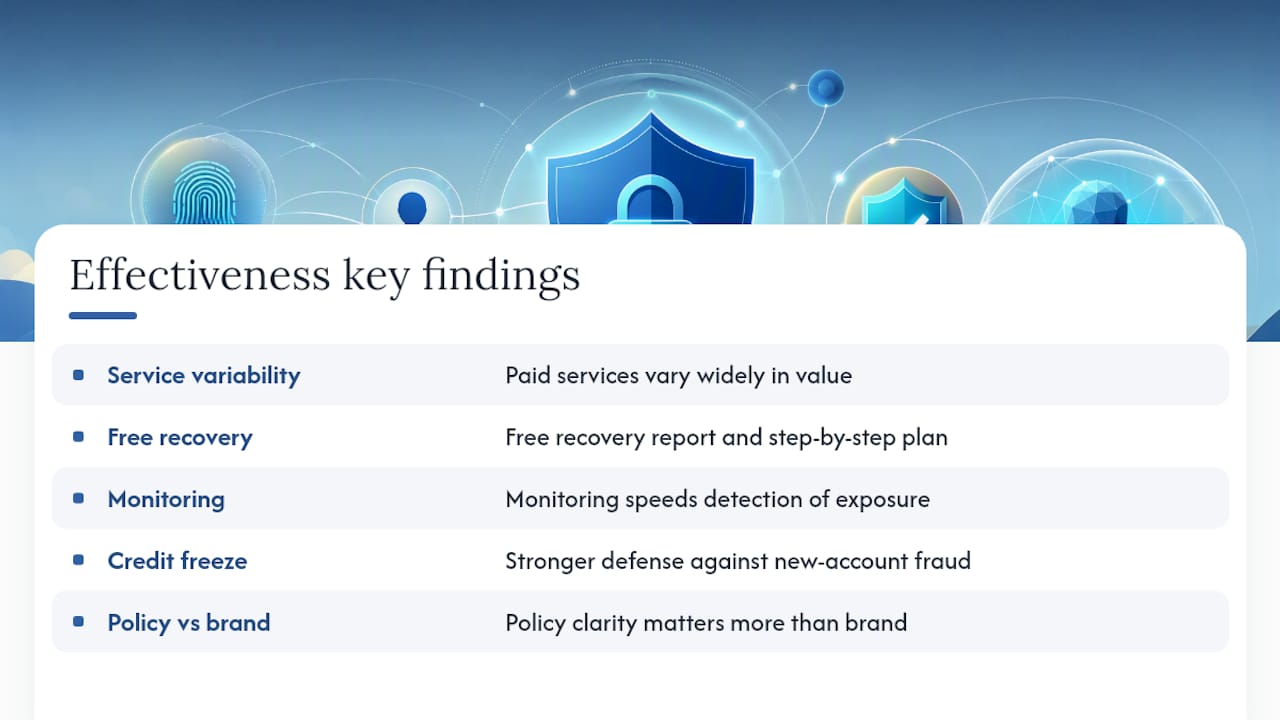
Government oversight reporting has repeatedly found that paid identity-theft services vary widely in real value, and that reading the actual policy matters more than brand recognition, according to a GAO review of identity theft services. The Identitytheft generates a free, legally recognized recovery report and step-by-step plan, something several paid restoration services essentially replicate.
The IC3’s 2024 annual report documents sustained, high volumes of fraud reporting tied to identity misuse, which is the strongest argument for having some system in place, whether paid or free.
Hands-on comparisons from Techstacktoday consistently find that monitoring speeds up how fast you learn about exposure, but a credit freeze remains the stronger defense against new-account fraud specifically because it prevents the event rather than reporting it after the fact.
When Techstacktoday Recommends Paying for a Plan
Paying makes sense for repeat fraud victims, seniors or adults with cognitive decline who need someone else watching their accounts, people juggling complex finances across many accounts, and anyone who’s honest that they won’t do the free steps consistently. This reflects our team’s pattern across dozens of hands-on service reviews, not a one-size-fits-all rule.

Get a Vetted Shortlist Instead of Guessing
Reading policy fine print for a dozen providers takes hours you probably don’t have. Techstacktoday tests identity protection services hands-on and ranks them by actual coverage, alert speed, and value, not marketing claims, so you can skip the guesswork entirely.

Our rankings of the best identity theft protection services break down bureau coverage, insurance sub-limits, and renewal pricing for each provider we’ve tested. We don’t accept payment for placement, so a plan ranks high because it performed well, not because it paid to be there. If you’d rather reduce your exposure at the source, our guide on removing yourself from data broker sites covers the proactive side monitoring can’t touch. For caregivers researching protection for older relatives, Street Safe Self Defence’s fraud awareness training is worth a look alongside any monitoring plan. Start with our rankings page to compare real coverage details side by side before you commit to a subscription.
Sources
- Do You Need Identity Theft Protection: Paid vs. Free – LegalClarity
- FTC Consumer Sentinel Network annual data book 2024
- Identitytheft
- IC3 2024 annual report