People-search and reference-style services pull together public records for general curiosity or low-risk personal lookups. FCRA-compliant background checks are regulated consumer reports, compiled by registered consumer reporting agencies, that verify primary sources and are legally required for employment, housing, credit, and licensing decisions. Use the wrong one for a hiring or rental decision, and you face real legal exposure.
Here is what separates them at a glance:
- Legal status: People-search platforms are not consumer reporting agencies (CRAs). FCRA-compliant services are, and that distinction is what triggers your legal obligations as a requester.
- Data sources: People-search tools rely on scraped, bulk-licensed, or aggregated datasets. CRAs pull from primary sources: county court clerks, DMV records, credit bureaus, and employer or school verification calls.
- Accuracy and recency: Aggregated data can be months or years old and may carry name collisions or missing case dispositions. Primary-source verification is fresher and more defensible.
- Intended use: People-search is for personal curiosity. FCRA background checks are for formal decisions that carry legal consequences.
Bottom line: For hiring, renting to a tenant, or any decision that could trigger adverse action, you need an FCRA-compliant CRA report, not a people-search result.
Key Takeaways
The core rule is simple: if your decision could trigger adverse action, you need an FCRA-compliant CRA report, not a people-search result.
| Point | Details |
|---|---|
| Legal trigger is the deciding factor | Any employment, housing, credit, or licensing decision legally requires a registered CRA report under the FCRA. |
| County clerks are the source of truth | Statewide and national aggregators miss recent filings; direct county access is what separates CRA accuracy from people-search guesswork. |
| Hybrid approach saves money | Run an automated CRA sweep on all candidates, then add county-level manual verification only for finalists or high-risk roles. |
| Vendor checklist protects you | Confirm CRA registration, county coverage, data refresh cadence, and a documented audit trail before ordering any regulated report. |
| Techstacktoday tests every service | Hands-on scenario testing and FCRA compliance checks back every recommendation in Techstacktoday’s ranked background-check reviews. |
Table of Contents
- Why reference checks differ from background checks: defining the two service classes
- What U.S. law actually requires before you run a check
- Where each service gets its data — and why that gap matters
- How checks are actually run: automated vs. verified workflows
- When to use a people-search tool and when you legally need a CRA
- How to choose the right screening service for your situation
- A practical, risk-based approach for families and small businesses
- How Techstacktoday tests and evaluates these services
- The mistake most buyers make — and how to fix it fast
- Techstacktoday’s background-check reviews cut through the noise
- Sources
Why reference checks differ from background checks: defining the two service classes
Two very different products share overlapping marketing language, which is where most buyer confusion starts.
People-search / reference-style services are data aggregators. They compile public and private records from scraped web sources, bulk-licensed datasets, and public-record repositories, then sell access to consumers. As Checkr explains, these platforms typically disclaim that they are not consumer reporting agencies and explicitly advise users not to rely on their data for employment or housing decisions.
FCRA-regulated background checks are consumer reports compiled by registered CRAs. According to TechRadar’s breakdown of background-check services, a reputable provider verifies identity, searches criminal and court records, and confirms employment and education history through primary sources. The FCRA governs every step: how the report is requested, how the subject is notified, and what happens if the report leads to an adverse decision.
| Feature | People-search service | FCRA background check (CRA) |
|---|---|---|
| Legal allowed uses | Personal curiosity, general research | Employment, housing, credit, licensing |
| Typical sources | Scraped/aggregated/licensed datasets | County courts, DMV, credit bureaus, employers |
| Verification level | Automated match, no primary-source confirmation | Primary-source verification with documentation |
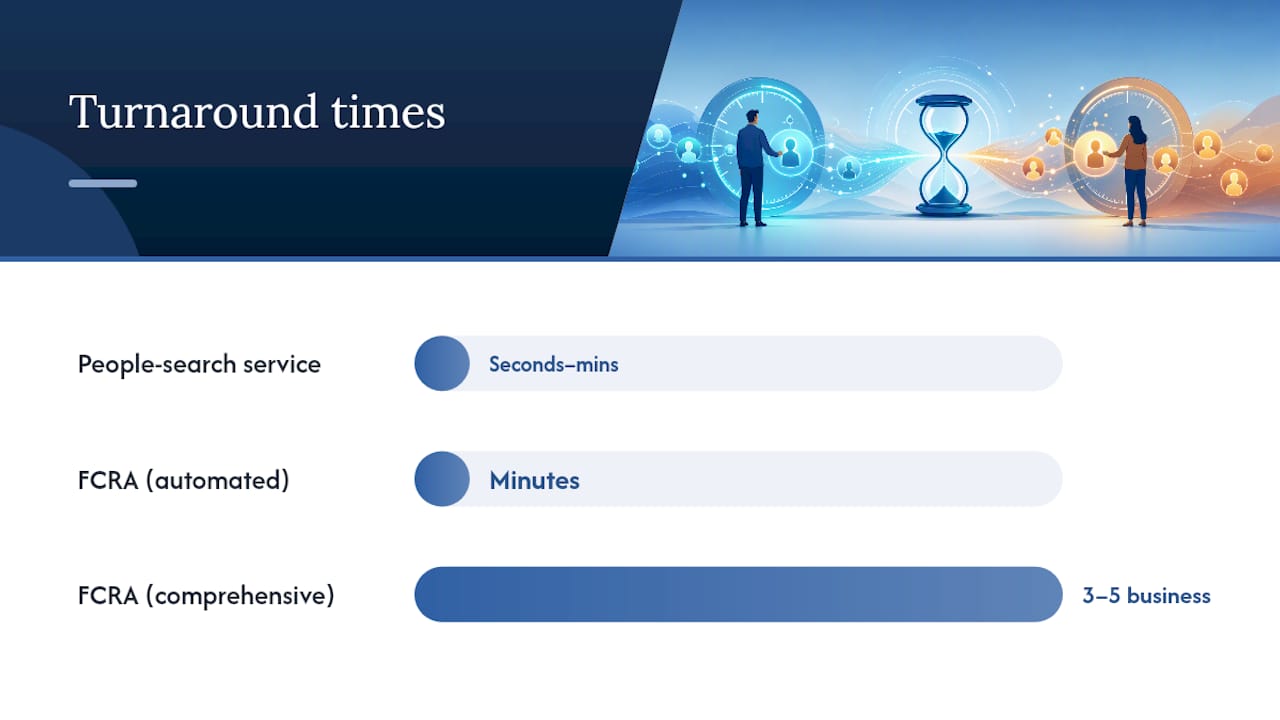
| Turnaround | Seconds to minutes | Minutes (automated) to 3–5 business days (comprehensive) |
What U.S. law actually requires before you run a check
The FTC’s guidance on background checks is direct: if you use a background report to make decisions about employment, housing, credit, insurance, or licensing, the FCRA requires you to use a compliant CRA and follow specific procedures. Using a non-CRA people-search tool for those decisions is an FCRA violation regardless of how accurate the data appears.
When you use an FCRA-regulated report, you must:
- Provide the applicant with a clear, written disclosure that a background check will be run
- Obtain written authorization before ordering the report
- Send a pre-adverse action notice (with a copy of the report and a summary of rights) before taking any negative action
- Wait a reasonable time, then send a final adverse action notice if you proceed
- Honor the subject’s right to dispute inaccurate information with the CRA
State law adds another layer. Many states have ban-the-box laws that restrict when you can ask about criminal history in the hiring process. California, New York, and Illinois, among others, also impose their own disclosure and timing rules that go beyond federal minimums. Check your state’s specific requirements before running any employment screen.
Pro Tip: Before ordering any report for a regulated use, ask the vendor directly: “Are you a registered consumer reporting agency?” and “Will you provide the required FCRA disclosure and authorization forms?” A legitimate CRA will answer yes to both without hesitation.
Where each service gets its data — and why that gap matters
County clerks are the source of truth for trial-court dockets. Statewide repositories are uneven. National aggregators can miss recent filings and case dispositions entirely. That gap is why the same person can look clean on a people-search platform and show a conviction on a properly run CRA report.

Common record layers and how each service class typically accesses them:
| Record layer | CRA access method | People-search access method |
|---|---|---|
| Federal indexes (PACER, OFAC, sex-offender registries) | Direct query or licensed feed | Aggregated/scraped, variable freshness |
| State criminal repositories | Licensed state feeds | Bulk-licensed, often lagging |
| County court clerks | Direct courthouse pull or county-level vendor | Rarely accessed directly |
| DMV / motor vehicle records | Permissible-purpose query | Generally not accessible |
| Employment / education records | Direct employer/school verification call | Not verified |
People-search datasets are frequently compiled from older bulk-licensed sources and refreshed on irregular schedules. A CRA prioritizes primary-source access precisely because a stale or mismatched record can harm both the subject and the requester. Name collisions are a particular risk: a common name in a large metro area can produce false positives that a county-level follow-up would immediately clear.
Pro Tip: Ask any vendor: “Which counties do you access directly, and how often are those records refreshed?” A CRA with real county-level coverage will give you a specific answer. Vague responses like “we cover all 50 states” without detail are a red flag.
How checks are actually run: automated vs. verified workflows
Instant automated checks return results in seconds by querying aggregated databases. Comprehensive checks layer in manual courthouse searches and employer or education verification calls, which takes longer but produces a more accurate and legally defensible result.
A reputable CRA typically follows this workflow:
- Identity match: Confirm the subject’s SSN, name, and address history to anchor the search correctly
- Multi-jurisdiction criminal search: Query federal, state, and county-level records across all jurisdictions where the subject has lived or worked
- County follow-up: Pull the actual docket for any hit to confirm disposition and avoid false positives
- Employment and education verification: Call the employer or school directly to confirm dates, title, and degree
- Audit-trail creation: Timestamp every step, store disclosure forms, and log any dispute activity
Turnaround windows vary by scope. Automated database-only checks often complete in under five minutes. Add county courthouse pulls and you are typically looking at one to three business days. Full employment and education verification can push a comprehensive check to three to five business days, depending on how quickly third parties respond.
Pro Tip: A hybrid approach works well for most small businesses: run an automated database sweep first to flag obvious issues, then order targeted county-level or manual verification only for finalists. This keeps costs down without sacrificing compliance.
When to use a people-search tool and when you legally need a CRA
Use people-search tools for general curiosity or low-risk personal lookups. Use an FCRA-compliant background check for employment, housing, credit, licensing, or any formal decision that may trigger legal obligations.
Practical examples:
- Personal safety screening (looking up a date or a contractor you found online): a people-search tool is appropriate and proportionate.
- Reconnecting with someone: people-search is fine.
- Pre-screening a job applicant before a formal offer: you may use a people-search tool for internal curiosity, but you cannot use that data to make or deny an offer. The formal decision requires a CRA report.
- Tenant selection: FCRA applies. You need a CRA report with proper disclosure and consent.
- Volunteer clearance for roles involving children or vulnerable adults: most states require a CRA-level check. Confirm your state’s specific rules.
Misusing people-search data for regulated decisions carries real consequences. FCRA violations can result in actual damages, statutory damages of $100–$1,000 per violation, punitive damages, and attorney’s fees. Wrongful adverse action based on inaccurate aggregated data also exposes you to discrimination claims if the error disproportionately affects a protected class.
How to choose the right screening service for your situation
Prioritize FCRA compliance when your use is regulated. For personal or low-risk use, focus on source provenance, freshness, accuracy, and clear dispute and refund policies.
Checklist for evaluating any vendor:
- Confirm the vendor is a registered CRA and will provide FCRA disclosure and authorization forms
- Verify county-level coverage for the jurisdictions where your subject has lived or worked
- Ask about data refresh cadence for each record layer (criminal, DMV, employment)
- Evaluate verification methods: does the vendor confirm dispositions at the county level?
- Check whether the vendor provides a documented audit trail (timestamps, forms, dispute logs)
- Compare turnaround times and pricing models (pay-as-you-go vs. subscription)
- Review the dispute and correction process: how quickly does the CRA respond to challenges?
Red flags to avoid:
- No CRA registration paperwork or evasive answers about FCRA compliance
- Opaque source claims (“we cover everything”) with no county-level specifics
- No audit trail or documentation of the verification process
- Lifetime subscription models that obscure per-search limits or data age
For a deeper compliance checklist by state, Techstacktoday has a dedicated guide covering federal and state-level requirements side by side.
A practical, risk-based approach for families and small businesses
Start with an automated people-search sweep for broad awareness, then run an FCRA-compliant CRA check with targeted county or manual verifications before any formal decision.
Low-risk personal use (reconnecting, contractor vetting for a one-time job): a people-search tool is proportionate. Budget a few dollars and a few minutes.
Medium-risk hires (part-time employees, freelancers with limited access to sensitive data): an automated CRA criminal search plus employment verification covers most of the risk. Turnaround is typically one to two business days. Cost is generally modest per search.
High-risk roles (employees with financial access, positions involving children, or roles requiring professional licenses): run a comprehensive CRA check with county-level follow-up, education verification, and a professional license board query. Budget three to five business days and a higher per-search fee.
Cost-saving tip: For small businesses, you can delay the full manual verification until the conditional offer stage. Run the automated CRA sweep on all finalists, then invest in the comprehensive county pull only for your top candidate. This approach, detailed in Techstacktoday’s guide for small teams, keeps screening costs proportionate to actual hiring volume.
How Techstacktoday tests and evaluates these services
Techstacktoday tests background-check and people-search services using real-world scenario checks, measuring source coverage, verification methods, turnaround, and documentation quality. No service earns a recommendation based on marketing claims alone.
What the Techstacktoday evaluation process covers:
- Hands-on scenario testing: each service is run against real test profiles to verify what records it actually surfaces and how quickly
- Source coverage audit: we confirm which record layers each service accesses directly versus through aggregated feeds
- FCRA compliance check: we verify CRA registration status and review the disclosure and authorization workflow each vendor provides
- Turnaround measurement: we time automated and comprehensive checks across multiple jurisdictions
- Documentation review: we assess whether the audit trail is complete enough to defend an adverse-action decision
You can browse Techstacktoday’s ranked background-check reviews to compare vetted services by compliance status, coverage, and cost. If you are also concerned about your own data appearing on people-search platforms, the site’s data removal service guide explains your opt-out options.
The mistake most buyers make — and how to fix it fast
The single most common error is treating convenience as compliance. A people-search result that loads in three seconds feels authoritative. It is not.
Buyers routinely pull a people-search report on a job applicant, see no red flags, and move forward with a hire, never realizing they just made a regulated employment decision without a CRA report, without written consent, and without any adverse-action process. If that hire later causes harm, or if the applicant disputes the decision, the employer has no legally defensible documentation and no FCRA protection.
The fix is straightforward: before you run any check for a formal decision, ask yourself one question. “Could this result lead me to deny someone a job, housing, or credit?” If yes, stop and use a registered CRA. The extra step takes minutes to set up and protects you from liability that can cost far more than the check itself.
Techstacktoday’s background-check reviews cut through the noise
Sorting through dozens of screening services is slow, and the compliance stakes are high. Techstacktoday’s hands-on review process does the vetting for you: every service in our rankings is tested against real scenarios, scored on FCRA compliance, source coverage, turnaround, and documentation, and updated regularly so you are not reading stale advice.

Whether you are a small-business owner running your first hire or a family doing a personal safety check, the right starting point is a service that matches your legal need. Browse Techstacktoday’s ranked reviews and privacy tool comparisons to find a vetted, compliant option in minutes. If people-search data on you is the concern, check out our guide on whether a data removal service is worth it for your situation.
Sources
The claims in this article draw from primary legal guidance and hands-on industry explainers. Review these directly to verify any legal or technical point before making a compliance decision.
- Background checks: What employers need to know
- What is a background check service and how does it work? | TechRadar
- People Search: How It Works & Public Records Explained | Checkr
- Publicrecordcenter
- Instant vs Comprehensive Background Checks
This article is general information, not a substitute for advice from a qualified lawyer. Consult a qualified legal professional about your own circumstances before acting on anything here.