Criminal record screening — also called a criminal history check, background check, or rap sheet review — is the process of searching official law enforcement and court databases to identify a person’s arrests, charges, convictions, or incarceration history. State criminal history files alone held records on a very large number of individuals, illustrating how common and consequential these searches are. This is based on a 2019 data collection, which tells you just how common and consequential these searches are.
If you’re staring down a screening right now, here’s what to do first:
- Run your own check. Request your FBI Identity History Summary (the federal rap sheet) and your state repository record before anyone else pulls yours.
- Ask what type of check is being run. County court search? State repository? National vendor database? The answer changes what shows up.
- Get the paperwork right. If an employer is involved, they must give you a written disclosure and get your signed authorization under the Fair Credit Reporting Act (FCRA) before ordering a consumer report. The Equal Employment Opportunity Commission (EEOC) also limits how employers can use what they find.
Pro Tip: Request your own records at least two weeks before a job interview or housing application. Errors are common, and fixing them takes time.
Key Takeaways
Criminal record screening requires combining county, state, and federal searches because no single database captures every U.S. criminal record, and FCRA compliance is mandatory whenever results are used for employment or housing decisions.
| Point | Details |
|---|---|
| No single national database | Always layer county, state repository, and FBI/PACER searches for complete coverage. |
| FBI rap sheet costs $18 | The FBI Identity History Summary requires fingerprints and takes 2–4 weeks; request it early. |
| FCRA protects you | Employers must give written disclosure, get authorization, and send pre-adverse notices before acting on a report. |
| Dispute within 30 days | CRAs must investigate and resolve disputes within 30 days under FCRA; follow up in writing. |
| DIY vs. CRA | Use a licensed CRA for employment or housing decisions; DIY searches are fine for personal record review only. |
Table of Contents
- What types of criminal record checks exist?
- What shows up on a criminal record screening report?
- Who asks for criminal record screenings and why?
- What are your rights when an employer runs a background check?
- How do you request your own criminal record?
- How do you authenticate records for international use?
- Why no single search covers everything
- How to dispute errors and understand sealing or expungement
- DIY searches vs. professional screening services
- How criminal record screening differs from other background checks
- How to choose the right type of criminal record check
- How criminal records affect employment and housing opportunities
- Privacy laws and data protection beyond FCRA and EEOC
- What to expect after you dispute an error
- The TechStackTeam’s take on criminal record screening
- Sources
What types of criminal record checks exist?
Not all criminal background checks are created equal. The type of search determines what comes back, how fast, and how reliable the results are.
Name-based vs. fingerprint-based
Name-based searches match your name (and usually date of birth) against court or repository records. They’re fast and widely used, but they can miss records filed under a name variation and can return false positives for people with common names.
Fingerprint-based searches tie results to your biometric identity, not just a name string. They’re more accurate and are required for certain regulated roles — licensed childcare workers, teachers, and many healthcare positions, for example. Massachusetts explains that fingerprint-supported checks can return information on arrests and may pull records from other states depending on reporting.
The main search types
| Search Type | What It Covers | Best For |
|---|---|---|
| County/court docket | Local arrests, charges, dispositions at the court level | Detailed local history; fastest updates |
| State repository | Statewide aggregated records (e.g., PA PATCH, NC SBI, TX DPS) | State-level employment, licensing |
| FBI Identity History Summary | Fingerprint-linked federal and multi-state records | Visa applications, regulated industries |
| Federal courts (PACER) | Federal district, appellate, and bankruptcy cases | Federal offense history |
| Commercial/national database | Aggregated multi-state data from vendors | Fast broad sweeps; supplement, not replace |
- County/court searches pull directly from the courthouse docket and often include disposition details that state aggregates miss.
- State repositories like Pennsylvania’s PATCH, North Carolina’s SBI, and Texas DPS Crime Records Division aggregate statewide data but vary in completeness.
- The FBI Identity History Summary is the gold standard for fingerprint-linked history across multiple states and federal records.
- PACER is the only reliable way to search federal court records — federal offenses won’t show up in state or county searches.
- Commercial vendor databases compile data from multiple sources and can return results quickly, but they may lag on updates and dispositions.
Pro Tip: If you’re applying for a volunteer role with children, a nursing license, or a federal security clearance, expect a fingerprint-based check. Prepare your fingerprint card in advance through an authorized channeler to avoid delays.
What shows up on a criminal record screening report?
The short answer: it depends on the source. Here’s what you’ll typically see across most reports:
- Felony and misdemeanor convictions — the most consistently reported entries across all search types
- Pending charges — active cases that haven’t reached a verdict
- Arrest records — may appear even without a conviction, though FCRA-governed consumer reports cannot report arrests older than seven years for most employment purposes
- Warrants — outstanding warrants often appear in county and state searches
- Incarceration history — jail and prison records, including release dates
- Case dispositions — whether a charge was dismissed, reduced, or resulted in a plea; county-level searches are most likely to include this detail
County records often contain the richest disposition data because they pull directly from the court docket. State repositories aggregate from counties, so there’s sometimes a reporting lag — a case resolved last month may not yet appear in the state file.
⚠️ FCRA time limit: Consumer reporting agencies (CRAs) generally cannot report non-conviction arrest records older than seven years in employment-related reports. This limit does not apply to convictions, and it does not apply to jobs paying above a certain salary threshold in some states. State laws may impose stricter limits.
Who asks for criminal record screenings and why?
Criminal record verification is requested across a surprisingly wide range of situations. Knowing who’s asking helps you prepare the right documentation.
- Employers run checks during hiring, promotion, or reassignment — especially in regulated industries like healthcare, finance, education, and transportation. Background checks matter at every hiring stage, and the type of check often reflects the sensitivity of the role.
- Landlords use criminal history as part of tenant screening, typically through a commercial CRA. Fair housing laws limit how they can use results.
- Licensing boards (medical, legal, financial, real estate) require criminal history disclosures and often conduct their own searches.
- Volunteer organizations — particularly those working with minors or vulnerable adults — frequently require fingerprint-based checks through state or FBI channels.
- Adoption and foster care agencies run thorough checks on all household members, often including FBI rap sheets.
- Immigration and visa applicants typically need an FBI Identity History Summary for foreign government submissions, sometimes with an apostille.
- Individuals checking their own records to verify accuracy, prepare for a job search, or correct errors before a screen is run on them.
The right check type follows the purpose. Visa applications need the FBI rap sheet. A landlord running a tenant screen typically uses a commercial CRA. A county-level search makes sense when you need the most current local court data.
What are your rights when an employer runs a background check?
Employers have real legal obligations here, and you have enforceable rights. Don’t skip this section.
FCRA requirements for employers
Under the Fair Credit Reporting Act, before an employer orders a consumer report from a CRA, they must:
- Give you a clear written disclosure that a background check will be conducted — in a document by itself, not buried in an application.
- Get your signed written authorization before ordering the report.
- Provide you a copy of the report and a Summary of Rights before taking any adverse action (like rescinding a job offer).
- Send a pre-adverse action notice giving you time to review and respond.
- Send a final adverse action notice if they proceed with the decision.
You have the right to dispute inaccurate information in the report. The CFPB’s market snapshot on background screening documents how CRAs generate these reports and the compliance obligations that come with them.
EEOC guidance: the Green factors
The EEOC requires employers to ensure that any criminal-record exclusion is job-related and consistent with business necessity. A blanket “no felonies” policy can create disparate-impact liability under Title VII. The EEOC recommends an individualized assessment using the Green factors:
- Nature and gravity of the offense — how serious was it?
- Time elapsed since the offense or completion of sentence — how long ago?
- Nature of the job — does the offense actually relate to the duties?
For employers, running this assessment for every flagged applicant reduces legal risk. For candidates, it means you can respond to a pre-adverse notice with context — a letter explaining rehabilitation, references, or the circumstances of the offense.
Pro Tip: If you receive a pre-adverse action notice, respond in writing within the timeframe given. Attach supporting documentation: court records showing dismissal, proof of completed sentence, or character references. Employers are required to consider your response before finalizing the decision.
See how to run employee background checks legally for a full employer checklist covering disclosure templates and adverse-action workflows.
How do you request your own criminal record?
You have four main routes. Each has different costs, timelines, and coverage.
Route 1: FBI Identity History Summary
- Go to the FBI Identity History Summary Checks page.
- Choose your submission method: online through an FBI-approved channeler, or by mail.
- Submit a fingerprint card (rolled prints from a local law enforcement agency or approved channeler).
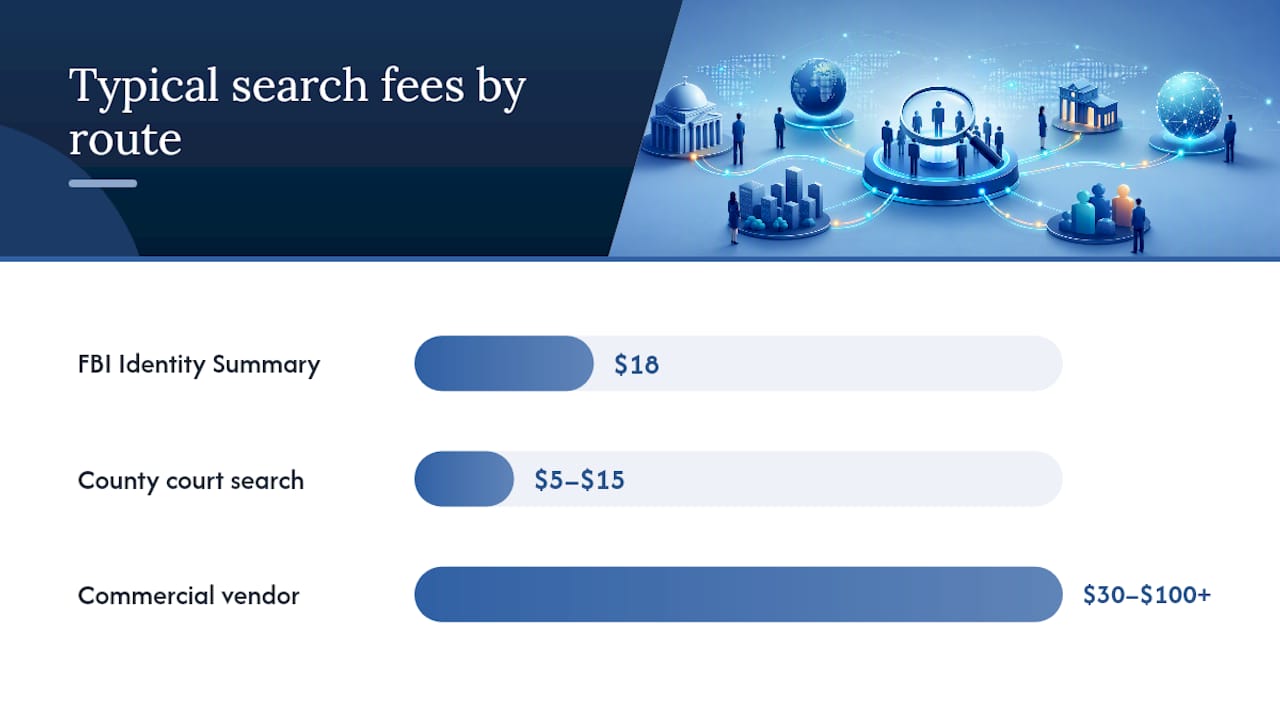
- Pay the $18 fee.
- Expect results in approximately 2–4 weeks by mail; channelers may be faster.
This is the check to request for visa applications, adoption proceedings, or any situation requiring a fingerprint-linked federal record.
Route 2: State criminal history repository
Each state runs its own portal. Three examples:
- Pennsylvania PATCH — submit online or by mail; fees and notarization options are listed on the PA PATCH page.
- North Carolina SBI — requests go through the NC State Bureau of Investigation; fees and turnaround vary.
- Texas DPS Crime Records Division — Texas DPS runs incremental name and date-of-birth combinations to improve matches; fingerprints are required for personal review when disputing results.
State repositories return state-level records only. They won’t include federal offenses or records from other states.
Route 3: County clerk or court search
Contact the clerk of court in each county where you’ve lived or been charged. Many courts now offer online docket searches. Request a certified copy if you need it for official purposes. Fees are typically a few dollars per search, though they vary by jurisdiction.
Route 4: Commercial vendor
Services like GoodHire compile data from multiple sources and return results quickly — often within 24–72 hours. When used for employment decisions, they must comply with FCRA. For personal use only, FCRA protections may not apply. Vendor fees typically range from $30–$100+ depending on search depth.
| Search Route | Typical Fee | Typical Turnaround | Coverage |
|---|---|---|---|
| FBI Identity History Summary | $18 | 2–4 weeks | Federal + multi-state (fingerprint-linked) |
| State repository (e.g., PA PATCH) | Varies by state | Days to 2 weeks | State-only |
| County court search | Varies (often $5–$15) | Same day to 1 week | County-level docket |
| Commercial vendor (e.g., GoodHire) | $30–$100+ | 24–72 hours | Multi-source aggregate |
Pro Tip: Before ordering any search, gather your full seven-year address history, your Social Security number, and any name variations (maiden name, aliases). Providing complete identifiers dramatically reduces false positives and missed records.
How do you authenticate records for international use?
If you need to submit a U.S. criminal record to a foreign government — for a visa, work permit, or adoption — a plain copy usually won’t be accepted. Here’s what the process looks like:
- Certified copy: Request a certified copy directly from the issuing agency (county clerk, state repository, or FBI). This carries an official seal or stamp.
- Notarization: Some countries require the document to be notarized by a U.S. notary public before further authentication.
- Apostille: For countries that are members of the Hague Apostille Convention, the Secretary of State in the issuing state (or the U.S. Department of State for federal documents) issues an apostille — a standardized certificate confirming the document’s authenticity.
- Embassy legalization: For countries not in the Hague Convention, you may need embassy or consulate legalization after the apostille step.
The FBI offers a specific process for internationally bound Identity History Summary requests — check the FBI’s Identity History Summary page for current instructions on obtaining a result suitable for apostille.
⏱️ Timing callout: Allow at least 6–10 weeks for the full chain: FBI request (2–4 weeks) + state certification + apostille processing (1–3 weeks) + any embassy step. Start early.
Documents to prepare:
- Completed fingerprint card
- Government-issued photo ID
- Payment for each agency’s fee
- Written request specifying the country of destination (some agencies adjust the format)
Why no single search covers everything
There is no single national criminal database that captures every record. Understanding why helps you avoid dangerous gaps.
Criminal records in the U.S. are decentralized by design. A charge filed in a county court may take weeks or months to flow up to a state repository. State repositories don’t automatically share with each other. Federal offenses sit in the federal court system and must be searched separately through PACER. Private databases aggregate from multiple sources but can lag on updates and miss sealed or expunged records.
Common pitfalls in criminal record verification:
- Name-only searches generate false positives for common names and miss records filed under aliases or maiden names.
- Missing dispositions — a state file may show an arrest but not the dismissal that followed.
- County-to-state reporting delays — a recent conviction may not yet appear in the state repository.
- No federal coverage — state and county searches will not return federal drug trafficking, wire fraud, or other federal charges.
Ways to improve accuracy:
- Always include date of birth and Social Security number in your search parameters.
- Run county searches for every jurisdiction where the subject has lived or worked.
- Use fingerprint-based checks when identity certainty is critical.
- Search PACER separately for any federal offense history.
Pro Tip: Keep a one-page checklist of your identifiers: full legal name, all aliases, SSN, DOB, and a list of counties where you’ve lived. Hand this to any screener or CRA at the start of the process. It cuts errors before they happen.
How to dispute errors and understand sealing or expungement
Errors on criminal records are more common than most people expect. Here’s how to fix them.
Disputing an error: step by step
- Get the full report. If a CRA provided the report for employment, you’re entitled to a free copy. For your own state record, request it directly from the repository.
- Identify the specific error. Wrong name, wrong date, missing disposition, or a record that belongs to someone else.
- File a dispute with the source. Go to the county clerk if the error is in court records. Go to the state repository (e.g., NY DCJS for New York residents) for state-level corrections. File with the FBI if the error is in your Identity History Summary.
- Submit documentation. Court orders, certified dispositions, or proof of identity are typically required.
- Notify the CRA. If a consumer reporting agency used the record for an employment decision, dispute it with the CRA directly as well. Under FCRA, CRAs must investigate within 30 days.
- Follow up in writing. Keep copies of every submission and every response.
Sealing and expungement basics
Expungement removes or destroys a record so it no longer appears in most public searches. Sealing restricts access — the record still exists but is hidden from most background checks. The distinction matters because:
- Sealed records typically don’t appear in consumer reports or public court searches.
- Law enforcement can still access sealed records in most states.
- Expunged records generally don’t appear anywhere, though some states allow exceptions for certain licensing decisions.
State laws vary enormously. New York, for example, offers sealing pathways through NY DCJS. Other states have broader expungement eligibility. Start by contacting your state’s court system or a legal aid organization to determine what you qualify for.
Pro Tip: After a successful dispute or expungement, send written notification to every CRA that used the original record in an employment decision. They are required to update their files, but they won’t do it automatically unless you tell them.
DIY searches vs. professional screening services
Choosing between running your own search and hiring a consumer reporting agency comes down to four factors: purpose, compliance, coverage, and cost.
When DIY makes sense:
- You’re checking your own record before a job search.
- You need a narrow-scope search (one county, one state).
- Cost is the primary concern and FCRA compliance isn’t required.
When a professional CRA makes sense:
- You’re an employer making a hiring decision — FCRA compliance is mandatory.
- You need multi-jurisdictional coverage quickly.
- You want built-in pre-adverse and adverse-action workflows.
- You need dispute support if a candidate challenges the results.
The CFPB’s background screening market snapshot documents how the industry relies on CRAs for structured, compliant report generation — and why employers increasingly outsource this function rather than run searches manually.
| Approach | Typical Cost | FCRA Compliant | Coverage | Dispute Support |
|---|---|---|---|---|
| DIY (county/state/FBI) | $5–$18 per search | No (for employment use) | Varies by search | None |
| Commercial CRA (e.g., GoodHire) | $30–$100+ | Yes | Multi-source | Yes |
For employers and landlords who need affordable background check options, a CRA typically delivers better coverage and legal protection than a DIY approach, even at a higher upfront cost. For individuals running a personal check, the FBI rap sheet plus your state repository is the most authoritative combination.
Techstacktoday’s reviewed and ranked background check services cover the top CRAs with hands-on testing — useful if you’re comparing vendors for employment or tenant screening.
How criminal record screening differs from other background checks
Criminal record screening is one component of a broader background check, not the whole thing. Here’s how it compares to the other common checks:
Criminal record check searches court and law enforcement databases for arrests, charges, and convictions. It tells you about legal history, not financial behavior or work history.
Credit check pulls a consumer credit report from Equifax, Experian, or TransUnion. It shows debt, payment history, bankruptcies, and credit utilization. Employers in certain industries (finance, positions with financial responsibility) use it, but it requires separate FCRA authorization and is governed by additional state restrictions.
Employment verification confirms job titles, dates of employment, and sometimes salary history with past employers. It doesn’t touch criminal or financial records.
Education verification confirms degrees and dates of attendance with institutions. Completely separate from criminal history.
Motor vehicle record (MVR) check pulls driving history from the state DMV. Relevant for roles involving driving, but unrelated to criminal court records.
A full background check for a sensitive position might include all five. A landlord might run only a criminal check and a credit check. Understanding which check is being run tells you exactly what information is being reviewed. See examples of background check categories for a breakdown of how these checks are combined in practice.
How to choose the right type of criminal record check
Match the check type to the purpose. Here’s a direct decision guide:
Employment (general): Start with a county search for every jurisdiction where the applicant has lived in the past seven years, plus a state repository search. Add a commercial database sweep for speed. Use a CRA to stay FCRA-compliant.
Employment (regulated industry — healthcare, finance, education): Add a fingerprint-based state check and, where required by law, an FBI Identity History Summary. Some roles require checks through specific state licensing boards.
Housing/tenant screening: A commercial CRA report covering criminal history and credit is standard. Confirm the CRA’s report complies with FCRA and any applicable state fair housing rules.
Volunteering with vulnerable populations: Most states require a fingerprint-based check through the state repository or FBI. Contact the organization’s state licensing body to confirm the required check type.
Visa or immigration: The FBI Identity History Summary is the standard requirement. Request it early — the 2–4 week turnaround is the minimum, and apostille processing adds time.
Personal record review: FBI Identity History Summary plus your state repository covers the most ground. Add a county search for any jurisdiction where you’ve had legal contact.
The key decision criterion: does the result need to be FCRA-compliant? If it’s being used to make a decision about employment, housing, or credit, the answer is yes, and a licensed CRA is required.
How criminal records affect employment and housing opportunities
A criminal record doesn’t automatically disqualify you from a job or apartment. But it does create real obstacles, and knowing how to address them matters.
Employment: Many employers use blanket policies that screen out applicants with any criminal history. The EEOC’s individualized assessment guidance pushes back on this — an employer who rejects every applicant with a felony, regardless of the offense or how long ago it occurred, faces potential Title VII liability. If you’re flagged, you have the right to respond to a pre-adverse notice with context.
Practical steps to take:
- Obtain certified copies of court records showing dismissals, completions of sentence, or expungements before you apply.
- Prepare a brief, factual written statement explaining the circumstances and what has changed since.
- Research “ban the box” laws in your state or city — many jurisdictions now prohibit employers from asking about criminal history on the initial application.
Housing: Landlords have more discretion than employers, but HUD guidance discourages blanket bans on renting to people with criminal records, particularly for arrests without convictions. If you’re denied housing based on a criminal record, ask for the specific reason in writing. Some states require landlords to conduct individualized assessments similar to the EEOC standard.
If outdated or inaccurate records are showing up in public searches and affecting your opportunities, a data removal service can help reduce your digital footprint beyond what formal expungement covers.
Privacy laws and data protection beyond FCRA and EEOC
FCRA and EEOC guidance are the federal floor. Many states go further.
State-level restrictions on criminal history use:
- California (AB 1008) prohibits employers from asking about criminal history before a conditional offer and requires individualized assessments before withdrawal.
- New York City (Fair Chance Act) bans criminal history questions before a conditional offer and requires a detailed written analysis before any adverse action.
- Illinois (Job Opportunities for Qualified Applicants Act) restricts when criminal history can be considered in hiring.
- Massachusetts (CORI reform) limits what criminal records can be reported and who can access them, with specific rules for employers and landlords.
Data handling obligations for CRAs:
Consumer reporting agencies that compile and sell criminal history data must comply with FCRA’s accuracy, dispute, and deletion requirements. They must also follow state data broker laws where applicable — California’s CCPA, for example, gives consumers rights to access and request deletion of personal data held by data brokers, which can include background check companies.
For individuals: If you discover that a data broker is publishing your criminal history online (even expunged records), you may have grounds to request removal under state privacy laws. The identity protection checklist at Techstacktoday covers the steps to audit and reduce your public data exposure.
What to expect after you dispute an error
Filing a dispute starts a clock. Here’s what the timeline looks like and what to do at each step.

With a CRA (consumer reporting agency):
Under FCRA, the CRA must complete its investigation within 30 days of receiving your dispute (45 days if you provide additional information during the investigation). The CRA must contact the source of the information (the county court, state repository, or other data provider) and verify accuracy. If the information can’t be verified, it must be deleted or corrected.
With a state repository:
Timelines vary by state. Most repositories acknowledge receipt within 10–15 business days and aim to resolve disputes within 30–60 days, though complex cases can take longer. Texas DPS, for example, requires fingerprints for personal record review when disputing results — factor in the time to get fingerprinted.
With the FBI:
Disputes to your Identity History Summary go through the FBI’s Criminal Justice Information Services (CJIS) Division. The FBI contacts the originating agency (the state or local agency that submitted the record) to verify or correct it. This process can take 30–90 days depending on how quickly the originating agency responds.
Follow-up steps:
- Confirm the correction in writing from each agency.
- Request an updated copy of your record after the correction is confirmed.
- Notify any CRA that used the incorrect record for an employment or housing decision — send the correction notice and request that they update their file.
- If a CRA fails to correct after notification, you can file a complaint with the CFPB or your state attorney general.
Keep every piece of correspondence. A paper trail is your protection if the error resurfaces.
The TechStackTeam’s take on criminal record screening
Most people treat criminal record screening as something that happens to them. That’s the wrong frame. The smarter move is to treat it as something you manage proactively.
Run your own FBI Identity History Summary and state repository check before any employer or landlord does. Errors are common enough that discovering one after a pre-adverse notice — when you have days to respond — is a genuinely bad situation. Discovering it three weeks before your job search starts gives you time to fix it.
The second mistake we see constantly: relying on a single national database search as if it’s comprehensive. It isn’t. No private database captures every county court record, every federal case, and every state repository entry with current dispositions. A thorough search requires layering county, state, and federal sources. That’s not a flaw in the system — it’s how the U.S. court structure works, and understanding it puts you ahead of most applicants.
For employers: the EEOC’s individualized assessment isn’t just a legal shield. It’s a better decision-making process. A blanket exclusion policy rejects qualified candidates and creates liability. An individualized review takes ten minutes and produces a defensible, documented decision.
Finally, keep a single folder — physical or digital — with your certified record copies, dispute receipts, and any correction confirmations. If a record error resurfaces months later (it happens), that folder is what resolves it quickly.
Sources
Official pages to bookmark for procedures, forms, and legal guidance:
- FBI — Identity History Summary Checks
- EEOC — Enforcement guidance on the consideration of arrest and conviction records in employment decisions under Title VII
- Bureau of Justice Statistics (BJS)
- CFPB — Market Snapshot: Background screening reports
- Request a Criminal History Background Check | Commonwealth of Pennsylvania
- PACER — Public Access to Court Electronic Records
This article is general information, not a substitute for advice from a qualified lawyer. Consult a qualified legal professional about your own circumstances before acting on anything here.