Financial data brokers build detailed, permanent dossiers on you and sell them to nearly anyone willing to pay. That single fact is why the risks of financial data brokers are so serious: your income estimates, credit identifiers, home address, debt signals, and transaction patterns sit in databases you never consented to, updated constantly, and available to scammers, stalkers, and foreign intelligence services alike. The Joint Economic Committee estimated in 2026 that broker-related breaches have cost American consumers more than $20.8 billion over the preceding decade. That is not a hypothetical threat.
Take these three steps right now:
- ❄️ Freeze your credit at all three major bureaus (Equifax, TransUnion, and Experian) — free and immediate at each bureau’s website.
- 🔍 Submit opt-out requests at the largest data broker sites (start with Spokeo, Whitepages, and Intelius) and check whether your state has a centralized opt-out registry.
- 🔐 Enable multi-factor authentication on every financial account and use a dedicated password manager to replace reused or weak credentials.
Pro Tip: If you are a domestic violence survivor, active-duty military member, or federal employee with a security clearance, treat this as a high-priority emergency. Use an attorney’s address as your contact point on sensitive accounts and file an identity-theft affidavit template with the FTC before a breach happens, not after.
Table of Contents
- How do data brokers collect and combine your financial data?
- What specific dangers do financial data brokers create for you?
- What do documented breaches and investigations tell us about the scale?
- How can you reduce your risk from financial data brokers right now?
- What should you do if your financial data has already been misused?
- Key Takeaways
- The real problem with how most people think about data broker risk
- How Techstacktoday helps you choose the right privacy tools
- Useful sources to verify and go deeper
How do data brokers collect and combine your financial data?
The collection pipeline is more sophisticated than most people realize. Here is how your data moves from source to sale:
- Public records ingestion: Property deeds, court filings, voter registrations, and business licenses are scraped automatically and continuously.
- Credit-header purchases: Some brokers buy header data directly from credit bureaus or their affiliates, capturing name, address, and partial identifiers without triggering FCRA consumer-report rules.
- App and SDK telemetry: Mobile apps embed third-party SDKs that transmit location, device identifiers, and behavioral signals to broker networks in real time.
- Fintech and aggregator feeds: When you connect a bank account to a budgeting app, that aggregator may retain your transaction metadata even after you disconnect. As EPIC has documented, fintech aggregators can act as hidden brokers, sharing or selling that downstream financial data to parties you never interacted with.
- Payment and loyalty data: Retail loyalty programs and co-branded card networks sell anonymized purchase histories that brokers then re-link to named individuals.
- Broker-to-broker purchases: Brokers buy from each other, layering datasets until a profile contains thousands of attributes per person.
The re-identification problem is critical. A dataset labeled “anonymous” becomes identifiable the moment it is combined with a second dataset containing even partial identifiers. The Brennan Center has documented how cross-source linking and inference models let brokers reconstruct named profiles from supposedly de-identified records. Brokers also evade accountability through vendor-label ambiguity, claiming they are “analytics” or “identity verification” firms rather than data brokers, and by burying opt-out pages with no-index tags so search engines cannot find them, as CalMatters reported.
Understanding how identity thieves exploit this data makes the collection pipeline much easier to defend against.
What specific dangers do financial data brokers create for you?
The dangers of data brokerage fall into five distinct harm categories, each with real documented cases.
Identity theft and account takeover
Broker dossiers contain exactly what a fraudster needs to open credit lines, file false tax returns, or take over existing accounts: full name, address history, partial Social Security numbers, and answers to common security questions. Large, permanent pools of financial data are an attractive target precisely because they let attackers predict passwords and impersonate victims with high confidence. See the role data brokers play in identity theft for a deeper breakdown of the mechanics.
Targeted scams and financial fraud
The Joint Economic Committee confirmed criminal cases from 2020 and 2021 where brokers supplied detailed profiles of vulnerable elderly Americans to scammers, resulting in criminal convictions. The brokers sold lists segmented by age, income estimate, and cognitive vulnerability indicators. Those lists went directly to fraud operations.

Doxxing, stalking, and physical safety threats
The CFPB’s December 2024 proposed rule specifically cited stalking and doxxing as documented outcomes of broker data sales. When a broker profile includes a current home address, workplace, daily routine inferences, and financial stress indicators, it gives a stalker or abusive ex-partner a ready-made surveillance package. The CFPB press release named this explicitly as a driver of the proposed rulemaking.
Automated discrimination and exclusion
FTC-presented research has measured coverage biases in broker datasets that can amplify discriminatory outcomes. Financial institutions and insurers can use inferred variables from broker profiles to deny access or raise prices without any transparency to the consumer. You may never know a broker’s inaccurate income estimate cost you a loan approval.
National-security and blackmail risks
Brokered profiles that include income levels, debt stress, foreign travel, and family contacts are useful to foreign intelligence services. The CFPB’s rulemaking rationale explicitly flagged espionage risk: a foreign actor purchasing a dossier on a federal employee or military member gets a ready-made blackmail or recruitment package. The Brennan Center’s analysis of this national-security dimension is among the most detailed available.
📊 Scale of harm: The Joint Economic Committee estimated broker-related breaches cost American consumers more than $20.8 billion over the preceding decade, calculated using breach exposure counts and a median loss per identity-theft incident.
Recovery from identity theft is not quick. Disputes with credit bureaus can take months. Fraudulent accounts may resurface. The emotional cost and the time spent on documentation, calls, and follow-up add a burden that statistics rarely capture. Knowing the warning signs of identity theft early cuts that recovery time significantly.
What do documented breaches and investigations tell us about the scale?
The evidence is not theoretical. Named incidents show exactly how broker data escapes into criminal hands.
| Year | Broker / Entity | Records Exposed | Key Source |
|---|---|---|---|
| — | Equifax | millions | FTC / Congressional record |
| 2018 | Exactis | hundreds of millions | Security researcher disclosure |
| 2023 | National Public Data | billions (claimed) | Investigative reporting |
| 2025 | TransUnion | a few million | JEC report |
The Equifax breach exposed credit-file data on millions of Americans, including Social Security numbers and birth dates. Exactis exposed hundreds of millions of records in 2018 including financial and personal attributes. The National Public Data breach in 2023 involved a claimed billions of records, though the verified unique count was lower. TransUnion’s exposure appeared in the congressional review timeline.
📊 The aggregate cost: The Joint Economic Committee put the total estimated consumer loss from broker-related breaches at more than $20.8 billion, based on breach exposure counts and an assumed median loss per identity-theft incident.
The Markup’s investigation tied several of these major breaches to hundreds of millions of exposed records and directly fed the congressional findings. The reporting chain matters: investigative journalism by The Markup and CalMatters triggered congressional scrutiny, which produced the JEC report, which in turn supported the CFPB’s December 2024 proposed rulemaking. Public pressure and reporting have produced real, if incremental, regulatory movement. The Independent’s reporting on the industry’s scale and the difficulty consumers face when trying to remove their data reinforces why individual action cannot wait for policy to catch up.
How can you reduce your risk from financial data brokers right now?
Start with the highest-impact steps and work down the list. Do not try to do everything at once.
- Submit opt-out requests at major broker sites. Start with the largest: Spokeo, Whitepages, BeenVerified, Intelius, and LexisNexis. California residents can use the state’s centralized broker registry. For a step-by-step walkthrough, Techstacktoday’s Spokeo removal guide is a practical starting point.
For a broader removal strategy, Techstacktoday’s guide on how to remove yourself from the internet covers suppression across dozens of broker sites with step-by-step instructions.
DIY vs. paid removal services: Manual opt-outs are free but time-consuming and rarely permanent. Brokers re-scrape public records and repurchase upstream data, so your profile often reappears within weeks. Paid removal services automate repeated requests and monitor for reappearance. They are not comprehensive, but they reduce the ongoing maintenance burden significantly. If your time is limited or your risk level is high (public figure, domestic violence survivor, government employee), outsourcing makes sense.
Pro Tip: If you are a survivor of domestic violence or a high-exposure professional, use an attorney’s address or a P.O. box as your contact address on sensitive accounts. File an FTC identity-theft affidavit template before any incident occurs. Some states offer address confidentiality programs (ACPs) that legally substitute a protected address for your real one in public records.
For readers interested in trading privacy and financial data exposure, the same broker risks apply to financial signals and trading activity.
What should you do if your financial data has already been misused?
Don’t panic. Work through these steps in order.
Immediate actions (within 24 hours):
- Secure your email account first. Change the password and enable MFA. Your email is the recovery key for every other account.
- Freeze credit at all three bureaus if you have not already done so.
- Contact your bank and card issuers directly. Report fraudulent transactions, request new account numbers, and ask for a fraud flag on your file.
- File a report at FTC IdentityTheft.gov. The site generates a personalized recovery plan, an identity-theft affidavit, and pre-written dispute letters for creditors and bureaus.
- File a police report if you have documented financial losses. Some creditors require a police report number to process disputes.
Documentation steps:
- Screenshot every fraudulent account, transaction, and communication you find.
- Record dates, times, and the names of every representative you speak with.
- Save all written correspondence in a dedicated folder. Creditors and law enforcement may request this evidence months later.
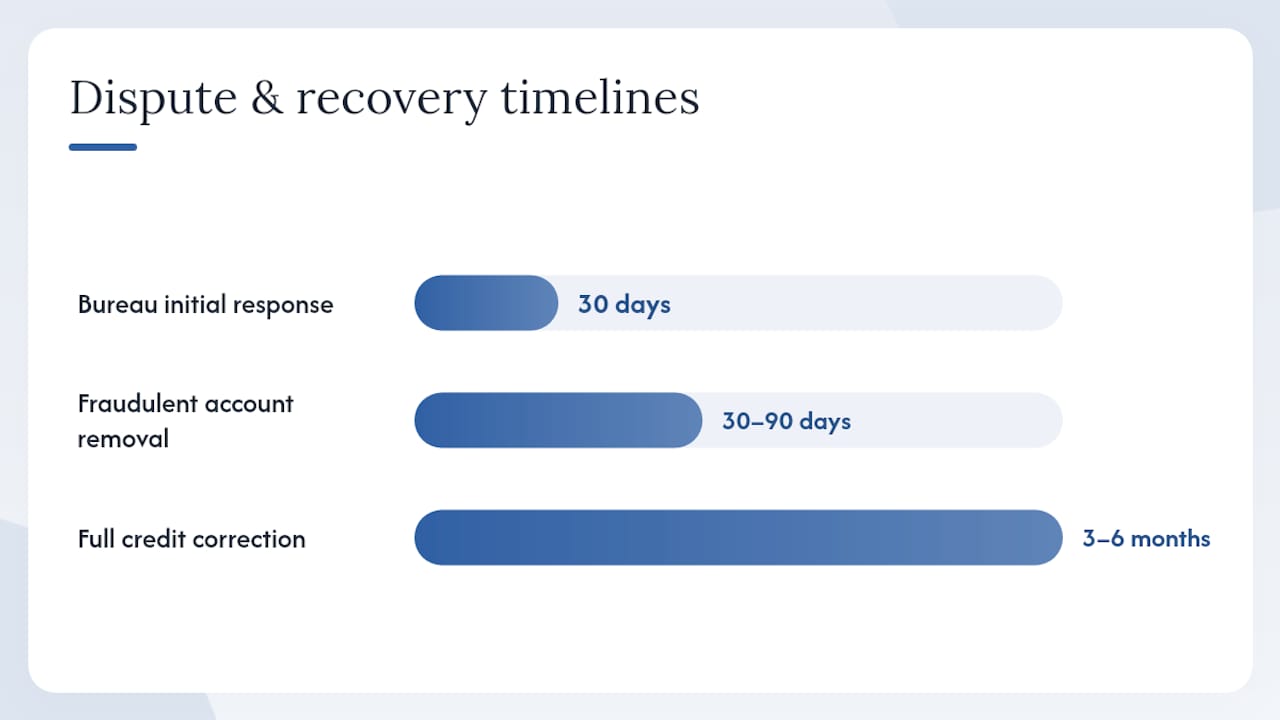
Dispute and recovery timeline:
- Credit bureau disputes: 30 days for initial response under FCRA.
- Fraudulent account removal: 30–90 days, depending on the creditor’s process.
- Full credit file correction: can take 3–6 months if multiple accounts are affected.
Expected costs: Credit freezes and fraud alerts are free. FTC reporting is free. Dispute letters cost nothing. Where costs appear: identity-theft protection monitoring services ($10–$30/month), legal help for complex cases, and replacement documents (Social Security card replacement is free; passport replacement is not).
Support resources:
- FTC IdentityTheft.gov: recovery plans, dispute letters, and affidavit templates
- Identity Theft Resource Center (IDTRC): free victim assistance by phone and chat
- Consumer Financial Protection Bureau complaint portal: for disputes with financial institutions
- State attorney general offices: for state-level fraud reporting
Techstacktoday’s guide on protecting your identity after a data breach walks through the full dispute process with templates and timelines. If you are unsure whether your identity has been compromised, the diagnostic checklist covers the key indicators to look for.
Pro Tip: Preserve evidence with timestamps. Take screenshots and immediately email them to yourself so the email server creates an independent timestamp. If you later need to prove to a creditor or law enforcement when you discovered the fraud, that timestamp is your documentation.
Key Takeaways
Financial data brokers create concentrated, long-lived dossiers that substantially raise your risk of identity theft, targeted fraud, stalking, discrimination, and national-security exposure, and the Joint Economic Committee estimates these breaches have already cost American consumers more than $20.8 billion.
| Point | Details |
|---|---|
| Freeze credit immediately | A free credit freeze at all three bureaus is the single highest-impact defense against new-account fraud. |
| Opt-outs are not permanent | Broker profiles reappear within 30–90 days; ongoing monitoring or a paid removal service is necessary for durable suppression. |
| Legal gaps are real | Most commercial data brokers currently operate outside FCRA obligations; the CFPB’s proposed rule is not yet final, so individual action is essential now. |
| Documented losses are massive | The Joint Economic Committee estimated more than $20.8 billion in consumer losses from broker-related breaches over the preceding decade. |
| Techstacktoday guides your choices | Techstacktoday’s hands-on reviews of data removal services, password managers, and identity protection tools help you pick the right defenses for your risk level. |
The real problem with how most people think about data broker risk
Most privacy advice treats data brokers as a nuisance. They are not. They are a structural vulnerability in the U.S. financial identity system, and the gap between how seriously consumers take them and how seriously criminals and foreign intelligence services take them is enormous.
The conventional wisdom says: “Submit a few opt-outs and you’re fine.” That is wrong in two ways. First, opt-out is not permanent. Brokers re-scrape and repurchase data continuously, so a profile you deleted last month may be back next month. Second, the harm does not require a breach. Your data is being sold right now, to buyers you will never know about, for purposes that range from targeted scam calls to national-security exploitation. A breach just makes the existing risk visible.
What actually works is a layered defense: freeze credit, use a password manager, enable MFA, and treat opt-outs as an ongoing maintenance task rather than a one-time fix. The readers who are most protected are not the ones who did the most research. They are the ones who did the three highest-impact things immediately and then set a calendar reminder to repeat the opt-out process every 90 days.
The CFPB’s proposed rulemaking is a meaningful step, but it is not final, and regulatory timelines are long. Waiting for policy to protect you is a losing strategy. The tools to reduce your exposure exist today. Use them.
How Techstacktoday helps you choose the right privacy tools
Choosing between data removal services, identity monitoring platforms, and VPNs is genuinely confusing. Techstacktoday cuts through that by testing each service in real-world conditions, scoring it on actual performance, and publishing the results without paid rankings influencing the outcome. No affiliate relationship changes a score. That independence is what makes the recommendations worth following.

If you are ready to act, start with Techstacktoday’s analysis of whether a data removal service is worth it for your specific situation. It covers the cost-benefit breakdown, which services cover the most brokers, and when the DIY route is sufficient. For credential security, the best password managers guide ranks options by security architecture and ease of use. And if you want to understand how VPNs layer into your overall privacy defense, the VPN services review and ranking gives you tested comparisons with current deals. Pick the guide that matches your most urgent gap and start there.
Useful sources to verify and go deeper
These are the primary documents and investigative reports behind this article. Read them in the order that matches your goal.
-
CFPB NPRM — Protecting Americans from Harmful Data Broker Practices (2024): — Read this to understand exactly what the proposed federal rule would change and which FCRA obligations it would extend to commercial brokers. Essential for anyone tracking the regulatory timeline.
-
The Markup — Congressional Findings (2026): — Read this to understand how investigative journalism directly triggered congressional action. Documents the reporting-to-policy chain.
-
CalMatters — Data Brokers Cost Americans $21 Billion (2026): — Covers the no-index opt-out page tactic and California-specific regulatory context. Best source for understanding how brokers actively obscure removal options.
-
Brennan Center — Closing the Data Broker Loophole (2024): — Detailed legal and policy analysis of reidentification risks, national-security implications, and the structural regulatory gaps. Read this if you want the policy argument in depth.
-
EPIC — Fintech Aggregators and Data Retention (2025): — Covers the hidden broker role of fintech apps and aggregators. Read this if you use budgeting apps, investment platforms, or any service that connects to your bank account.
-
FTC / PrivacyCon 2022 — Measuring Biases in a Data Broker’s Coverage: — Academic research on coverage gaps and discrimination risks. Read this if you want to understand how broker inaccuracies can produce unfair outcomes in credit, insurance, or employment.
This article is general information, not legal or financial advice. Verify current rules and your specific situation with the primary sources above or a qualified professional.