Data removal services can suppress your contact details, social profile copies, photos, device identifiers, and certain background-check records from people-search sites and data broker databases. They cannot erase official government records. That distinction matters for every decision you make about privacy protection.
TL;DR:
- ✅ Can suppress: Home address, phone numbers, email addresses, past addresses, social profile copies, mugshots, partial SSN exposures in search results, financial account numbers shown in broker profiles, inferred attributes (estimated income, political interests), IP/device identifiers in public logs
- ⚠️ Partial success: Criminal/court database display entries (broker copies yes, original court filings no), background-check aggregator records
- ❌ Cannot suppress: Original government records (property deeds, voter rolls, court filings), upstream enterprise data feeds, or any data at its source
The FTC’s guidance on identity theft and the CFPB both recommend combining opt-outs with credit freezes and active monitoring. Google’s Results About You tool lets you request removal of phone numbers, home addresses, email addresses, driver’s license numbers, passport numbers, and Social Security numbers from Google Search results — but only from search results, not from the underlying websites.
Table of Contents
- What are the main examples of suppressed data categories?
- What suppression can and cannot realistically do
- DIY opt-outs vs. paid removal services
- Protections to pair with suppression
- Key Takeaways
- The gap between what removal promises and what it delivers
- Techstacktoday’s tested resources for data removal and privacy
- Useful official and authoritative sources
What are the main examples of suppressed data categories?
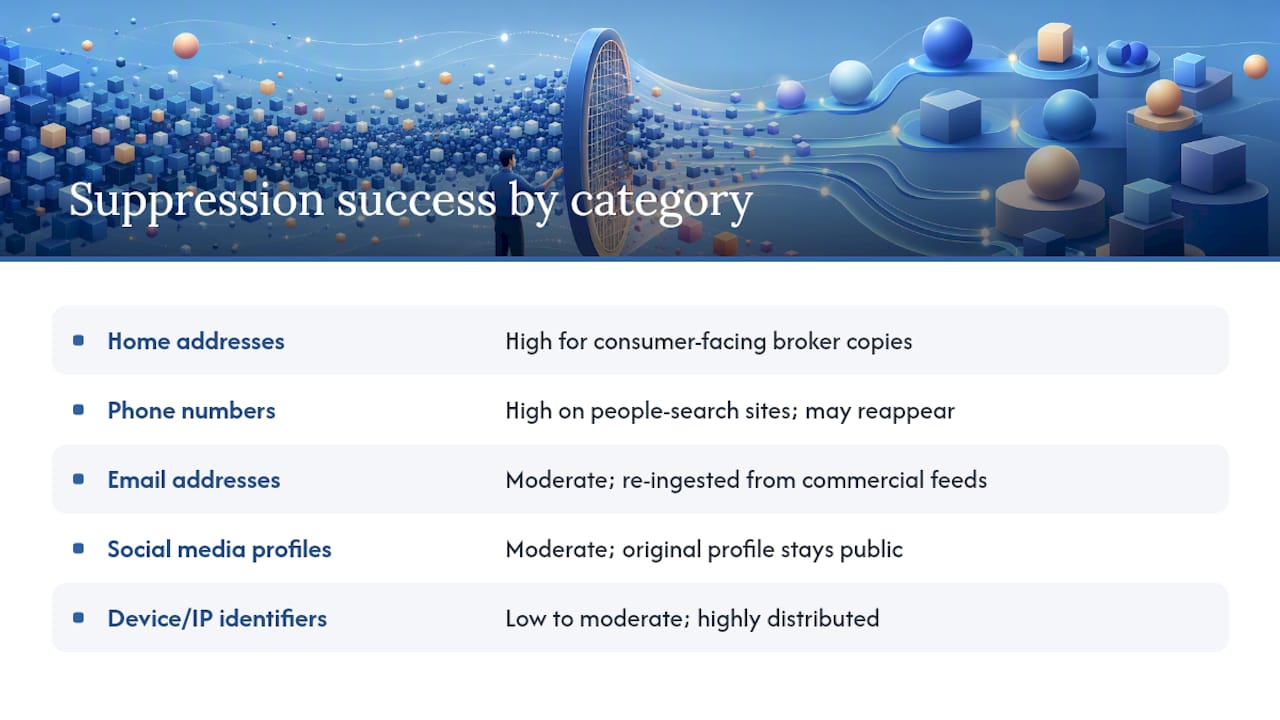
Data removal services focus on a consistent set of personal data fields. Here are the categories, what they look like in the wild, and how well suppression typically works.
1. Home address and past addresses
Your current street address and every address you’ve lived at for the past decade show up on Spokeo, Whitepages, BeenVerified, Intelius, and MyLife. Suppression success: high for consumer-facing broker copies. The underlying government records remain intact.
2. Phone numbers
Mobile and landline numbers scraped from public records and marketing lists. Spokeo and Whitepages display them prominently. Suppression success: high on people-search sites; numbers can reappear when brokers buy fresh marketing data.
3. Email addresses
Personal and work emails sourced from data breaches, warranty registrations, and loyalty programs. Suppression success: moderate — brokers re-ingest emails from commercial feeds regularly.
4. Social media profile copies and public posts
Aggregated copies of your LinkedIn, Facebook, or Instagram profile data. Suppression success: moderate — removal services can request delisting, but the original social profile remains public if you haven’t locked it down yourself.
5. Photos and mugshots
Arrest photos published by mugshot sites and scraped profile images. Suppression success: variable — dedicated mugshot removal often requires direct site contact or legal pressure; some sites charge fees to remove images.
6. Partial SSN exposures in search results
Partial Social Security numbers sometimes surface in background-check results on BeenVerified or Intelius. Google’s Results About You tool specifically targets SSN removal from search results. Suppression success: high via Google tool; broker-side removal is slower.
7. Financial account numbers
Account numbers occasionally appear in broker profiles compiled from data breach dumps or commercial sources. Suppression success: high when identified — but you need to find them first.
8. Criminal and court database display entries
Arrest records and court case summaries shown on MyLife and background-check aggregators. Suppression success: partial — brokers remove their compiled copy, but the original court filing stays with the county clerk. Background-check aggregators often require formal CCPA requests.
9. Device and IP identifiers in public logs
IP addresses and device IDs in publicly accessible logs or data breach databases. Suppression success: low to moderate — these are highly distributed and hard to track across all sources.
10. Inferred attributes
Estimated income, political affiliation, consumer interests, and household composition shown on broker profiles. Suppression success: moderate — brokers can remove the display, but they regenerate these inferences from fresh data.
Pro Tip: Mugshot sites and background-check aggregators are the two categories where DIY opt-outs most often stall. If you hit a wall, a paid removal service with legal escalation options is worth the cost for those specific records.
What suppression can and cannot realistically do
Suppression removes a broker’s compiled copy of your data. It does not touch the original government record that fed that copy. That structural reality means reappearance is expected, not a failure.
What suppression handles well:
- Consumer-facing people-search profiles (Spokeo, Whitepages, MyLife, BeenVerified, Intelius)
- Broker-held contact details and inferred attributes
- Search result entries via Google Results About You
- Mugshot site listings (with persistence)
What suppression cannot do:
- Delete property deeds, court filings, or voter registrations from government systems
- Remove data from upstream enterprise B2B feeds that never appear in consumer search
- Guarantee permanent deletion — reappearance is structurally built in when new public records are filed or brokers buy fresh data
| Scope | Suppression works | Suppression does not work |
|---|---|---|
| People-search broker profiles | ✅ Yes | |
| Google Search results (sensitive fields) | ✅ Yes (Results About You) | |
| Original government records | ❌ No | |
| Upstream enterprise B2B data | ❌ No | |
| Dark web breach dumps | Partial | |
| Background-check aggregators | Partial (CCPA request needed) |
Legal context: California’s DELETE Act (DROP) portal lets residents submit a single opt-out request to all registered brokers. Coverage and processing windows vary by broker size and registration status. CCPA/CPRA gives California residents the right to request deletion; other states have similar but narrower laws.
⚠️ Watch out for identity verification requests. Some brokers ask you to upload a government ID to process your opt-out. Only submit the minimum required — a redacted ID showing your name and address, nothing more. Oversharing to opt out can create a new exposure.
DIY opt-outs vs. paid removal services
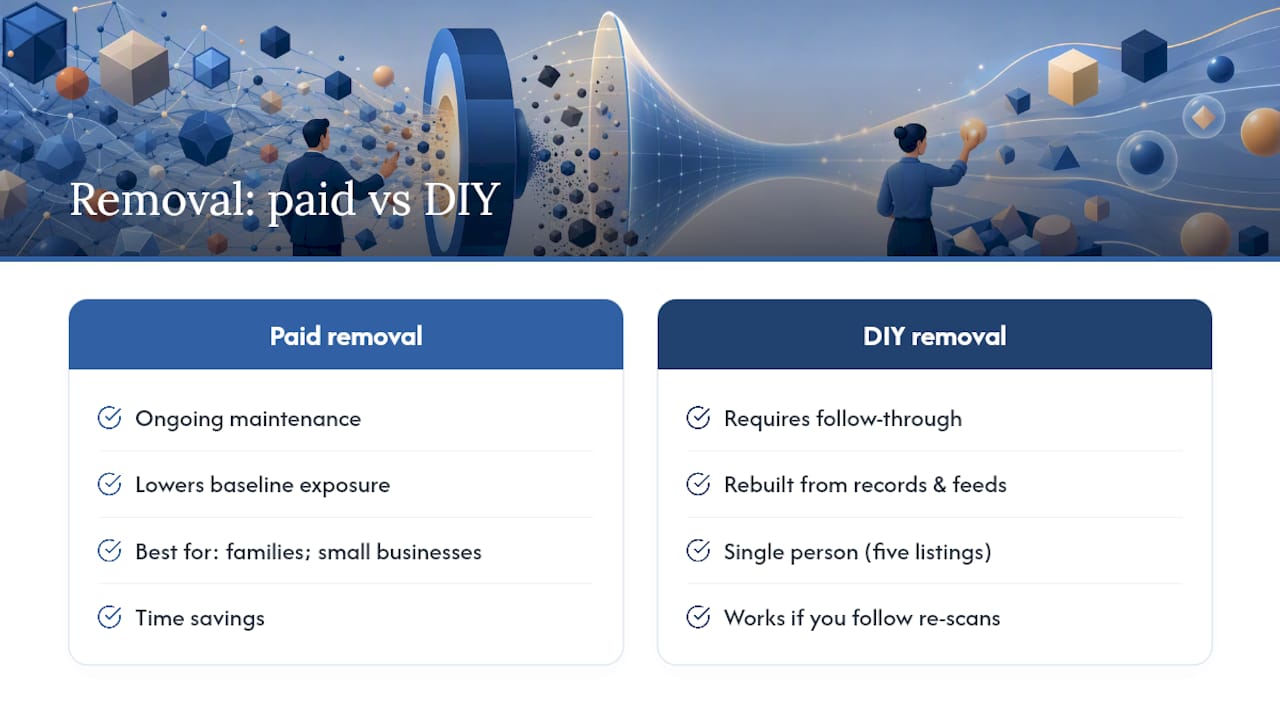
DIY works for a handful of listings. Paid services make sense when you have broad exposure, a family to cover, or a small business with multiple employees listed.
| Factor | DIY opt-outs | Paid removal service |
|---|---|---|
| Time required | High (hours per site) | Low (automated) |
| Coverage breadth | Limited to sites you find | Hundreds of brokers |
| Re-scan frequency | Manual, easy to forget | Scheduled automatically |
| ID verification friction | You manage it | Service handles it |
| Cost | Free | Monthly/annual subscription |
| Best for | 1–5 listings, low exposure | Families, businesses, high exposure |
Red flags to avoid in paid services:
- Promises of “permanent deletion” (structurally impossible)
- Requests for more personal data than necessary to file opt-outs
- No clear cancellation or refund policy
- No disclosure of which broker domains they actually submit to
Criteria for a legitimate service: submits to official broker opt-out domains, publishes rescan cadence, provides a removal report, and has a clear refund policy.
Pro Tip: Evaluating whether a paid service is worth it comes down to one question: how many active listings do you have? Run a free manual scan first. If you find more than 10–15 listings, the time math almost always favors a subscription.
Protections to pair with suppression
Suppression reduces your searchable profile. These actions protect you if your data is already out there.
- Identity monitoring — scans dark web, public records, and USPS change-of-address requests for your information; monitoring detects exposure but doesn’t prevent breaches at source
- Strong passwords and MFA — use a password manager and enable multi-factor authentication on every account that holds sensitive data
Pair suppression with a credit freeze and monitoring for the most complete protection stack, supported by ever evolving data quality and fraud prevention measures. Suppression alone won’t stop a breach at a company you do business with — but it reduces how much of your data is available to attackers who are building a profile on you.
Key Takeaways
Suppression removes broker copies of your personal data, not original government records — so expect reappearance and plan for ongoing maintenance.
| Point | Details |
|---|---|
| Suppress high-impact categories first | Start with live contact details, SSN exposures, and financial account numbers before tackling inferred attributes. |
| Reappearance is structural, not a failure | Brokers re-ingest fresh public records and commercial data; schedule re-scans every 30–90 days. |
| Credit freezes are free | Place a security freeze at Equifax, Experian, and TransUnion at no cost to block new fraudulent credit accounts. |
| Paid services fit broad or family exposure | DIY opt-outs work for a handful of listings; subscriptions make sense when coverage spans families or businesses. |
| Techstacktoday tests removal services hands-on | Techstacktoday’s hands-on reviews evaluate opt-out effectiveness and rescan cadence so you can compare services before buying. |
The gap between what removal promises and what it delivers
There’s a version of data removal marketing that implies a clean slate. You submit your requests, the listings disappear, and you’re done. That framing sells subscriptions but sets you up for frustration.
The honest picture is messier. Brokers don’t just hold your data — they continuously regenerate it from public records, commercial feeds, and other brokers. Removing your Spokeo listing today doesn’t stop Spokeo from rebuilding it next quarter when a new voter registration or property record gets filed. That’s not a flaw in the service you hired. It’s how the data ecosystem is built.
What removal services actually give you is a lower baseline exposure over time. Consistent re-filing keeps your profile off the most-searched consumer sites. That matters, especially for live contact details and SSN exposures, where the risk is immediate and concrete. The data suppression process is less like deleting a file and more like weeding a garden — you don’t do it once and walk away.
The readers who get the most value from paid removal services are the ones who understand this upfront. They’re not buying a one-time clean sweep. They’re buying ongoing maintenance and the time savings that come with it. For families with multiple members listed, or small businesses with employee data exposed, that math is straightforward. For a single person with five listings, DIY is probably enough — if you actually follow through on the re-scans.
Techstacktoday’s tested resources for data removal and privacy
Knowing which categories to suppress is step one. Finding a service that actually follows through on re-scans and opt-out submissions is step two — and that’s where most people get stuck.

Techstacktoday runs hands-on checks of data removal and identity protection services, testing opt-out effectiveness, rescan cadence, and coverage breadth across real broker databases. No paid rankings. No guesswork. Just performance-based comparisons you can act on.
If you’re ready to compare your options, start with the data removal service guide to see which services deliver on their promises. For a full privacy stack that pairs suppression with VPN protection and password management, the complete internet removal guide walks you through every layer.
Useful official and authoritative sources
- How identity theft protection works
- Data Broker Opt-Out: What It Does, What It Does Not, and How to Start
- Personal Data Removal Services: What They Can (and Can’t) Delete – How To Stay Private
- The Complete Data Broker Opt-Out Guide (2026) – OfflistMe Blog
- What a Data Removal Service Can and Can’t Realistically Do – Privacy Bee
- Personal data removal services: How they work and why you need one – PCMag
- What are the benefits of identity theft protection? – Experian
- How One Family Reduced Their Data Exposure by 87% in 30 Days | GhostMyData