Tax identity fraud happens when a criminal uses your Social Security number (SSN) or Employer Identification Number (EIN) to file a fraudulent tax return and steal your refund. Don’t panic — but do act fast.
Your first three priorities:
- Check whether your e-file was rejected as a duplicate return
- Report to the IRS and FTC at IdentityTheft.gov
- Request an IP PIN from the IRS to block future fraudulent filings
Table of Contents
- What tax identity fraud really means (and how it differs from other identity theft)
- How criminals pull off tax identity fraud
- Signs that tax identity fraud may have hit you or your business
- Step-by-step: what to do right now if you suspect tax identity fraud
- How the IRS handles your case after you report
- A practical prevention checklist you can start today
- How privacy tools reduce your tax identity fraud risk
- Special considerations for small businesses
- Key Takeaways
- Why tax identity fraud should be every privacy-minded person’s top concern
- Techstacktoday’s privacy tool reviews can help you stay protected
- Authoritative sources and contacts
What tax identity fraud really means (and how it differs from other identity theft)
Tax-related identity theft is a specific category: it directly affects federal tax administration. The IRS draws a clear line between tax-related and non-tax-related identity theft, and that distinction changes everything about how your case is handled.
Non-tax identity theft covers stolen credit cards, a lost wallet, or a compromised bank account. Tax identity fraud is narrower. Someone files a return with your SSN before you do, claims a refund, and vanishes. You find out only when the IRS rejects your legitimate return as a duplicate filing.
IRS Publication 5027 describes the symptoms clearly: multiple returns filed under one SSN, unexpected refund offsets, and collection actions on income you never earned. These are tax-administration problems, not credit problems, and the IRS handles them through its own identity-protection and victim-assistance programs.
How criminals pull off tax identity fraud
The attack usually starts well before tax season. Here are the most common tactics:
- Fraudulent e-filed returns: A thief files early in January using your SSN, claims a large refund, and directs it to a prepaid debit card. Your legitimate return arrives weeks later and gets rejected.
- Stolen W-2 and 1099 data: Payroll system breaches, phishing emails to HR departments, or dark-web data purchases give thieves the exact wage figures needed to file a convincing return.
- EIN misuse: For small businesses, criminals use a stolen EIN to file bogus payroll forms or business returns, sometimes creating fake employees.
- Fake tax preparers: Unscrupulous “preparers” collect your documents, file a return with inflated credits, redirect the refund to themselves, and disappear.
- IRS impersonation scams: Callers claim you owe taxes and demand immediate payment by gift card. The IRS never initiates contact by email, text, or social media to request personal or financial information — any unsolicited urgent message claiming to be the IRS is a scam.
Pro Tip: Watch for preparers who refuse to sign your return, demand cash-only payment, or ask to have your refund deposited into their own account. These are recognized red flags per IRS guidance — walk away immediately.
Signs that tax identity fraud may have hit you or your business

The single most telling sign: your e-file is rejected because a return with your SSN was already filed. That rejection notice is your trigger to act.
Other warning signs from IRS Identity Theft Central include:
- An IRS notice arrives about a return you never filed
- IRS records show wages from an employer you never worked for
- You receive a W-2 or 1099 from an unknown company
- Your expected refund is offset to cover a tax debt you don’t recognize
- You get an IRS CP notice about an account change you didn’t request
When any of these appear, screenshot or photograph the notice immediately. Note the letter number, date, and any case or notice ID. That documentation speeds up every subsequent step with the IRS.
Step-by-step: what to do right now if you suspect tax identity fraud
If your e-file was rejected or you received an unexpected IRS notice, follow this sequence:
- Respond to any IRS letter first. The IRS often flags suspicious returns and sends identity-verification letters before you need to file anything. Following those instructions is usually the right first move.
- Verify your identity online or by phone. Letters 5071C, 4883C, and 5747C each contain specific instructions — use the IRS’s online verification portal or call the number on the letter.
- File IRS Form 14039 only when instructed. Per IRS guidance, a general data breach does not automatically require Form 14039. File it when your e-file is rejected as a duplicate or when the IRS instructs you to do so.
- Report to IdentityTheft.gov. The FTC’s site walks you through filing Form 14039 online and creates a personal recovery plan.
- Request an IP PIN. Enroll at IRS.gov to get a six-digit Identity Protection PIN that must accompany any future return filed under your SSN.
- Freeze your credit. Contact Equifax, Experian, and TransUnion to place a security freeze — it costs nothing and blocks new accounts from being opened in your name.
- Document everything. Keep copies of all IRS letters, your Form 14039 submission, and any correspondence. You’ll need this for the IRS, your state tax agency, and potentially insurers.
For a full recovery workflow, Techstacktoday’s identity theft recovery action plan walks through documentation and follow-up steps in detail.
How the IRS handles your case after you report
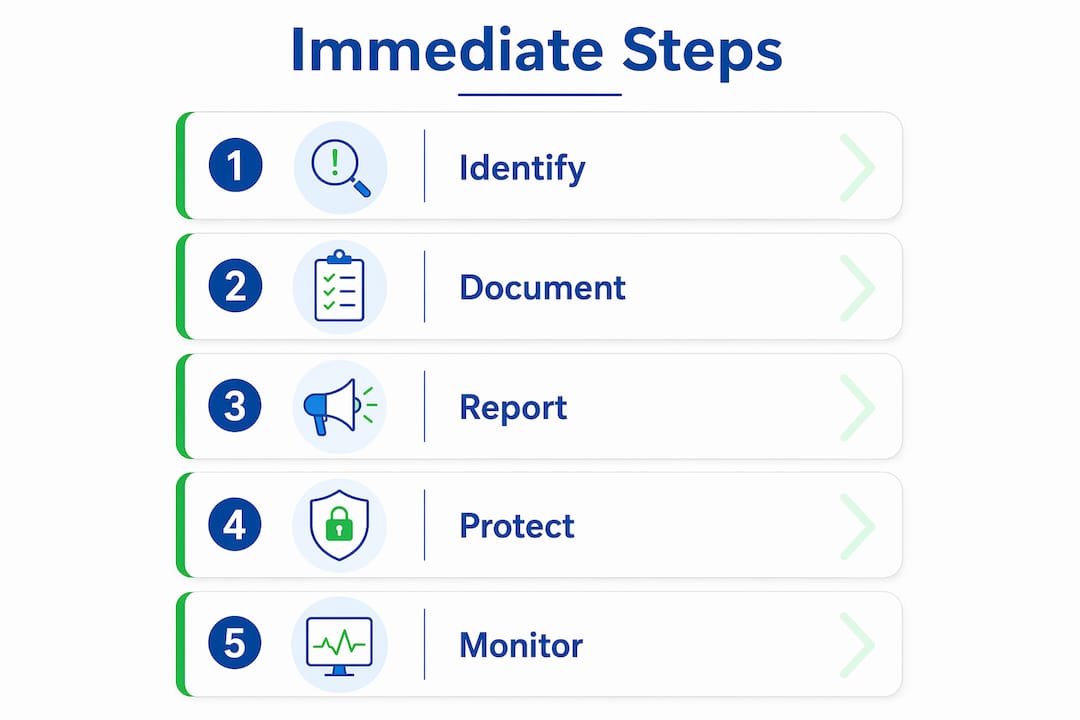
The IRS will flag your account, which prevents additional fraudulent returns from processing under your SSN. What happens next depends on how the fraud was detected.
| IRS Letter | What It Means | Your Next Step |
|---|---|---|
| 5071C | IRS detected a suspicious return; identity verification required | Verify online at idverify.irs.gov or call the number on the letter |
| 4883C | IRS needs to verify your identity before processing your return | Call the IRS promptly using the number on the letter |
| 5747C | In-person identity verification required | Visit a Taxpayer Assistance Center with valid photo ID |
The IRS will often notify you and request verification before you need to file Form 14039 at all. Following those letter instructions is typically the priority.
Once your case is open, you can:
- Check your IRS account transcript online at IRS.gov to see what returns and payments are on file
- Call the IRS Identity Protection Specialized Unit at 800-908-4490
- Enroll in the IP PIN program for all future filing years
Resolution timelines vary. Complex cases can take several months, so keep filing your legitimate return on paper if your e-file continues to be rejected.
A practical prevention checklist you can start today
The highest-impact moves, in order of priority:
Immediate (do these now):
- Enroll in the IP PIN program — any U.S. taxpayer can now request one
- File your tax return as early in the season as possible; a thief can’t file first if you already have
- Place a security freeze on your credit files at all three bureaus
Short-term (this week):
- Review your Social Security earnings statement at SSA.gov for wages you don’t recognize
- Shred any documents containing your SSN before disposal
- Verify your tax preparer’s credentials at the IRS Directory of Federal Tax Return Preparers
Ongoing:
- Store your SSN card securely; share your number only when legally required
- Use unique, strong passwords for IRS.gov, your payroll portal, and tax software accounts
- Monitor your IRS account transcript annually for unexpected activity
Pro Tip: Techstacktoday’s identity protection checklist covers PII hygiene, credential security, and monitoring setup in one place — a useful companion to the IRS steps above.
How privacy tools reduce your tax identity fraud risk
No single tool eliminates the risk, but the right combination cuts your exposure significantly. Here’s how each category helps:
- Password managers: Weak or reused passwords on IRS.gov, tax software, or payroll portals are a direct entry point. A strong password manager generates and stores unique credentials for every account, removing that vector entirely.
- Two-factor authentication (2FA): Enable it on every tax-related account. Even if a password is stolen, 2FA blocks unauthorized logins.
- VPNs: Filing taxes on public Wi-Fi exposes your session to interception. A VPN encrypts your connection, reducing that risk on networks you don’t control.
- Data-removal services: Your SSN, address, and employer data often appear on data broker sites. Removing that information makes it harder for thieves to assemble a convincing fraudulent return. Techstacktoday’s guide on removing yourself from the internet covers the most effective removal services.
- Credit monitoring: Real-time alerts on new accounts or hard inquiries give you early warning of identity misuse beyond the tax context.
Prioritize in this order if budget is limited: password manager first, then 2FA everywhere, then a credit freeze (free), then a VPN for public networks. Data-removal services are a valuable long-term investment once the basics are covered. Techstacktoday’s privacy tools comparison checklist helps you evaluate specific products across all these categories.
Special considerations for small businesses
Small businesses face attack vectors that individuals don’t. EIN misuse, fake employee schemes, and payroll manipulation can go undetected for months.
| Business Incident | Immediate Action |
|---|---|
| Unexpected business tax filing under your EIN | Call IRS Business & Specialty Tax Line: 800-829-4933 |
| Bogus W-2s issued to unknown employees | Reconcile payroll records; notify your payroll provider and the IRS |
| EIN used to open fraudulent credit accounts | Place a business credit freeze; report to Dun & Bradstreet and Experian Business |
| Fake vendor invoices tied to tax filings | Preserve all invoices; report to IRS Criminal Investigation if fraud is confirmed |
When to escalate beyond the IRS hotline:
- Involve a CPA or enrolled agent if your business returns have already been filed fraudulently
- Contact your payroll provider immediately if W-2 data was compromised
- Consider a vulnerability assessment of your business systems if you suspect an internal breach enabled the fraud
Preserve all evidence: original IRS notices, payroll exports, bank statements, and any communications with unknown parties claiming to represent your business. Insurers and the IRS both require this documentation.
Key Takeaways
Tax identity fraud requires immediate, sequenced action: respond to IRS letters first, file Form 14039 only when instructed, and secure an IP PIN to block future fraudulent filings.
| Point | Details |
|---|---|
| Respond to IRS letters first | Letters 5071C, 4883C, and 5747C contain specific verification steps — follow them before filing anything. |
| File Form 14039 selectively | Submit the Identity Theft Affidavit only when your e-file is rejected as a duplicate or the IRS instructs you to. |
| IP PIN blocks future fraud | Any U.S. taxpayer can enroll; the six-digit PIN must accompany every future return filed under your SSN. |
| Layer your defenses | Combine early filing, a credit freeze, strong credentials, and a VPN for the most effective protection. |
| Techstacktoday guides your tool choices | Techstacktoday’s hands-on reviews of password managers, VPNs, and data-removal services help you prioritize the tools that reduce tax identity fraud risk most effectively. |
Why tax identity fraud should be every privacy-minded person’s top concern
Tax identity fraud sits at the intersection of two things most people underestimate: how much personal data is already publicly available, and how little effort it takes for a criminal to weaponize it. Your SSN, employer name, and approximate income are often findable through data brokers, old breaches, and social media. A thief doesn’t need to hack the IRS. They just need enough of your data to file before you do.
What makes this category particularly frustrating is the timeline. You might not discover the fraud until months after it happened, and resolution can take even longer. The IP PIN program and early filing are the two moves that most directly close that window. The privacy tools — password managers, VPNs, data-removal services — reduce the upstream risk of your data being available in the first place.
Techstacktoday tests these tools in real-world conditions, scores them on actual performance, and publishes rankings without paid placement. If you want to know which password manager or VPN actually holds up, the guides are there.
Techstacktoday’s privacy tool reviews can help you stay protected
Tax identity fraud risk doesn’t disappear after filing season. The data that enables it circulates year-round on data broker sites and dark-web marketplaces. Techstacktoday tests and ranks the privacy tools that reduce that exposure directly: VPN services that protect your connection during online tax filing, password managers that lock down your IRS and payroll accounts, and data-removal services that pull your PII from the broker sites thieves use to build fraudulent returns.

Every review on Techstacktoday is based on hands-on testing against real performance metrics, with no paid rankings. Start with the VPN category or the password manager reviews, then work through the full privacy checklist. Your next step is one click away.
Authoritative sources and contacts
Use these resources to report, verify, and recover:
- IRS Identity Theft Central: Central hub for IP PIN enrollment, Form 14039, and victim guidance
- IdentityTheft.gov: FTC’s reporting portal; creates a personal recovery plan and helps file Form 14039 online
- IRS When to File Form 14039: Official guidance on when the affidavit is and isn’t required
- IRS Identity Protection Specialized Unit: 800-908-4490 (for confirmed or suspected tax identity theft)
- IRS Business & Specialty Tax Line: 800-829-4933 (for EIN misuse and business tax fraud)
- Social Security Administration: SSA.gov to review your earnings record for unauthorized wage reports
- Techstacktoday identity theft risk reduction guide: Practical tool and behavior checklist for ongoing protection
This article is general information, not legal or tax advice. Confirm current IRS procedures and your specific situation with a qualified tax professional or directly with the IRS.