Phishing is a social engineering attack that tricks you into handing over personal data, which attackers then use to steal your identity. It is the leading gateway to identity theft, targeting passwords, Social Security numbers, bank credentials, and session tokens. The impact of phishing on personal data is severe: a single successful lure can give a criminal everything needed to open credit accounts, file fraudulent tax returns, or sell your profile on the dark web. Understanding how phishing enables identity theft is the first step toward stopping it.
How phishing enables identity theft: the attack flow
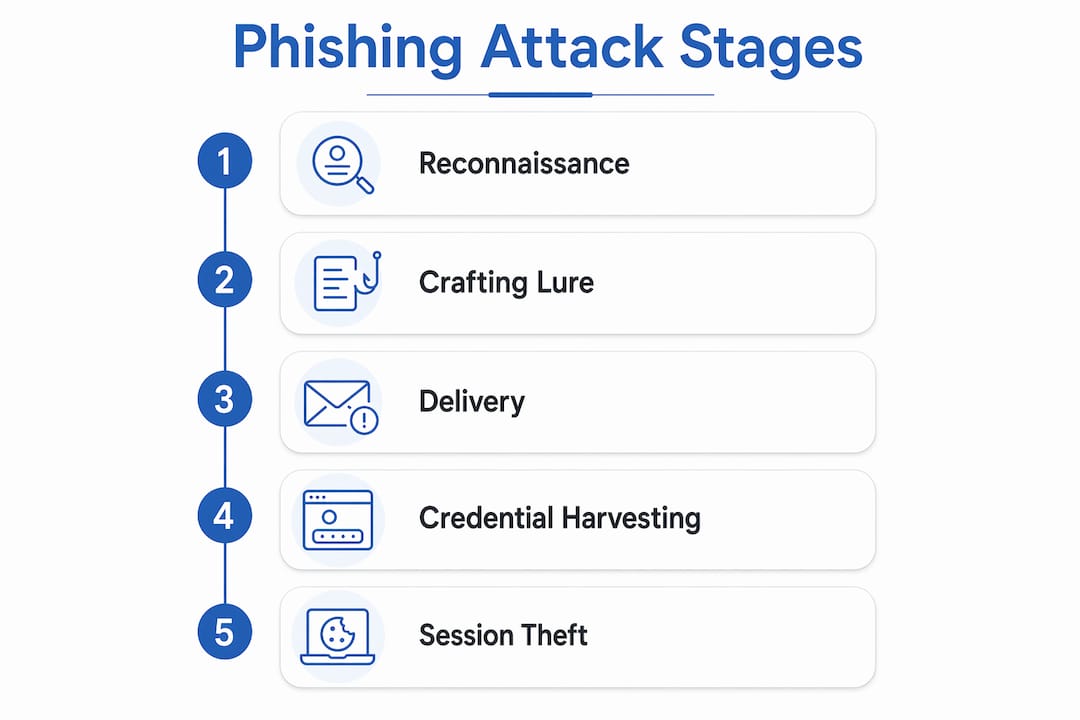
Phishing attacks follow a deliberate, multi-stage process. Attackers do not randomly blast emails and hope for the best. They plan, target, and execute with precision.
Stage 1: Reconnaissance. Attackers research their targets first. They pull names, job titles, and email addresses from LinkedIn, data broker sites, and previous breach dumps. The more they know, the more convincing the lure.
Stage 2: Crafting the lure. The attacker builds a fake message designed to look legitimate. This could be a spoofed bank email, a fake IRS notice, or a counterfeit Microsoft security alert. Urgency and fear are the primary psychological levers. Phrases like “Your account will be suspended in 24 hours” suppress critical thinking and push you to act without pausing.

Stage 3: Delivery. Phishing no longer lives only in email. Attackers now use SMS (smishing), phone calls (vishing), and fake app permission requests. Multi-channel service chaining combines email, voice, and malicious OAuth consents to bypass security controls that protect a single channel.
Stage 4: Credential harvesting. You click the link and land on a convincing fake login page. You enter your username and password. The attacker captures them instantly.
Stage 5: Session token theft. This is where modern phishing gets dangerous. Adversary-in-the-middle (AiTM) attacks proxy your authentication in real time. AiTM attacks intercept authentication traffic and steal your active session token, meaning the attacker stays logged in even after you complete multifactor authentication (MFA). Your password change does nothing if the session token is already stolen.
Pro Tip: Spear phishing targets you specifically by name and role. If an email references your employer, your manager, or a recent transaction, treat it as higher risk, not lower. Personalization is a red flag, not a sign of legitimacy.
What attackers do with your stolen data
Once an attacker has your credentials or session token, the exploitation begins fast. The window between theft and fraud is often measured in hours, not days.
The most immediate threat is account takeover. The attacker logs into your bank, email, or benefits portal and changes recovery settings to lock you out. Your email account is especially valuable. It acts as a master key to every other account that uses it for password resets.
Stolen data also flows directly to the dark web. Attackers sell credential packages in bulk, meaning your information can be purchased and misused by multiple criminals simultaneously. Techstacktoday’s guide on the dark web’s role in identity theft explains how this market operates and what your data is worth to buyers.
Synthetic identity fraud is a harder-to-detect threat. Attackers piece together fragments of stolen data from multiple phishing lures or breaches to build a credible fake identity. They might combine your real Social Security number with a different name and address. This synthetic profile then applies for credit cards, loans, or government benefits. Because no single real person matches the full profile, detection takes months or years.
Real-world phishing-enabled fraud scenarios include:
- IRS tax filing fraud: An attacker files a fraudulent tax return using your Social Security number before you do, claiming your refund.
- Bank account fraud: Stolen credentials allow direct transfers or new account openings in your name.
- Benefits fraud: Attackers redirect unemployment or Social Security payments to accounts they control.
- Medical identity theft: Your insurance details fund fraudulent claims, corrupting your medical records in the process.
What are the warning signs of phishing-enabled identity theft?
Catching identity theft early limits the damage. The IRS advises victims to watch for specific red flags and act immediately upon spotting them.
Watch for these warning signs:
- A tax return gets rejected because one was already filed with your Social Security number.
- You receive W-2 or 1099 forms from employers you never worked for.
- Unfamiliar accounts or hard inquiries appear on your credit report.
- You get password reset emails or login alerts you did not trigger.
- Bills arrive for services or purchases you never made.
- Your health insurer denies a claim because your benefits are already exhausted.
If you spot any of these, stop interacting with any suspicious messages immediately. The IRS recommends reporting identity theft at IdentityTheft.gov, which generates a personalized recovery plan. You should also request an Identity Protection PIN (IP PIN) from the IRS. This six-digit code prevents anyone else from filing a tax return using your Social Security number.
After a suspected phishing compromise, a password change alone is not enough. Reset credentials, revoke active sessions, remove unfamiliar devices, and audit app permissions connected to your accounts. Check account recovery settings, because attackers often change backup email addresses and phone numbers to maintain access.
Pro Tip: Check your credit reports at AnnualCreditReport.com immediately after any suspected phishing incident. All three major bureaus (Equifax, Experian, and TransUnion) are required by law to provide free reports. Look for accounts you did not open.
You can also use Techstacktoday’s identity theft warning signs list to cross-reference red flags you may have missed.
How can you prevent phishing-enabled identity theft in 2026?
Prevention requires layered defenses. No single tool stops every attack. Here is what actually works.
Use phishing-resistant MFA
Standard MFA is no longer sufficient against AiTM attacks. SMS codes and push notifications can be bypassed by proxying your authentication session in real time. Phishing-resistant MFA methods, specifically FIDO2 security keys and passkeys, bind authentication to the legitimate domain. A fake login page cannot intercept them because the key only responds to the real site.
| MFA Method | Phishing-resistant? | Notes |
|---|---|---|
| SMS one-time code | No | Interceptable via AiTM or SIM swap |
| Authenticator app (TOTP) | No | Bypassable via real-time proxy |
| Push notification | No | Vulnerable to MFA fatigue attacks |
| FIDO2 security key | Yes | Bound to legitimate domain only |
| Passkey | Yes | Device-bound, no shared secret |
Manage passwords with a dedicated tool
Reusing passwords across sites is the single biggest force multiplier for attackers. One phished credential unlocks every account that shares it. A password manager generates and stores unique, complex passwords for every account. You only need to remember one master password.
Monitor your credit and freeze what you do not use
Placing fraud alerts and security freezes on your credit files is free and blocks new accounts from being opened in your name without your direct approval. A security freeze is the stronger option. It prevents any new credit inquiry until you lift it. Fraud alerts require lenders to verify your identity before extending credit.
Build a zero-trust mindset
Visual polish is not a reliable signal of a legitimate message. Modern phishing lures are indistinguishable from real communications. Treat every unsolicited email, text, or call as suspect by default. Never click links in messages asking you to log in. Go directly to the official website by typing the address yourself.
Additional defenses worth applying:
- Check that email senders use SPF, DKIM, and DMARC authentication (your email client flags failures).
- Log out of accounts after each session on shared or public devices.
- Keep operating systems and browsers updated to patch known vulnerabilities.
- Review connected app permissions on Google, Microsoft, and social accounts quarterly.
Pro Tip: Before entering credentials anywhere, check the full URL in the address bar, not just the page logo. Attackers register domains like “secure-bankofamerica-login.com” that look convincing at a glance. The real domain is always the part immediately before the first single slash.
Key Takeaways
Phishing enables identity theft by stealing credentials and session tokens that attackers exploit for account takeovers, synthetic fraud, and dark web sales, making layered defenses the only reliable protection.
| Point | Details |
|---|---|
| AiTM attacks bypass standard MFA | Session token theft means password changes alone do not stop an active attacker. |
| Synthetic identity fraud is hard to detect | Attackers combine fragments from multiple breaches to build fake profiles that evade detection for months. |
| FIDO2 and passkeys stop phishing at the source | These methods bind authentication to the real domain, making fake login pages useless. |
| Freeze your credit proactively | A security freeze blocks new account openings without your approval and costs nothing to place. |
| Report immediately via IdentityTheft.gov | The IRS and federal authorities provide a structured recovery plan and IP PIN to block fraudulent filings. |
Why phishing still wins, even against prepared people
After reviewing dozens of phishing incidents and testing privacy tools at Techstacktoday, one pattern stands out: people overestimate how well they can spot a fake. The assumption is that a careful reader will catch the signs. That assumption is wrong in 2026.
Modern phishing lures are not the typo-filled emails from a decade ago. They are polished, personalized, and timed to moments when you are distracted. An attacker who has already pulled your name, employer, and recent transaction history from a data broker can craft a message that feels completely routine.
The second misconception I see constantly is that MFA makes you safe. It does not. MFA is not a silver bullet. Attackers now steal active session tokens, which means they bypass MFA entirely without ever knowing your one-time code. The only MFA that actually stops this is FIDO2 or passkeys, and most people are not using either yet.
The uncomfortable truth is that technology alone will not protect you. The human element remains the primary attack surface. Zero-trust skepticism toward every unsolicited message is not paranoia. It is the correct default posture in 2026. Pair that mindset with phishing-resistant MFA, a password manager, and a credit freeze, and you have a defense that actually holds.
— TechStackTeam
Protect your identity with the right tools
Knowing the threat is half the battle. Acting on it is the other half.
Techstacktoday has independently tested and ranked the privacy tools that matter most for identity protection. Start with a top-rated password manager to eliminate credential reuse across your accounts. Add a reviewed VPN service to encrypt your connection on networks you do not control. If your personal data is already circulating on data broker sites, Techstacktoday’s data removal guides show you exactly how to get it taken down. Every review is based on hands-on testing with no paid placements.
FAQ
What is phishing and how does it lead to identity theft?
Phishing is a social engineering attack that tricks you into revealing passwords, financial details, or personal identifiers. Attackers use that stolen data to access accounts, file fraudulent tax returns, or build synthetic identities in your name.
Can phishing bypass multifactor authentication?
Yes. Adversary-in-the-middle (AiTM) attacks intercept your authentication session in real time and steal the active session token, bypassing SMS codes and push notifications entirely. Only FIDO2 security keys and passkeys are phishing-resistant.
What should I do immediately after a phishing attack?
Stop interacting with the suspicious source, reset your credentials, revoke active sessions, and remove unfamiliar devices from your accounts. Report the incident at IdentityTheft.gov and request an IRS Identity Protection PIN.
How do I recognize a phishing attempt?
Urgency, fear-based language, and requests to log in via a link are the primary signals. Visual polish is not a reliable indicator of legitimacy. Always navigate directly to official sites by typing the address yourself rather than clicking links.
Is a credit freeze worth doing if I have not been phished?
A security freeze is free, reversible, and blocks new credit accounts from being opened in your name without your approval. Placing one proactively is one of the most effective identity theft prevention steps available.