Data brokers are companies that collect, aggregate, and sell personal information, and their role in identity theft is direct and severe. They pull records from public databases, social media, purchase histories, and court filings, then package that data into detailed profiles available to anyone willing to pay. Criminals exploit these profiles to bypass security checks, impersonate victims, and commit fraud at scale. Understanding how this pipeline works is not just reassuring. It is the first step toward protecting yourself.
How do data brokers facilitate identity theft?
Data brokers enable identity theft by giving criminals a ready-made dossier on their targets. Scammers can build detailed victim profiles in under 10 minutes using free and paid access on broker sites. Those profiles include home addresses, phone numbers, family members’ names, and property records. That is enough information to impersonate you convincingly.
The most dangerous application is bypassing knowledge-based authentication (KBA). Banks, phone carriers, and government agencies use KBA to verify your identity with questions like “What street did you grow up on?” or “What is your mother’s maiden name?” Broker profiles enable bypassing KBA used by financial institutions and phone carriers, making account takeovers straightforward for a prepared criminal.

Synthetic identity fraud is a related threat. This is when a criminal combines a real Social Security number with fabricated personal details to create a new, fake identity. Data brokers supply the real-world address and employment data that makes synthetic identities look legitimate to lenders and credit bureaus. Without that verified address layer, these fake identities are far easier to catch.
Scammers also use broker data to personalize phishing attacks. A generic email asking you to reset your password is easy to ignore. An email that references your actual address, your bank’s name, and your family member’s name is far more convincing. This is why broker data fuels social engineering attacks that avoid any technical hacking at all.
- Profile construction: Criminals aggregate your address, phone, relatives, and employer from multiple broker sites in minutes.
- KBA bypass: Security questions at banks and carriers become trivial when the answers are publicly listed.
- Synthetic fraud: Real address data makes fake identities pass lender verification checks.
- Targeted phishing: Personal details make fraudulent emails and calls far more believable.
Pro Tip: Search your full name on Whitepages or Spokeo right now. What you see is exactly what a scammer sees. That visibility is your starting point for removal.
What has been the impact of data broker breaches on identity theft losses?
The financial damage from data broker breaches is not theoretical. Four major breaches cost U.S. consumers over $20.9 billion in identity theft losses over the past decade. Congress confirmed these findings, making this one of the most documented privacy crises in American history.
| Breach | Year | People Affected |
|---|---|---|
| Equifax | 2017 | 147 million |
| Exactis | 2018 | 230 million |
| National Public Data | 2023 | 270 million |
| TransUnion | 2025 | 4 million |
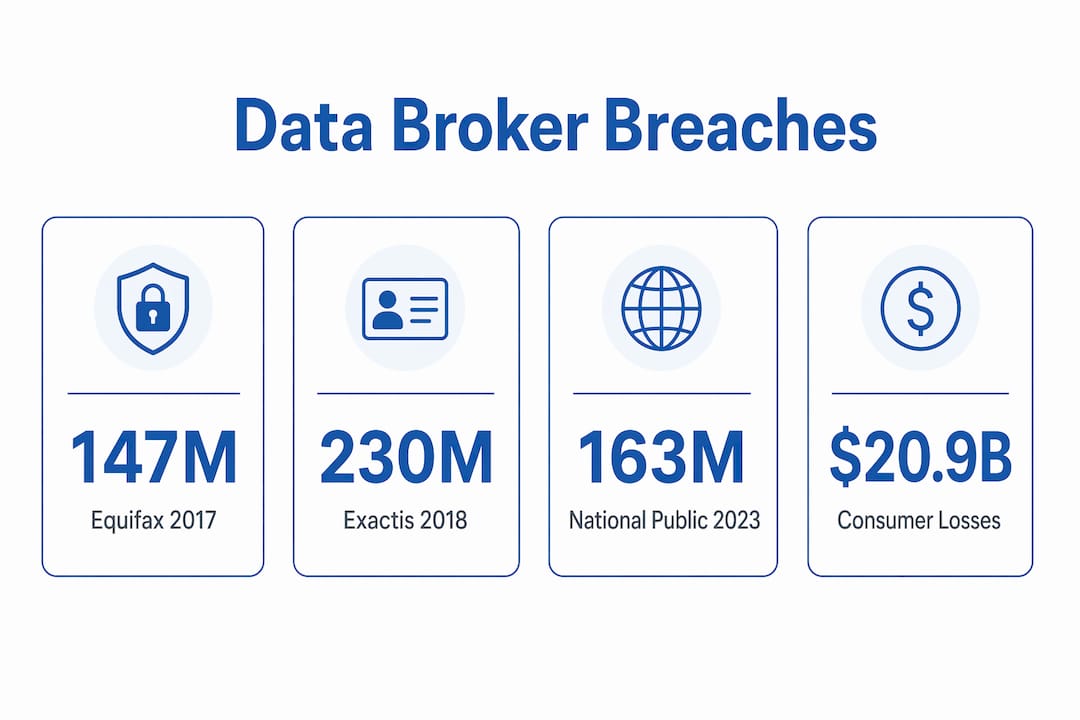
Each breach handed criminals a fresh, verified dataset to work with. The Exactis breach alone exposed 230 million records, which is nearly every adult in the United States. The National Public Data breach in 2023 was even larger, covering 270 million people.
The burden does not stop with consumers. When breaches occur, recovery costs shift to banks and service providers because most people have no direct relationship with the broker that lost their data. You never signed up with Exactis. You never agreed to their terms. Yet your data was there, and when it leaked, you absorbed the consequences. That accountability gap is one of the defining problems with the data broker industry.
Understanding how identity thieves steal information helps put these breach numbers in context. Brokers are not the only source criminals use, but they are among the most efficient.
Why are current protective measures insufficient against data broker threats?
Credit freezes are the most commonly recommended defense against identity theft. They work well for one specific threat: stopping a criminal from opening a new credit account in your name. Credit freezes do not prevent social engineering, targeted phishing, or synthetic identity fraud enabled by broker data. The freeze blocks the credit bureau, not the criminal’s access to your personal details.
Data removal from broker databases is a separate and necessary layer of protection. The problem is that brokers share and resell records constantly. Cross-platform verification by fraudsters uses multiple broker sites to filter outdated information before attacking. Removing your data from one site does not protect you if it reappears on five others within weeks.
Finding opt-out pages is harder than it should be. Broker sites historically used “no-index” tags on opt-out pages to prevent search engines from showing them. Recent regulatory pressure has improved this, but you still have to seek out each form manually, site by site. Most people never do.
- Credit freezes: Effective only against new credit account fraud. They do not remove your data from broker databases.
- Single opt-outs: Removing data from one broker is not enough. Records reappear through data sharing between brokers.
- Hidden removal pages: Opt-out forms are often buried or unsearchable, reducing how many people actually complete them.
- Profile refresh cycles: Brokers update profiles continuously from new public records, reversing previous removals.
Pro Tip: When submitting opt-out requests, document every submission with a screenshot and date. Brokers sometimes restore removed records, and your documentation gives you grounds to escalate.
What practical steps can you take to reduce data broker risks?
Reducing your exposure to data broker-enabled identity theft requires consistent, layered action. No single step eliminates the risk. The goal is to make yourself a harder target.
-
Submit opt-out requests across multiple brokers. Start with the largest aggregators: Whitepages, Spokeo, BeenVerified, and Intelius. Each has its own removal process. Work through them systematically. Techstacktoday’s guide on removing yourself from the internet walks through this process step by step.
-
Use a data removal service. Manual opt-outs are time-consuming and need repeating every few months. Automated data removal services submit and resubmit requests on your behalf. Techstacktoday reviews and ranks these services based on real-world testing, not paid placements.
-
Use a VPN when browsing. A VPN masks your IP address and reduces the behavioral data that brokers collect from your online activity. This does not remove existing records, but it limits new data collection going forward.
-
Use a password manager. Strong, unique passwords for every account reduce the damage when one credential is compromised. A password manager generates and stores these automatically. Check Techstacktoday’s best password managers list for tested options.
-
Monitor your credit and accounts actively. Set up alerts for new accounts, hard inquiries, and address changes. Early detection limits the damage. Review your credit reports from all three major bureaus at least twice a year.
-
Watch for warning signs of identity theft. Unexpected bills, unfamiliar accounts, or calls about debts you don’t recognize are red flags. Techstacktoday’s identity theft warning signs list helps you spot these fast.
-
Freeze your credit at all three bureaus. Equifax, Experian, and TransUnion each require a separate freeze request. This is free and takes about 15 minutes total. Do it even if you plan to take other steps.
Key Takeaways
Data brokers are the single most underestimated enabler of identity theft, and removing your data from their databases is a necessary complement to credit freezes and password security.
| Point | Details |
|---|---|
| Brokers build criminal-ready profiles | Scammers access your address, family, and employer in under 10 minutes from broker sites. |
| Breaches cost consumers billions | Four major broker breaches caused over $20.9 billion in identity theft losses across the U.S. |
| Credit freezes are not enough | Freezes block new credit accounts but do not stop social engineering or phishing attacks. |
| Opt-outs require ongoing effort | Broker data reappears through reselling, so removal requests must be repeated regularly. |
| Layered defense is the standard | Combine opt-outs, a VPN, a password manager, and active monitoring for real protection. |
The accountability gap no one talks about enough
The detail that bothers me most about data brokers is not the breaches. It is the distance. You never agreed to share your data with Exactis or National Public Data. You never signed their terms. You have no customer relationship with them, no account to close, and no direct way to hold them responsible when things go wrong. That distance is deliberate, and it creates an accountability gap that shifts every cost of a breach onto you.
Most people I speak with focus entirely on credit freezes after a breach. That is a reasonable first step, but it addresses only one attack vector. The broker profile sitting online still contains your address, your relatives’ names, and your employment history. A criminal does not need to open a credit account to cause serious harm. They can use that profile to impersonate you on a call with your bank, redirect your mail, or craft a phishing email your family members will trust.
The regulation picture is improving slowly. States like California have pushed brokers toward better transparency, and congressional scrutiny is growing. But regulation moves far slower than the data economy. Until the rules catch up, the practical reality is that you have to manage your own exposure. That means treating data removal as a recurring task, not a one-time fix. It means checking what brokers have on you at least twice a year. And it means building a defense that goes beyond the credit bureau.
— TechStackTeam
Your next move against data broker risks
Knowing the risk is step one. Acting on it is step two.
Techstacktoday has tested and ranked over 50 privacy services, including data removal tools, VPNs, and password managers, all evaluated in real-world conditions with no paid placements influencing the results. Start with the data broker removal guide to begin clearing your profiles from the most common aggregator sites. Then review Techstacktoday’s data removal service rankings to find an automated tool that keeps your records suppressed over time. Every step you take now reduces the raw material criminals have to work with.
FAQ
What is the role of data brokers in identity theft?
Data brokers collect and sell personal profiles that criminals use to bypass security checks, conduct phishing attacks, and commit synthetic identity fraud. They are the primary source of the detailed personal information that makes these attacks effective.
Can a credit freeze protect me from data broker risks?
A credit freeze stops new credit accounts from being opened in your name, but it does not remove your data from broker databases or prevent social engineering attacks using your personal details.
How do I remove my data from data broker sites?
Submit opt-out requests directly to each broker site, including Whitepages, Spokeo, BeenVerified, and Intelius. Because brokers share and resell records, you need to repeat this process every few months or use an automated data removal service.
How much have data broker breaches cost consumers?
Four major data broker breaches, including Equifax in 2017 and National Public Data in 2023, caused an estimated $20.9 billion in identity theft losses for U.S. consumers over the past decade.
Does a VPN help protect against data brokers?
A VPN limits the behavioral and location data brokers collect from your online activity going forward, but it does not remove records already held in broker databases. Use it as one layer of a broader defense strategy.