A background check is a formal process that verifies a person’s identity, history, and credentials to support safe, informed decisions. Employers, landlords, and individuals use them to confirm application details, flag safety risks, and meet legal compliance requirements. Whether you’re hiring your first employee, screening a tenant, or checking someone for personal safety, understanding how this process works protects you from costly mistakes. This guide covers the types of background checks, the step-by-step process, your legal rights, and how to get accurate results every time.
What is a background check and what does it reveal?
A background check is a structured review of a person’s records, verifying identity and history to assist decision-making across employment, housing, and personal safety. The formal industry term is “consumer report” under the Fair Credit Reporting Act (FCRA), though most people use “background check” interchangeably. Both terms refer to the same process: pulling data from public records, databases, and direct verification sources to build a picture of who someone is.
What a background check reveals depends entirely on what you order. A standard employment check typically surfaces criminal history, past employers, education credentials, and professional licenses. A tenant screening report adds credit history and eviction records. A personal safety check might focus on identity confirmation and address history. The scope is always defined before the check begins, which is why knowing the types matters before you request one.

The FCRA governs most background checks in the United States, setting rules on consent, disclosure, and how results can be used. This legal framework exists because background check data directly affects people’s jobs, housing, and financial lives. Getting it wrong has real consequences for everyone involved.
What are the common types of background checks?
Background checks are not one-size-fits-all. The type you need depends on your purpose, the role involved, and the legal requirements in your jurisdiction.
Employment background checks
Employment background checks typically include these core components:
- Criminal history: County, state, and federal court records searched by name or fingerprint
- Employment verification: Confirming job titles, dates, and reasons for leaving with past employers
- Education verification: Confirming degrees, diplomas, and certifications with institutions directly
- Motor vehicle records (MVR): Required for roles involving driving or operating machinery
- Professional license checks: Confirming active status of medical, legal, financial, or trade licenses
- Identity verification: Social Security Number (SSN) trace to confirm the person is who they claim to be
The specific package an employer orders depends on the role. A financial analyst position may include a credit check. A school bus driver position requires an MVR and fingerprint-based FBI check. A software engineer role may skip both.
Tenant screening background checks
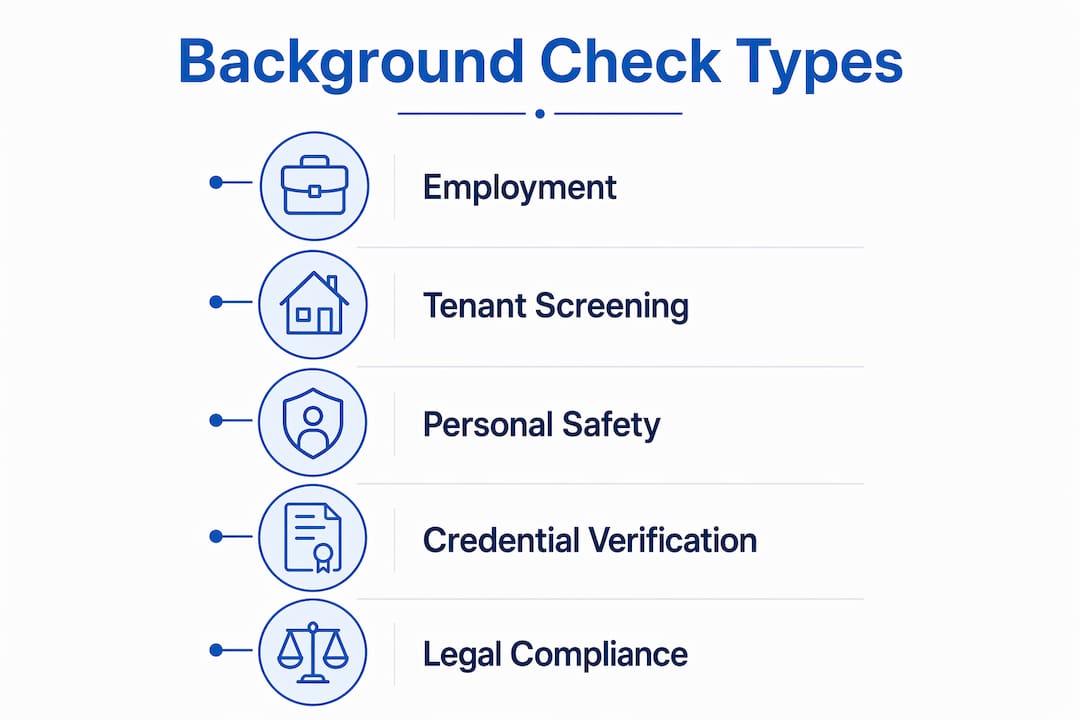
Tenant screening combines credit reports, criminal history, eviction history, and identity verification to assess rental risk. The eviction history component is often overlooked but critical. Eviction records live in specialized court databases, not credit reports, so a tenant with a clean credit score can still have multiple eviction filings. Landlords who skip this step miss a major risk signal.
Coverage also varies by state. Some jurisdictions limit how far back criminal records can be used in housing decisions. Always verify local rules before screening tenants.
Personal safety and other checks
Individuals run background checks on contractors, caregivers, online dates, and new neighbors. These personal safety checks typically focus on criminal history and identity confirmation. Professional credential verification is a separate category used by licensing boards, healthcare organizations, and financial institutions to confirm ongoing compliance.
| Check Type | Primary Use | Key Data Points |
|---|---|---|
| Employment | Hiring decisions | Criminal, employment, education, licenses |
| Tenant screening | Rental applications | Credit, criminal, eviction, identity |
| Personal safety | Individual decisions | Criminal history, identity, address history |
| Credential verification | Licensing compliance | Active license status, disciplinary actions |
Pro Tip: Order only the checks relevant to your specific decision. Pulling unnecessary data creates legal exposure and slows the process down.
How does the background check process work?
The background check process follows a defined sequence. Skipping any step creates legal risk under the FCRA.
-
Consent and disclosure. Before any check begins, the requester must provide a clear written disclosure and obtain signed consent from the individual. This is a hard legal requirement, not a courtesy. The disclosure must be a standalone document, not buried in an employment application.
-
Scope definition. Employers define the verification scope per role before the check starts. A background check provider then executes the verifications, contacting employers, educational institutions, and courts directly. This step determines what data gets pulled and from which sources.
-
Data collection. The provider searches public records, proprietary databases, and direct sources. Criminal records come from county courts, state repositories, and federal databases. Employment and education records come from direct contact with institutions. Credit data comes from Equifax, Experian, or TransUnion.
-
Verification and reporting. The provider compiles results into a consumer report. Two checks labeled identically can yield different results because database coverage and jurisdiction indexing vary between providers. This is why using a reputable service matters.
-
Review and decision. The requester reviews the report and makes a decision. If the report contains negative information that may affect the outcome, the FCRA adverse action process kicks in immediately.
-
Adverse action process. FCRA-governed adverse action requires two steps: a pre-adverse action notice (including the report and a Summary of Rights) followed by a waiting period, then a final adverse action notice detailing the consumer reporting agency (CRA) and the individual’s right to dispute. This process applies even if the background report only partially influenced the decision.
-
Dispute and correction. If you receive a pre-adverse action notice, act immediately. The FCRA dispute window is time-limited. You can contact the CRA directly to challenge inaccurate records before the final decision is made.
Pro Tip: If you’re the subject of a background check, request a copy of your own report from the provider before your job or rental application. Fix errors before they cost you an opportunity.
Why are background checks important for individuals and organizations?
Background checks serve three core functions: risk management, credential verification, and legal compliance. Each one matters independently, and together they form the foundation of responsible screening.
Risk management is the most immediate benefit. Employers who skip criminal history checks expose their workforce and customers to preventable harm. Landlords who skip eviction history checks face costly evictions and property damage. Individuals who skip checks on caregivers or contractors put their families at risk. The check is not about distrust. It is about due diligence.
Credential verification protects organizations from fraud. Résumé fraud is more common than most hiring managers expect. Candidates inflate job titles, fabricate degrees, and claim licenses they do not hold. A direct call to a university or licensing board takes minutes and catches these issues before they become expensive problems.
Legal compliance is non-negotiable. Many industries, including healthcare, finance, education, and transportation, require background checks by law. Failing to conduct them creates regulatory liability. Conducting them incorrectly, such as skipping consent or ignoring adverse action rules, creates a different kind of liability.
Background checks also support fair decision-making when used correctly. The goal is not to disqualify people automatically but to gather verified facts that inform a proportionate, context-aware decision.
The risks of getting this wrong are real on both sides. Organizations face lawsuits for negligent hiring and FCRA violations. Individuals face wrongful rejections based on inaccurate or irrelevant data. A well-run background check process protects everyone.
What legal considerations apply to background checks?
The FCRA is the primary federal law governing background checks in the United States. It sets rules for consent, disclosure, accuracy, and the adverse action process. State laws add additional layers, and they vary significantly.
Key compliance requirements include:
- Written consent: Required before any consumer report is pulled, with a standalone disclosure document
- Permissible purpose: You must have a legally recognized reason to run a check, such as employment, housing, or credit decisions
- Adverse action procedures: Pre-adverse and final notices are mandatory when a report contributes to a negative decision
- Accuracy obligations: CRAs must follow reasonable procedures to ensure maximum possible accuracy
- Individualized assessment: Blanket exclusion policies based on criminal records create legal risk. Employers and landlords must consider the nature of the offense, its gravity, and the time elapsed before making a decision.
The individualized assessment requirement is where many organizations stumble. Automatically rejecting anyone with a criminal record violates both FCRA principles and fair housing guidance. HUD guidance on criminal history in housing decisions specifically recommends individualized assessments to avoid disparate impact discrimination.
State-level “ban the box” laws add further restrictions, prohibiting employers from asking about criminal history on initial job applications. California, New York, Illinois, and over a dozen other states have enacted these laws. If you operate across multiple states, your screening policy must account for each jurisdiction’s rules.
Pro Tip: Work with a background check provider that offers built-in FCRA compliance workflows. Services like Checkr, First Advantage, and Cisive include adverse action management tools that reduce your legal exposure significantly.
How can you get accurate and fair background check results?
Accuracy in background checks is not automatic. It requires deliberate steps from both the requester and the subject.
For organizations running checks:
- Verify identity carefully. A wrong Social Security Number or misspelled name can pull records for the wrong person. Confirm full legal name, date of birth, and SSN before ordering.
- Use reputable services. Tailoring checks to job roles and using compliant providers reduces both errors and legal risk. Review Techstacktoday’s ranked background check services to compare providers by accuracy, turnaround time, and compliance features.
- Do not rely on a single source. One database rarely captures the full picture. A thorough check cross-references multiple sources.
- Apply context to findings. A 15-year-old misdemeanor is not the same as a recent felony. Evaluate relevance to the specific role before making a decision.
For individuals going through a check:
- Pull your own report first. Services like Checkr and First Advantage allow individuals to request their own consumer reports. Review it for errors before an employer or landlord does.
- Dispute errors immediately. If you spot an inaccuracy, file a dispute with the CRA directly. You have the right to a correction, and the CRA must investigate within 30 days.
- Protect your digital identity. Your online data feeds into background check databases. Use strong, unique passwords managed through a tool like a trusted password manager to reduce the risk of identity mix-ups.
- Know your rights. You are entitled to a copy of any report used against you, the name of the CRA that produced it, and the right to dispute inaccurate information.
Pro Tip: Check your credit reports annually through AnnualCreditReport.com. Errors there can surface in background checks and affect both employment and housing decisions.
Key takeaways
A background check is only as useful as the process behind it. Accurate data, legal compliance, and context-aware decisions determine whether a check protects or harms.
| Point | Details |
|---|---|
| Definition and scope | A background check verifies identity and history; scope varies by purpose and role. |
| Types matter | Employment, tenant, and personal safety checks pull different data from different sources. |
| FCRA governs the process | Consent, disclosure, and adverse action notices are legally required steps, not optional ones. |
| Individualized assessment | Blanket criminal record exclusions create legal risk; context and relevance must guide decisions. |
| Accuracy requires action | Both requesters and subjects must verify data, dispute errors, and use reputable providers. |
The part most guides skip: context is everything
The most common mistake I see organizations make is treating background checks as a pass/fail filter. They order a report, see a flag, and reject the applicant without reading the details. That approach is both legally risky and practically counterproductive.
A criminal record from 12 years ago for a non-violent offense tells you almost nothing useful about whether someone will perform well in a warehouse role today. A fabricated degree from last year tells you everything. The weight you assign to each finding should reflect its relevance to the specific role and the time elapsed since the event.
The technology side of this is also changing fast. AI-assisted screening tools now flag anomalies in employment timelines and cross-reference credentials against institutional databases in seconds. That speed is useful, but it amplifies errors just as fast as it catches them. A wrong name match processed by an automated system can disqualify a qualified candidate before a human ever reviews the file.
My honest advice: build a review step into every adverse decision. No automated system should have the final word on a person’s employment or housing. Use the technology to gather data faster, then apply human judgment to interpret it. That combination is what separates a fair, defensible process from a liability waiting to happen.
For candidates, the best thing you can do is get ahead of your own data. Pull your report, check your credit, and verify your credentials are correctly recorded before you need them. Waiting until a pre-adverse action notice arrives is too late to fix most problems cleanly.
— TechStackTeam
See exactly what background check services are worth your time
Techstacktoday has hands-on tested and ranked the leading background check platforms available in 2026, evaluating each one on accuracy, turnaround time, FCRA compliance tools, and pricing transparency. No paid rankings. No sponsored placements. Just real test results. If you’re deciding which service to use for employment screening, tenant checks, or personal safety, start with our 2026 background check rankings before spending a dollar. We also cover the privacy tools that protect your personal data from showing up incorrectly in the databases these services pull from.
FAQ
What is a background check used for?
A background check verifies a person’s identity, criminal history, employment record, and credentials to support hiring, tenant screening, or personal safety decisions. Employers, landlords, and individuals all use them to reduce risk and confirm that application information is accurate.
How long does a background check take?
Most standard employment background checks complete within one to five business days, though checks requiring direct contact with international institutions or courts can take longer. Turnaround time depends on the provider, the scope of the check, and the responsiveness of the sources being contacted.
What rights do I have if a background check is used against me?
Under the FCRA, you have the right to receive a copy of the report used against you, a Summary of Rights, and a reasonable window to dispute inaccurate information before a final adverse action is taken. The CRA that produced the report must investigate your dispute within 30 days.
Can a landlord reject me based on criminal history?
A landlord can consider criminal history, but blanket rejection policies based solely on a record create legal risk. HUD guidance and many state fair housing laws require individualized assessments that weigh the nature, gravity, and recency of any offense before a housing decision is made.
What is the best background check service for employers?
The best service depends on your industry, volume, and compliance needs. Checkr, First Advantage, and Cisive are widely used for employment screening and include built-in FCRA compliance workflows. Techstacktoday’s ranked service reviews compare these and other providers based on hands-on testing, not sponsored rankings.