Your child’s Social Security number is worth more to a thief than yours. Children have clean credit files and no debt history, making them prime targets for fraud that can go undetected for years. AI-driven fraud tools like FraudGPT now help criminals rapidly cycle through valid SSN combinations at scale, turning child identity theft prevention steps from a nice-to-have into a necessity. The good news? A few deliberate moves on your part can lock down your child’s identity before anyone gets near it.
Table of Contents
- Key takeaways
- Understanding child identity theft
- What to gather before you start
- Step-by-step prevention measures
- Common mistakes and what to do if something goes wrong
- Ongoing protection after the initial steps
- My take on protecting your child’s identity
- Tools that make this easier
- FAQ
Key takeaways
| Point | Details |
|---|---|
| Freeze credit early | You can freeze your child’s credit for free at all three bureaus, even with no existing credit file. |
| Layered defense works best | A credit freeze alone does not stop tax fraud or synthetic identity theft. Add an IRS IP PIN. |
| Limit SSN exposure | Question every institution that asks for your child’s SSN and share it only when legally required. |
| Store freeze PINs securely | Losing your freeze PIN creates delays. Use a password manager to store credentials safely. |
| Make it a routine | One-time prevention is not enough. Monthly checks and annual reviews keep your child protected long-term. |
Understanding child identity theft
Child identity theft happens when someone uses your child’s personal information, usually their Social Security number, to open credit accounts, file taxes, apply for loans, or even get a job. The victim typically does not find out until they turn 18 and apply for their first credit card or student loan, only to find a damaged file waiting for them.
Criminals get access to children’s data through several routes:
- Data breaches at schools, pediatricians’ offices, or government databases
- Caregiver access, including estranged family members who know the child’s SSN
- Online exposure from parental oversharing on social media or unsafe apps
- Dark web purchases of SSN-linked data stolen in bulk hacks
Children in especially vulnerable situations face elevated risks. Foster care youth face higher identity theft rates due to frequent relocations and repeated exposure of their personal data across agencies.
The red flags to watch for include unexpected credit card offers arriving in your child’s name, collection calls for debts you do not recognize, IRS notices about unreported income linked to their SSN, or rejection letters for government benefits because someone else already filed a claim. If you spot any of these, act immediately. Do not wait.
What to gather before you start
Before you take a single prevention step, get organized. Scrambling for paperwork mid-process slows everything down and can delay a freeze request by days or weeks.
Here is what you need on hand:
- ✅ Your child’s original birth certificate
- ✅ Your child’s Social Security card
- ✅ Your own government-issued ID (driver’s license or passport)
- ✅ Proof of guardianship if you are not the biological parent
- ✅ Proof of your current address (utility bill or bank statement)
Each credit bureau has its own submission process, and some require certified copies rather than originals. Know the difference before you mail anything. The bureaus create a record just to apply the freeze, even if your child has no existing credit file. That surprises a lot of parents, but it means you absolutely can freeze a file that does not yet exist.
Also set up a secure, dedicated place to store your freeze PINs and confirmation codes. A physical binder in a locked cabinet works. A trusted password manager works even better since it is accessible from anywhere and protected by encryption.
Pro Tip: Create a single folder, digital or physical, for all child identity documents. Label it clearly, store it securely, and tell one other trusted adult where to find it in an emergency.

Step-by-step prevention measures
These are the core child identity theft prevention steps. Work through them in order. Each one adds a separate layer of protection.
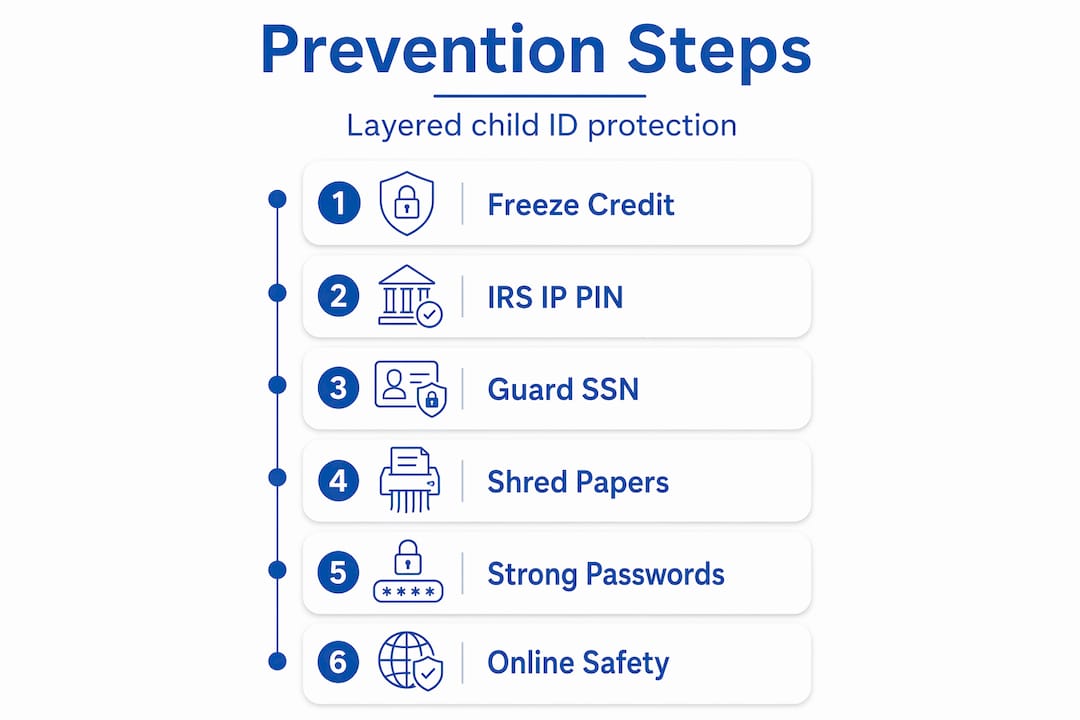
1. Freeze your child’s credit at all three bureaus
Federal law gives you the right to freeze your child’s credit for free at Equifax, Experian, and TransUnion if your child is under 16. The freeze stays in place until you lift it or your child turns 16 and manages it themselves. This blocks any new credit application from going through in their name.
Do all three bureaus. Not one, not two. All three. Criminals only need one open bureau to cause damage.
2. Request an IRS Identity Protection PIN
A credit freeze does nothing to stop someone from filing a fraudulent tax return in your child’s name. The IRS IP PIN is a six-digit code that must appear on any tax return filed using that SSN. Without it, the IRS rejects the filing. You can request one for your minor child at IRS.gov.
3. Guard the SSN aggressively
Most institutions that ask for your child’s SSN do not legally need it. Schools, sports clubs, and even some medical offices ask out of habit. Question every request. Ask why they need it, how they store it, and who has access. You can often substitute another identifier.
4. Shred and secure physical documents
Paper documents are an easy attack vector. Any mail, form, or printout containing your child’s SSN goes through a cross-cut shredder before it goes in the trash. Store originals in a locked location. Never carry the SSN card in your wallet.
5. Lock down digital access with strong passwords and MFA
Password managers and two-factor authentication significantly reduce the risk of account takeovers on family accounts that contain your child’s data. Use a unique, complex password for every account. Enable multi-factor authentication on school portals, medical portals, and any government account.
6. Talk to your kids about online safety
Older children and teens share personal information online without realizing the consequences. Teach them never to share their full name, date of birth, address, or school name in public forums, gaming profiles, or with strangers online. This is basic identity theft awareness for kids, and it needs to be a regular conversation, not a one-time lecture.
Prevention steps at a glance
| Step | Action | When to do it |
|---|---|---|
| Credit freeze | Submit requests to all three bureaus | Do it now |
| IRS IP PIN | Request at IRS.gov for your minor | Do it now |
| SSN limits | Question and decline unnecessary requests | Ongoing |
| Document shredding | Shred any paper with PII before disposal | Ongoing |
| Strong passwords + MFA | Use a password manager on all family accounts | Do it now |
| Talk to your kids | Age-appropriate conversations about data sharing | Regularly |
Pro Tip: Set a calendar reminder every six months to review each of these steps. Circumstances change. New school years, new accounts, and new devices all create fresh exposure points.
Common mistakes and what to do if something goes wrong
Many parents believe a credit freeze could harm their child’s future credit access. That is not accurate. Freezing child credit does not damage future credit ability at all. When your child is ready to apply for their first loan or card, you simply lift the freeze with the PIN. It takes minutes and costs nothing.
Here are the most common pitfalls to avoid:
- Assuming no credit file means no risk. Thieves can open one. The bureau creates a file the moment they try.
- Skipping one bureau. You must freeze at all three independently.
- Losing the freeze PIN. Store it in at least two secure locations.
- Thinking a freeze covers everything. Credit freezes do not stop tax fraud, employment fraud, or synthetic identity schemes where criminals attach fictitious data to a real SSN.
If you discover your child’s identity has already been compromised, move through these steps fast:
- Place a fraud alert or freeze at all three bureaus immediately
- File a report at IdentityTheft.gov (the FTC’s official portal)
- File a police report if criminal use is confirmed
- Contact each institution where fraud occurred and dispute the accounts in writing
- Request a copy of any credit file in your child’s name and dispute every item
⚠️ Do not delay reporting. The longer fraudulent accounts stay open, the harder they are to remove. Act within 24 to 48 hours of discovery.
Ongoing protection after the initial steps
Locking things down once is a solid start. Keeping them locked down takes a routine. Regular maintenance including monitoring, shredding, and alert reviews is more effective than any single action you take today.
Here is what an ongoing protection routine looks like:
- Monthly: Check bank and school portal accounts for unauthorized activity
- Annually: Request a manual credit check at each bureau to confirm no file has been opened
- Ongoing: Use a VPN on your home and mobile networks to reduce data exposure when using public Wi-Fi
- Ongoing: Monitor the dark web for your child’s SSN using an identity protection service
- At age 16: Transfer freeze management to your child and walk them through the process together
| Tool | What it protects | Effort level |
|---|---|---|
| Credit freeze | New credit accounts | Low, set and forget |
| IRS IP PIN | Tax filings | Low, annual renewal |
| Password manager | Online accounts and portals | Low once set up |
| VPN | Network-level data exposure | Very low, runs in background |
| Identity monitoring service | Dark web and credit alerts | Low, automated alerts |
The goal is to make protection automatic, not a crisis response. Build these tools into your family’s digital habits now so they run without you having to think about them.
My take on protecting your child’s identity
I have spent years reviewing privacy services and reading through real fraud cases, and the pattern I keep seeing is the same. Parents know child identity theft is a risk. They just think it will not happen to their kid, or they plan to “get around to it soon.” By the time they act, the damage is already done.
What I have found actually works is treating your child’s identity the same way you treat their physical safety. You buckle their seatbelt every single time without thinking about it. Apply that same automatic mindset to their SSN. Do not share it unless you have no choice, and even then, ask.
The layered approach matters more than any one tool. A credit freeze is strong, but synthetic identity fraud bypasses it entirely by pairing your child’s SSN with invented personal data. That is why the IRS IP PIN, limited SSN sharing, strong account security, and a dark web monitoring service all need to work together.
One thing that often gets overlooked: teach your kids early. Teenagers post their birthday, school, and home city without hesitation. A motivated criminal can piece together enough to cause serious damage from a public social media profile alone. Talking to your kids about why this matters is not fearmongering. It is practical preparation.
Start today. One bureau freeze today is better than a perfect plan you never execute.
— TechStackTeam
Tools that make this easier
You have the manual steps covered. Now let the right technology carry the load so you are not relying on memory alone.

At Techstacktoday, we test and rank privacy tools in real-world conditions with no paid placements influencing results. For child identity protection, three categories matter most. A reviewed VPN service protects your family’s internet connection and keeps sensitive data off public networks. A reliable password manager handles strong, unique passwords across every family account automatically. And an identity protection service monitors the dark web and sends alerts the moment your child’s data surfaces somewhere it should not be. Use our independent reviews to find the right fit for your family’s budget and needs.
FAQ
Can you freeze a child’s credit if they have no credit file?
Yes. Credit bureaus create a record just to apply the freeze, even if your child has never used credit. You need proof of identity, guardianship, and the child’s birth certificate and SSN.
Does a credit freeze hurt my child’s future credit score?
No. Freezing child credit has no negative effect on future credit. You lift it when needed, and the file continues building credit normally from that point forward.
What does a credit freeze not protect against?
A freeze blocks new credit applications but does not stop tax fraud, employment fraud, or synthetic identity fraud. Adding an IRS IP PIN and using dark web monitoring closes most of those gaps.
How often should I check my child’s credit?
Request a manual credit report check at all three bureaus at least once a year. Set up automated dark web alerts through an identity monitoring service to catch anything between annual checks.
At what age can my child manage their own credit freeze?
At age 16, your child can take over management of their own credit freeze. Plan ahead by walking them through the process and transferring the freeze PINs to their secure storage at that time.