Most people think a strong password is enough. It is not. Identity theft attacks do not stop at the login screen. They target multiple points across your digital life, from your credit file to your email recovery address. That is exactly why identity protection needs a multi-layer approach. The industry term for this is “defense in depth,” and it means no single tool or action covers everything. Single controls can be bypassed, and when one layer fails, the next one catches what slipped through. This guide explains how that system works and how you can build it.
Table of Contents
- Key Takeaways
- Why single-layer security always falls short
- The core layers every individual needs
- What industry frameworks tell us about layered defenses
- How to build your own layered protection right now
- Common mistakes that leave gaps in your protection
- Our take: stop thinking prevention, start thinking blast radius
- Build your full protection stack with Techstacktoday
- FAQ
Key Takeaways
| Point | Details |
|---|---|
| Single tools leave gaps | No one password, app, or service can cover every identity attack vector on its own. |
| Credit freezes block new fraud | Freezing your credit at all three bureaus costs nothing and stops most new account fraud cold. |
| MFA stops most credential attacks | Multi-factor authentication blocks the majority of automated login attacks that steal your credentials. |
| Monitoring catches what prevention misses | Real-time alerts on your credit and dark web exposure let you respond before damage compounds. |
| Recovery is a layer too | Having a documented recovery plan means faster action when a breach does happen. |
Why single-layer security always falls short
Modern attackers target identity rather than technical perimeter weaknesses. They exploit trust, access, and the gaps between the tools you already use. A password is one gate. But your identity has many gates.
Understanding this attack complexity is the foundation of any real defense. Consider the typical identity lifecycle: you prove who you are, you authenticate to a system, that system shares your verified status with another. Attackers look for the weakest point in that chain, and they shift tactics depending on where defenses are strongest.
Here is what that looks like in practice:
- Login attacks: Credential stuffing and phishing target your username and password directly.
- Credential misuse: Stolen login data is sold on dark web markets and used across multiple services.
- Access abuse: Once inside, attackers escalate privileges or access financial accounts tied to your identity.
- Recovery weaknesses: Your email or phone number used for account recovery becomes a backdoor if compromised.
- Credit and financial fraud: Attackers open new credit lines using your Social Security number, often without touching your existing accounts at all.
Identity protection combines strong authentication, strict access controls, continuous credential monitoring, and external threat intelligence. Notice that is four separate disciplines, not one product. That is why relying on just a password manager or just a credit monitoring service leaves you exposed. The importance of layered security is not a marketing slogan. It is an acknowledgment that attackers are adaptive, and your defense needs to be too.
The core layers every individual needs
Think of multi-layered identity protection as a set of overlapping shields. Each one covers a different attack surface. Together, they reduce the chance that any single breach becomes a full identity takeover.
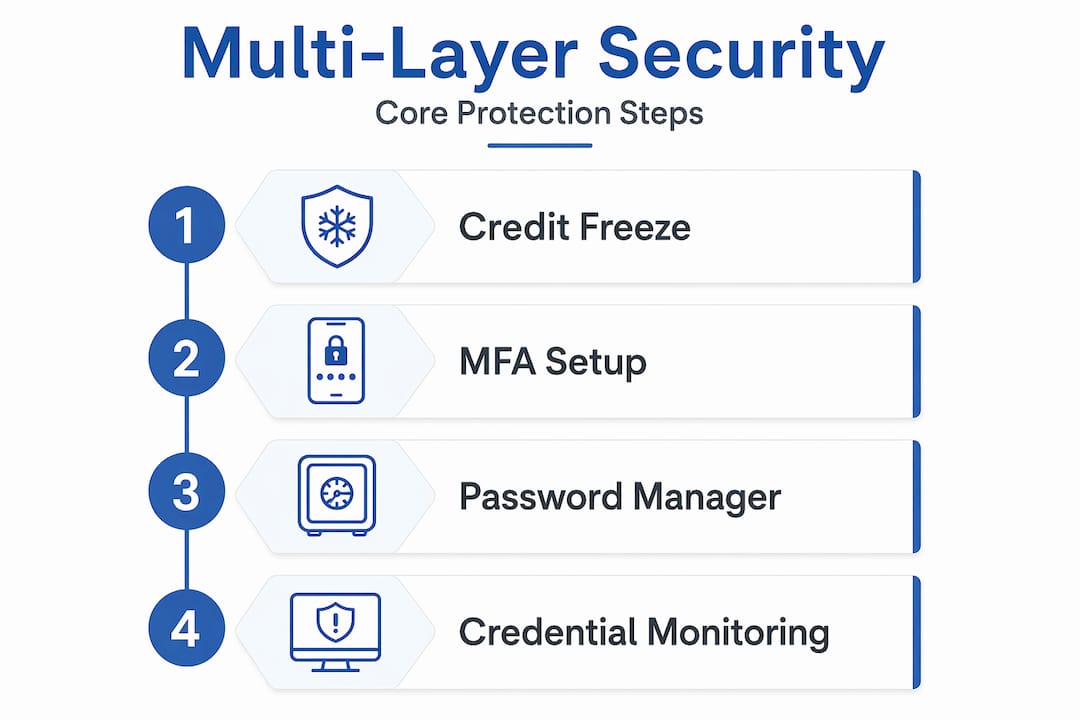
Here is how the most impactful layers compare:
| Layer | What it blocks | Cost | Effort to set up |
|---|---|---|---|
| Credit freeze | New account fraud using your SSN | Free (federal law) | 15 minutes across 3 bureaus |
| Multi-factor authentication (MFA) | Credential-based login attacks | Free | 5 minutes per account |
| Credential exposure monitoring | Dark web data leaks with your email/passwords | Free to low cost | Ongoing, automated |
| Password manager | Weak or reused password attacks | Low cost | 1 hour initial setup |
| VPN | Network-level data interception | Low cost | Minutes |
| Recovery plan | Delays and losses after a breach occurs | Free | 30 minutes to document |
The credit freeze is your first line of defense. Credit freezes prevent lenders from pulling your credit report unless you temporarily lift the freeze. That means even if a thief has your full Social Security number and date of birth, they cannot open a new credit card or loan in your name. And freezes are free at all three major bureaus under federal law.

MFA is the second non-negotiable layer. It adds a verification step beyond your password, typically a one-time code sent to your phone or generated by an authenticator app. Even if your password is stolen, the attacker cannot get in without that second factor.
Pro Tip: Do not use SMS text messages as your only MFA option. SIM-swapping attacks can redirect your texts to a thief’s phone. Use an authenticator app like Google Authenticator or a hardware key whenever the service allows it.
Credential monitoring watches data breach dumps for your email address and alerts you when your credentials appear. Services like identity protection tools automate this so you are not manually checking every few weeks.
What industry frameworks tell us about layered defenses
The most authoritative standard for digital identity is NIST SP 800-63. It is a federal guideline, but its logic applies directly to how you think about protecting your own identity. It breaks identity protection into three distinct stages, each with its own assurance level.
| NIST Component | What it governs | Why it matters to you |
|---|---|---|
| SP 800-63A (IAL) | Identity Assurance Level: how strongly your identity is verified | Weak proofing means anyone can impersonate you during account setup |
| SP 800-63B (AAL) | Authenticator Assurance Level: how strong your login method is | Low AAL means a stolen password equals full account access |
| SP 800-63C (FAL) | Federation Assurance Level: how securely your identity is shared across systems | Weak federation lets attackers hijack sessions across linked accounts |
The key insight from NIST’s risk-based framework is that you can have strong authentication and still be vulnerable if your identity proofing or account recovery is weak. Most people strengthen their login (password plus MFA) but leave recovery pathways wide open. That is exactly where sophisticated attackers pivot.
The modular structure also means you can identify your weakest link and fix it first. You do not need everything perfect on day one. You need to cover your most exposed point now, then build outward. This risk-based thinking is what separates a real layered strategy from a checklist of random security tips.
How to build your own layered protection right now
You do not need an IT department. These steps are practical, low-cost, and ordered by impact.
- Freeze your credit today. Go directly to Equifax, Experian, and TransUnion. It takes about five minutes per bureau and is free. This is the single highest-impact action for preventing new account fraud.
- Enable MFA on every critical account. Start with email, banking, and any account tied to financial information. Use an authenticator app, not just SMS.
- Use a password manager. Unique passwords for every account eliminate the risk that one breach unlocks everything else. Techstacktoday has reviewed the top password managers if you need a starting point.
- Set up credential monitoring. Use a service that scans dark web markets and breach databases for your email address. Set alerts so you know within hours, not months.
- Add a VPN for network privacy. Public Wi-Fi is a real risk. A VPN encrypts your traffic and removes your real IP from the equation, especially on shared networks.
- Create a recovery plan now. Know exactly what you will do if your identity is compromised. Bookmark IdentityTheft.gov, which provides a step-by-step recovery checklist covering disputes, freezes, and reporting.
Pro Tip: Review your free annual credit reports at AnnualCreditReport.com and stagger them across the year, one from each bureau every four months. That way you get free monitoring three times a year.
Common mistakes that leave gaps in your protection
The biggest misconception about identity protection is that it is a product you buy once and forget. It is not. It is a posture you maintain. Here is where people go wrong:
- Assuming one tool covers everything. A password manager does not protect your credit file. A credit freeze does not stop phishing. Each tool has a specific job. Do not expect any single one to do all of them.
- Confusing credit freezes with fraud alerts. A fraud alert asks lenders to take extra steps before issuing credit in your name. It does not block access to your credit file the way a freeze does. Both have uses, but they are not interchangeable.
- Skipping the monitoring layer. Prevention is not perfect. Recovery is multi-layered too. If you are not monitoring your credit and exposed credentials, you will not know a breach happened until the damage is done.
- Ignoring behavior as a layer. Technology cannot protect you from clicking a phishing link. User awareness is genuinely a security layer. Slow down on unexpected emails, verify before you click, and treat any “urgent” financial message with suspicion.
- Waiting for a breach to start. No single tool is sufficient on its own, and waiting until something goes wrong to build your defense means the attacker already has a head start.
The benefits of identity security layers are not theoretical. They are the practical difference between catching a breach in hours and discovering it on a collection notice six months later.
Our take: stop thinking prevention, start thinking blast radius
I have reviewed dozens of identity protection services at Techstacktoday. The most common thing I see is people who did one thing right and thought they were done. They froze their credit but never enabled MFA. Or they used a password manager but had no monitoring in place.
Here is the mental shift I think matters most: stop treating identity protection as pure prevention. No method blocks every attack. What you are really doing is reducing blast radius. When an attacker gets one thing, you want to make sure they cannot use it to get everything else. That is what defense in depth actually means in practice.
I also see people hold off on setting things up because it feels overwhelming. My advice: do not wait for the perfect setup. A credit freeze and MFA on your email account today is worth more than a complete plan you have not started yet. Build layer by layer. Adjust as your situation changes. The threats evolve, and your defenses should too.
The readers I respect most are not the ones who found one magic tool. They are the ones who treat this as an ongoing practice rather than a one-time fix.
— TechStackTeam
Build your full protection stack with Techstacktoday

You now know the layers. The next step is picking the right tools to fill them. Techstacktoday has hands-on tested and ranked every major service across the categories you need, with no paid rankings and no sponsored placements. Start with our best VPN services to lock down your network layer. Then check our identity protection reviews to find monitoring and alert services ranked by real coverage. Every review is updated regularly so you are never working from outdated information. Pick your weakest layer first. Then build from there.
FAQ
What does a multi-layer approach to identity protection mean?
It means using multiple independent defenses, such as credit freezes, MFA, monitoring, and recovery plans, so that if one fails, others limit the damage. No single tool covers every attack vector.
Is a credit freeze the same as a fraud alert?
No. A credit freeze blocks all access to your credit file until you lift it, while a fraud alert simply flags your file and asks lenders to verify your identity. A freeze offers stronger protection against new account fraud.
How many layers of protection do I actually need?
At minimum, you need a credit freeze, MFA on critical accounts, unique passwords via a password manager, and credential monitoring. Each layer covers a different type of attack, so more layers mean fewer gaps.
Can identity theft happen even if I use strong passwords?
Yes. Attackers exploit recovery pathways, credit files, and access abuse that have nothing to do with your password strength. Strong passwords are one layer, not a complete defense.
Where do I start if I have no identity protection in place right now?
Freeze your credit at all three major bureaus today. It is free and takes about 15 minutes total. Then enable MFA on your email account. Those two steps alone close the most common attack paths immediately.