What are the best VPN guide platforms to replace VPNGuider.com?
The top VPN comparison platforms you can trust in 2026 are Techstacktoday, Top10VPN, CNET, and Mullvad. Each one publishes independent editorial content, discloses its testing methods, and covers the U.S. market with current security benchmarks. If VPNGuider.com left you unsure whether rankings were paid for or genuinely earned, these platforms are where you go next.
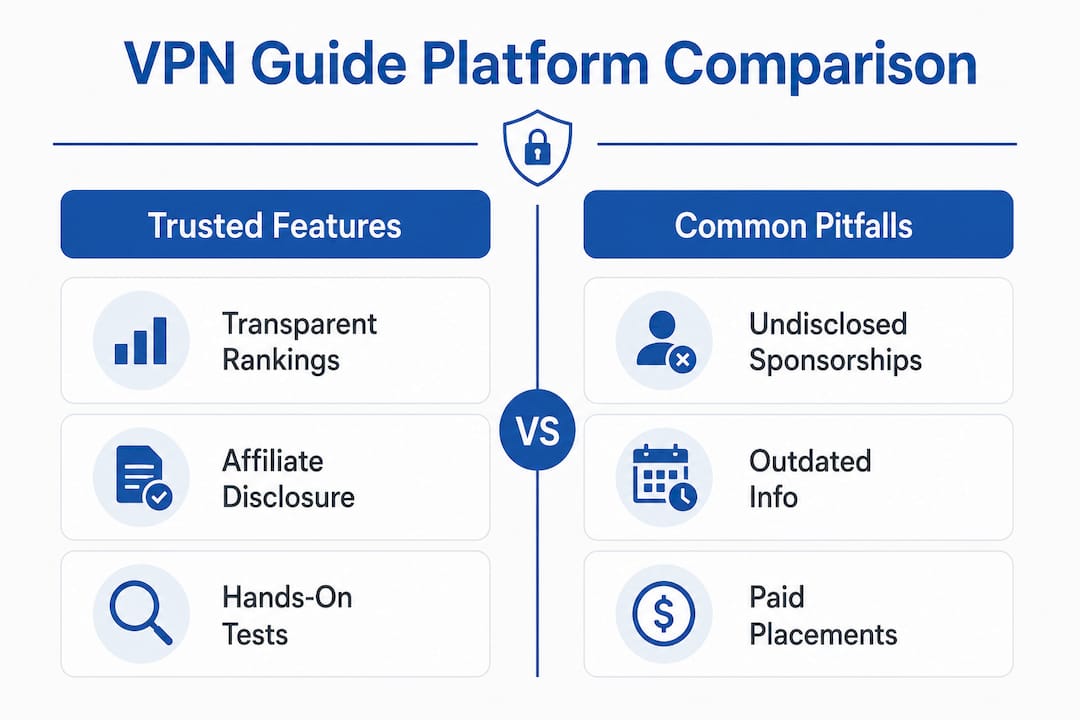
Here is what separates a trustworthy VPN guide from a biased one:
- Editorial independence: Rankings are not sold. Affiliate relationships, when they exist, are disclosed clearly.
- Hands-on testing: Platforms like Techstacktoday and CNET test VPNs in real-world conditions, not just on spec sheets.
- Audit transparency: The best guides confirm whether a VPN’s no-logs policy has been independently verified by firms like Cure53 or Deloitte.
- Update frequency: Rankings pulled from provider pages weekly reflect real pricing and real availability, not stale data.
- Coverage breadth: A credible guide covers at least a dozen VPN services across multiple use cases, not just the highest-paying partners.
- Jurisdiction awareness: Top platforms flag whether a VPN is headquartered outside the 14 Eyes alliance, which matters for privacy.
Pro Tip: Before trusting any VPN guide site, check whether it lists its ranking criteria publicly. If you cannot find a methodology page, treat every recommendation with skepticism.
How do leading VPN guide platforms compare to VPNGuider.com?

The core question is not just which platforms exist, but which ones you can actually rely on. The table below maps the most important trust dimensions across the featured platforms.
| Platform | Editorial Independence | Testing Methodology | VPNs Covered | Affiliate Transparency | Update Frequency | Best For |
|---|---|---|---|---|---|---|
| Techstacktoday | No paid rankings | Hands-on, real-world testing | 50+ services | Clearly disclosed | Regular | Privacy-focused readers wanting unbiased picks |
| Top10VPN | Independent editorial | Multi-factor testing | 50+ | Disclosed | Frequent | Users wanting accessible comparisons |
| CNET | Editorial team | Expert-driven, performance-focused | — | Disclosed | Regular | Tech-savvy readers |
| Mullvad | Privacy advocacy focus | Open-source transparency | Own service + education | N/A (provider) | Ongoing | Users prioritizing jurisdictional privacy |
| VPNSeekr | Independent data | Weekly provider data pulls | — | Disclosed | Weekly | Side-by-side filter comparisons |
What the table reveals:
- Techstacktoday stands out for its no-paid-rankings policy. Most platforms accept affiliate commissions, which is fine when disclosed, but Techstacktoday’s rankings are based solely on performance metrics. That is a meaningful distinction for readers who want the unfiltered verdict.
- Top10VPN covers a broad range of VPNs with clear scoring criteria and user-friendly presentation. It is a solid starting point if you want a large pool of options quickly.
- CNET brings the credibility of established tech journalism. Its VPN reviews are thorough and written by experienced editors, though its coverage list is narrower than dedicated VPN platforms.
- Mullvad occupies a different category. It is primarily a VPN provider, but its commitment to open-source software and privacy education makes it a reference point for understanding what a trustworthy VPN actually looks like.
- VPNSeekr pulls pricing data directly from providers every week and converts currencies using official rates. That level of data discipline is rare and useful for price-sensitive comparisons.
Key differences from VPNGuider.com:
- Transparent ranking criteria are published and verifiable on all platforms above.
- Hands-on testing, not just aggregated specs, drives the scores on Techstacktoday and CNET.
- Affiliate relationships are disclosed rather than hidden, so you know when a recommendation carries a financial incentive.
Which VPN services do trusted guides recommend for 2026?
The VPN services that consistently appear across credible comparison platforms share a short list of non-negotiable qualities: audited no-logs policies, WireGuard support, and headquarters outside the 14 Eyes surveillance alliance. Here is how the leading services stack up.
| VPN Service | Starting Price | Security Audit | Jurisdiction | Free Tier | Best For |
|---|---|---|---|---|---|
| ExpressVPN | — | KPMG | British Virgin Islands | No | High-speed streaming and travel |
| NordVPN | — | Deloitte | Panama | No | Multi-hop and obfuscation |
| Surfshark | — | Deloitte | Netherlands | No | Budget users, unlimited devices |
| Private Internet Access | — | Verified | United States | No | Configurable, open-source clients |
| IPVanish | — | Self-owned infra | United States | No | Speed-focused streaming/gaming |
| Proton VPN | — | Securitum (Jan 2026) | Switzerland | Yes, no cap | High security + free tier |
| CyberGhost | — | Verified | Romania | No | Streaming-optimized servers |
| Hide.me | — | Verified | Malaysia | Yes, limited | Basic protection, kill switch |
| Windscribe | — | Verified | Canada | Yes, limited | Ad blocking + privacy tools |
| PrivateVPN | — | Verified | Sweden | No | Budget-friendly fundamentals |
| Mullvad | €5/mo (flat) | Cure53 (Feb 2026) | Sweden | No | Maximum privacy, no accounts needed |
Standout details worth knowing:
- Proton VPN is the only service on this list offering a truly unlimited free tier with no bandwidth cap. For users who need basic protection without paying, it is the only credible free option.
- Mullvad received the highest audit score in 2026 from Cure53, and it accepts cash and cryptocurrency payments, meaning you can subscribe without linking a personal identity to your account.
- NordVPN uses its own WireGuard implementation called NordLynx, which delivers fast speeds while maintaining the privacy benefits of the WireGuard protocol.
- Private Internet Access publishes open-source clients, so security researchers can inspect the code independently. That is a level of transparency most providers do not offer.
- IPVanish owns its entire server infrastructure rather than renting from third parties. That reduces the number of hands your data passes through.
- CyberGhost optimizes specific servers for individual streaming platforms, which makes it practical for users whose primary goal is accessing geo-restricted content.
How do you choose the right VPN guide and VPN service in 2026?
Start with your actual goal. The EFF’s guidance on VPN selection makes this point directly: there is no single best VPN because the right choice depends entirely on your threat model. A journalist in a high-censorship country needs obfuscated servers and multi-hop routing. A remote worker needs split tunneling and a reliable kill switch. A casual streamer needs fast servers in specific countries.
For choosing a VPN guide platform, check these signals:
- Does the platform publish a methodology page explaining how it tests and scores VPNs?
- Are affiliate relationships disclosed, and does the platform clarify that disclosure does not affect rankings?
- Does the platform verify no-logs claims through third-party audits rather than accepting provider statements at face value?
- Is company leadership publicly listed? Anonymous or opaque ownership is a red flag for both guide sites and VPN providers.
For choosing a VPN service, prioritize these technical benchmarks:
- An independently audited no-logs policy, dated within the last 18 months
- WireGuard support or a verified WireGuard-based protocol like NordLynx or Lightway
- Headquarters outside the 14 Eyes alliance, such as Switzerland, Panama, Sweden, or the British Virgin Islands
- A working kill switch that cuts your internet connection if the VPN drops
Match your use case to the right VPN:
- Streaming: CyberGhost’s optimized servers or ExpressVPN’s global coverage handle geo-restrictions well.
- Privacy above all: Mullvad or Proton VPN. Both passed every major audit in 2026.
- Budget: Surfshark or PrivateVPN offer solid security at under $3/month on annual plans.
- Gaming: IPVanish’s self-owned infrastructure and zero-logs policy keep latency low and data exposure minimal.
- High-risk environments: NordVPN’s obfuscation and multi-hop features protect against deep traffic inspection in censored regions.
One firm warning on free VPNs: free services frequently monetize by selling user data. If a VPN charges nothing, the business model is almost certainly built around your browsing behavior. Proton VPN’s free tier is the exception because it is funded by paid subscribers, not data sales.
Pro Tip: Before subscribing to any VPN, search for the provider’s most recent independent audit report. If the audit is older than 18 months or was never published in full, treat the no-logs claim as unverified.
Frequently asked questions about VPN alternatives and choosing VPNs
What is the best free VPN in 2026?
Proton VPN is the strongest free option. It offers no bandwidth cap and servers in multiple regions, funded by paid subscribers rather than data collection.
Is there one VPN that is best for everyone?
No. The right VPN depends on your specific goals, whether that is streaming, privacy, travel, or gaming. Define your use case first, then match the VPN to it.
What can I use instead of a VPN for anonymity?
Tor provides stronger anonymity than a VPN because no single server sees your full browsing data. However, Tor is slower and not suitable for streaming or high-bandwidth tasks.
How do I spot a trustworthy VPN guide?
Look for a published methodology page, disclosed affiliate relationships, and verification of no-logs claims through named third-party auditors like Cure53 or Deloitte.
Are paid VPN rankings on guide sites reliable?
Paid placements are a conflict of interest. Platforms that do not sell rankings, like Techstacktoday, base their order strictly on tested performance metrics.
Does VPN jurisdiction actually matter?
Yes. A VPN headquartered in a 14 Eyes country can be compelled to hand over user data under national security laws. Providers in Switzerland, Panama, or Sweden face stricter privacy protections.
What security protocols should a VPN support in 2026?
WireGuard is the current standard for speed and security. OpenVPN remains widely trusted for enterprise use. Avoid any provider still relying on PPTP, which uses broken encryption.
How Techstacktoday evaluates VPN guide platforms and services
Techstacktoday’s evaluation process is built around hands-on testing in real-world conditions, not spec-sheet comparisons. Every VPN service in the review catalog is tested across multiple devices and connection types, with results measured against a consistent set of criteria rather than adjusted per provider.
The evaluation framework covers six core dimensions. First, security and protocol support: does the VPN use WireGuard or a verified equivalent, and does it have a kill switch that actually works when the connection drops? Second, no-logs verification: Techstacktoday checks for published third-party audit reports and flags any provider whose claims are unverified. Third, speed and reliability: connections are tested across multiple server locations to assess real-world performance, not peak-condition marketing numbers. Fourth, ease of use: apps are evaluated on setup time, interface clarity, and how well they handle reconnection after a drop. Fifth, pricing transparency: Techstacktoday documents the actual post-discount price a user pays, not the headline rate that disappears after the first billing cycle. Sixth, jurisdiction: each provider’s headquarters country is noted alongside its 14 Eyes status.
For VPN guide platforms specifically, the evaluation adds two more checks: whether the platform discloses affiliate relationships, and whether its ranking methodology is publicly documented. A platform that hides either of those facts does not make the recommended list.
Price and feature comparison among recommended VPNs
Pricing across top VPN services varies depending on plan length and included features. Annual plans typically offer lower per-month costs but require longer upfront commitments.
Budget options include VPNs with low monthly rates and features like unlimited simultaneous device connections, appealing for households or multi-device users. Some providers offer open-source clients, adding transparency.
Some VPNs provide free options with no bandwidth cap, funded by paid subscribers rather than data sales, appealing to users prioritizing verified privacy.
Higher-priced VPNs justify costs through audited security, proprietary protocols, and consistent performance suitable for reliability-focused users. Mid-range options offer a balance of audit-backed security and competitive pricing.
Feature highlights by category:
- Unlimited devices: Surfshark only (among the featured services)
- Free tier with no cap: Proton VPN only
- Open-source clients: Proton VPN, Private Internet Access
- No account required: Mullvad
- Obfuscation and multi-hop: NordVPN, Proton VPN, Surfshark
- Self-owned server infrastructure: IPVanish
- Streaming-optimized servers: CyberGhost, ExpressVPN
One pricing caution: always check the renewal rate, not just the introductory price. Some providers advertise a low first-year rate that jumps significantly at renewal. Techstacktoday’s free vs. paid VPN analysis covers this in detail, including which providers have faced criticism for auto-renewal practices.
What do user reviews say about VPN guide sites?
User feedback on VPN guide platforms tends to cluster around three complaints: outdated information, undisclosed affiliate bias, and inconsistent testing standards. Readers who have been burned by a biased recommendation are quick to call it out in app store reviews and forum threads.
Platforms that publish their methodology publicly tend to attract more positive feedback because readers can verify the logic behind a recommendation. When a guide explains exactly how it tested a VPN’s kill switch or measured server speeds, the recommendation carries weight. When it does not, readers reasonably assume the ranking reflects who paid the most.
CNET and Top10VPN receive consistent praise for readability and coverage depth. Their reviews are written for a general audience, which makes them accessible but occasionally less technical than privacy-focused readers need. Techstacktoday’s approach of testing over 50 services without paid placements addresses the bias concern directly, and its VPN reviews and rankings page reflects that methodology in the ordering of results.
For VPN services themselves, user reviews on app stores and Reddit’s r/privacy community consistently flag the same issues: unexpected price increases at renewal, slow customer support, and kill switches that fail silently. Cross-referencing user reviews with independent audit results gives you the most complete picture. A VPN with a clean audit but poor user reviews on reconnection reliability tells you something the audit alone would not.
Techstacktoday: a no-paid-rankings alternative for VPN research
If you have been using VPNGuider.com and found yourself second-guessing whether the top-ranked VPN was there on merit or because of a paid placement, Techstacktoday is the direct answer to that concern.
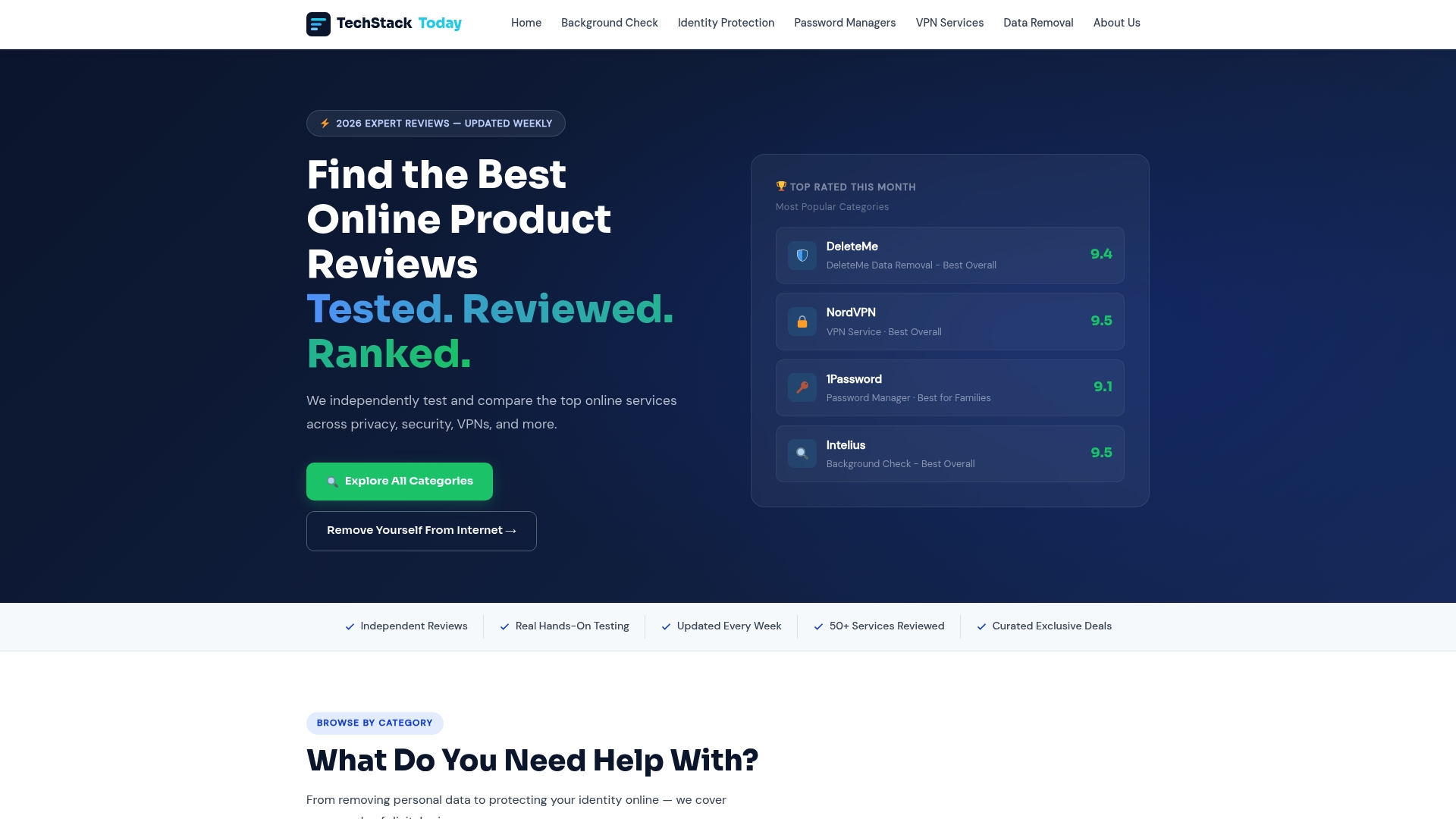
Techstacktoday reviews and ranks VPN services based entirely on hands-on performance testing, with no paid placements in the rankings. Over 50 privacy services are covered, including VPNs, data removal tools, and password managers, all evaluated against the same criteria and updated regularly. The methodology is transparent: you can see what was tested, how it was scored, and why one service ranked above another. For readers who want a straight answer without wondering who funded it, that transparency is the point. You can also use Techstacktoday’s privacy tools checklist to evaluate any VPN or privacy service against 2026 security standards before you subscribe.
Key Takeaways
The most trustworthy VPN guide platforms in 2026 combine hands-on testing, disclosed affiliate relationships, and verified no-logs audits to give you rankings you can actually act on.
| Point | Details |
|---|---|
| No paid rankings matter | Platforms like Techstacktoday rank VPNs on performance alone, removing financial bias from recommendations. |
| Audit verification is non-negotiable | Only trust no-logs claims backed by a named third-party auditor like Cure53 or Deloitte within the last 18 months. |
| Jurisdiction affects your privacy | VPNs headquartered outside the 14 Eyes alliance, such as Mullvad in Sweden or Proton VPN in Switzerland, face stronger legal privacy protections. |
| Free VPNs carry real risk | Most free VPNs monetize user data; Proton VPN’s free tier is the credible exception, funded by paid subscribers. |
| Techstacktoday for unbiased picks | Techstacktoday covers 50+ privacy services with hands-on testing and no paid placements, making it a reliable starting point for VPN research. |