Removing your address from the internet takes three steps: audit where it appears, remove it at the source, then de-index what’s left in search results. Skip the order and the work does not stick. Here’s what you can do in the next hour.
Start now, before you read another word:
- Search your own address and full name in quotes in a private browser window and screenshot every hit.
- Copy each URL into a spreadsheet or notes app so you have a working hit list.
- Turn on Google’s Results About You monitoring so new listings alert you automatically.
Pro Tip: Removing a page from Google Search does not delete it from the site that published it. The source removal step is what actually gets rid of your address, not the search suppression alone.
Key Takeaways
Removing your address from the internet permanently requires deleting it at the source first, then de-indexing what remains in search results, and repeating both on a schedule.
| Point | Details |
|---|---|
| Audit before acting | Run exact quoted searches for your name and address in a private window to build your hit list. |
| Source removal comes first | Opt out on people-search and broker sites before requesting Google removals, or listings reappear. |
| Match the Google tool to the case | Use Results About You for contact info, PII removal for combined details, Outdated Content for stale cached pages. |
| Fix upstream exposure | Drop address fields from social and shopping profiles, and use a registered agent for business filings. |
| Schedule recurring checks | Run a quick scan every three months and a full audit every 6 to 12 months. |
Table of Contents
- How Do I Find Where My Address Is Listed Online?
- How Do I Remove My Address Directly From the Websites?
- How Do I Remove My Address From Google and Other Search Engines?
- How Do I Stop My Address From Being Re-Listed?
- Is It Worth Paying for an Address Removal Service?
- What the Cleanup Process Actually Rewards
- Sources
How Do I Find Where My Address Is Listed Online?
You cannot remove what you have not found. Start with exact-match searches, since a partial address search buries the pages that matter under noise.
Run these three searches in an incognito or private window, so your personal search history doesn’t skew results:
- Your exact address in quotes:
"123 Main St, Anytown" - Your full name plus city:
"Jane Smith" Anytown - Your name and address together:
"Jane Smith" "123 Main St"
Sort what comes back into two piles. People-search sites and data brokers, like Whitepages, Spokeo, and BeenVerified, republish your address from public records and are your priority targets. Public records, like county assessor pages or court filings, and old social posts go in a separate pile, since they often need different removal tactics entirely.
Build a simple tracking sheet with five columns: site name, URL, opt-out or contact link, verification method required, and date submitted. This becomes your follow-up map when a site takes three weeks to respond.
Once your list is built, set up Google Alerts for your name and address so future listings surface without another manual search.
Pro Tip: Search your maiden name, nicknames, and any old addresses too. Brokers often link records across name variations, and one leftover listing under an old name can undo the rest of your cleanup.
How Do I Remove My Address Directly From the Websites?
Source removal is the step that actually works long term. If you skip it and only chase Google results, your address reappears within weeks because the underlying page is still live and still gets re-crawled.
Work your hit list in order of traffic. The big people-search sites (Whitepages, Spokeo, TruePeopleSearch, Radaris, Intelius) feed data straight into search engines, so clearing them first has the biggest impact on what shows up later.
- Find each site’s dedicated opt-out page (search “[site name] opt out”), never use a generic contact form.
- Submit exactly what’s requested, usually your name, the listing URL, and an email for confirmation.
- Watch for verification requests. Some sites ask only for email confirmation, others want a phone call or a photo ID.
Be careful with ID uploads. Handing your driver’s license to a dozen different broker sites multiplies your exposure instead of shrinking it. Privacy reporting on Google’s removal tools flags this exact risk and notes it’s one reason people turn to removal services that limit how many vendors see their documents.
When a site ignores your opt-out request after two or three weeks, escalate with a direct email to the site owner. Keep it short: state the listing URL, that you’re requesting removal of personal contact information under their own privacy policy, and attach a screenshot as proof. Give them 10 business days before you follow up again.
Log every submission date on your tracking sheet. Data brokers get slow when they know no one’s checking.
How Do I Remove My Address From Google and Other Search Engines?
Google gives you three separate tools, and picking the wrong one wastes your submission.
- Use Results About You first for any page showing your address, phone number, or email; it’s built for exactly this and often resolves in days.
- Use the PII removal form when a page has your home address alongside other identifying details, like a photo or family member names.
- Use the Outdated Content tool only when the page has already been changed or taken down, but Google’s cached version still shows the old data.
For any submission, attach the exact URL, a screenshot of the listing, and a one-line note on why it matches Google’s personal information removal policy. Most requests get a decision within a few days to two weeks.
Here’s the part people miss: Google removing a result from Search suppresses it from view, it does not delete the page. If the broker’s own site still hosts your address, it can resurface in results months later, which is why source removal has to come first. If a site refuses your source removal request outright, the Google removal tools are your fallback, not your first move.
Bing runs a similar content removal process through its webmaster tools, though it handles far less search traffic than Google for most people-search results.
How Do I Stop My Address From Being Re-Listed?
Cleanup that ignores the upstream sources is temporary. Data brokers scrape public records on a recurring cycle, so if your address is still sitting in a county database or a store loyalty profile, it will resurface.
- Strip address fields from social media profiles, online shopping accounts, and domain WHOIS records.
- If you run a business from home, use a commercial mailbox or registered agent service instead of your home address on filings.
- Look into your state’s address confidentiality program if you’re a survivor of domestic violence or stalking; availability and eligibility vary by state.
- Accept that some public records, like property deeds and court filings, may be legally unremovable no matter how many opt-out forms you file.
Pro Tip: Set a recurring calendar reminder: a quick search-based scan every three months, and a full review of your tracking sheet every 6 to 12 months. Privacy researchers recommend this cadence specifically because brokers re-scrape and relist on their own schedule, not yours.
Is It Worth Paying for an Address Removal Service?
Manual removal is free and it works, but it costs hours you may not have. Paid services earn their fee in three specific situations: you’re listed on 15 or more broker sites, your information keeps reappearing after you’ve already cleared it, or you simply don’t have a free afternoon every few months to keep checking.
The tradeoff is verification exposure. Some services ask for the same identity documents the brokers do, so look for a provider that minimizes repeated ID sharing across multiple vendors rather than passing your documents around.
Before you pay for anything, check four things:
- How many broker sites the service actually covers.
- How often it resubmits opt-out requests (monthly is standard, quarterly is too slow).
- Whether it publishes real coverage numbers instead of vague promises.
- Whether it offers a refund if your address is still listed after 90 days.
Coverage and resubmission frequency vary widely between paid removal services, independent testing shows, which is exactly why the cheapest option and the best option are rarely the same one.
Techstacktoday’s hands-on data removal reviews break down coverage and resubmission cycles service by service, so you’re not guessing which one actually delivers.
If your situation doesn’t call for a subscription, our guide on whether a data removal service is worth it walks through the DIY math in more detail, and our full removal walkthrough covers every broker-specific opt-out flow, including a step-by-step Spokeo removal plan if that’s where your address turned up first. Techstacktoday’s VPN reviews and rankings are worth a look too, since a VPN keeps your IP address from feeding fresh data back into the same broker pipelines you just spent hours clearing.
What the Cleanup Process Actually Rewards
Most advice on this topic treats Google removal as the finish line. It isn’t. The research is consistent on this point: source deletion has to happen first, because a de-indexed page tied to a live broker listing just gets re-crawled and reappears. Readers who chase the Google tools first and skip the tedious opt-out forms end up doing the work twice.
The other place conventional advice falls short is verification risk. Nobody warns you upfront that opting out of a dozen broker sites can mean uploading your driver’s license a dozen times, which itself creates new exposure. That’s the real argument for a paid service, not convenience but document hygiene.
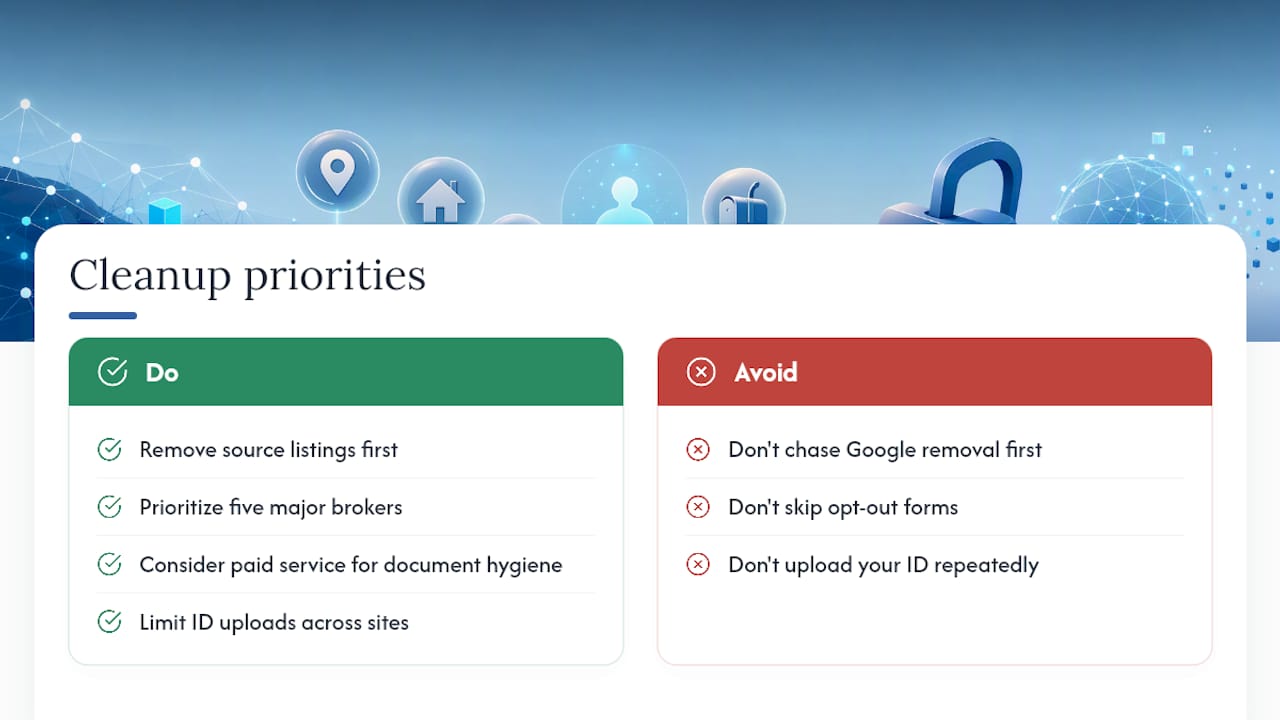
If you take one thing from this, prioritize the highest-traffic broker sites first. Clearing five major brokers usually does more than clearing twenty obscure ones, and it’s where your first hour is best spent.
Sources
- Remove my private info from Google Search
- CBS News: Google ‘Results about you’ coverage and privacy implications
- WhatIsMyIPAddress: monitoring and alerts for personal info