Usually, no. An expunged record should not appear on a standard employment background check. But “usually” is not “always.” Fingerprint-based FBI checks, some licensing boards, law enforcement employers and outdated private databases can still surface it. Don’t panic. Below you’ll find where expunged records can still turn up, what the law says, and what to do if one does.
TL;DR
- ✅ Most standard employer background checks should not show an expunged record, and federal regulators say screening companies shouldn’t report one.
- ⚠️ Exceptions exist: FBI fingerprint checks, law enforcement, teaching, childcare, banking and bar admission can reach sealed or cleared records.
- 🔎 Private data brokers and old database copies are the most common reason an expunged record keeps showing up.
- 📝 If one appears, request your report, dispute the error in writing, and attach your court order.
Table of Contents
- What “expunged” actually means
- What the law says about private background checks
- Can employers see expunged records?
- Where an expunged record can still show up
- Why a screening report might still be wrong
- What to do if an expunged record shows up
- Our perspective
- Clean up what the courts can’t
- Questions to ask before your next background check
- FAQ
- Sources
What “expunged” actually means
Expungement is a court process that clears or restricts an arrest or conviction record. The word means different things in different places. Some states use it to mean the record is sealed, while others treat expungement and sealing as separate remedies, as LawInfo explains. In some California counties, expungement is legally a dismissal. That hides the conviction from many private employers but does not erase the legal history entirely.
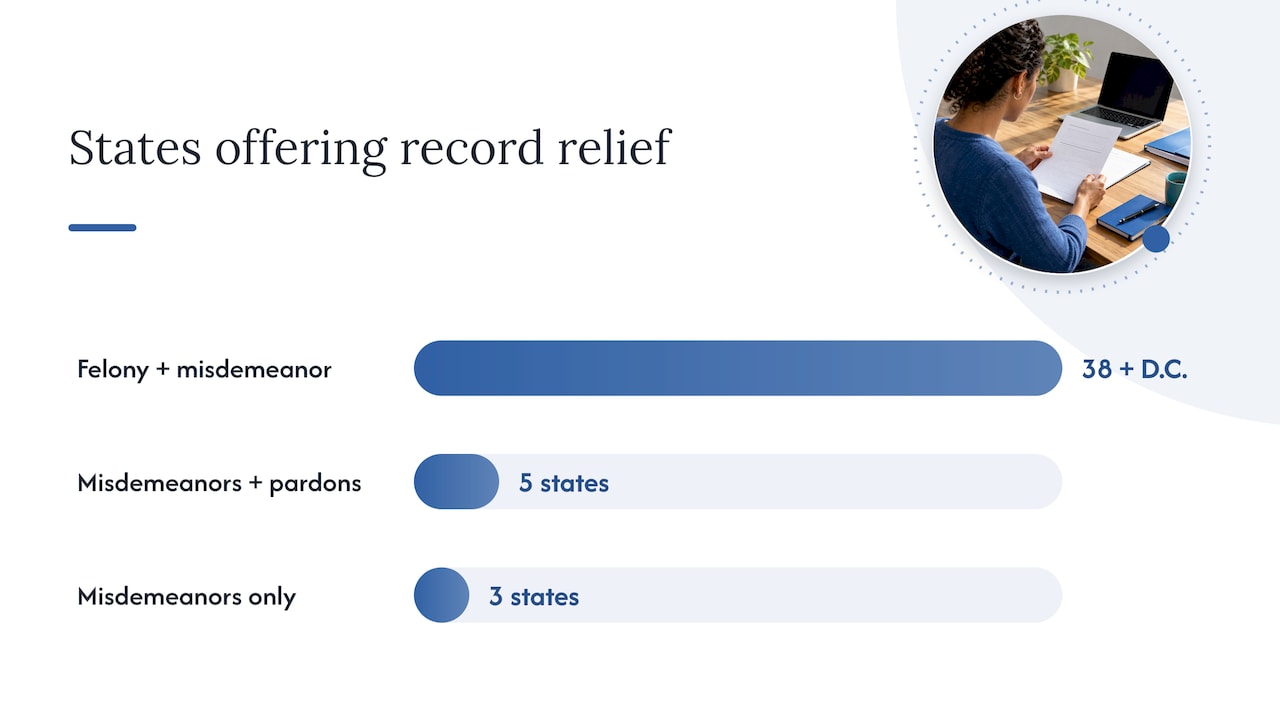
Who can get relief also depends on where you live. A March 2024 report from the National Center for State Courts found that 38 states and D.C. offer record clearing for felony and misdemeanor convictions. Five more limit it to misdemeanors and pardoned felonies, and three limit it to misdemeanors only.
So the first step is simple: read your court order. Find out whether your state called it expunged, sealed, set aside or dismissed, and what the order says about who may still see it.
What the law says about private background checks
Most employer checks are run by third-party screening companies, known as consumer reporting agencies. They fall under the Fair Credit Reporting Act (FCRA). In January 2024, the Consumer Financial Protection Bureau (CFPB) said it reads the FCRA as barring screeners from including expunged or sealed records that the public cannot legally obtain from the government. The agency calls reporting such a record misleading and inaccurate.
The same notice says a screener that fails to use reasonable procedures to keep those records out of reports is not meeting its duty of maximum possible accuracy. One example is failing to cross-check old data against updated court sources. An earlier analysis from a criminal records research center made a similar point: case law on the topic is limited, but screeners must still use reasonable procedures to ensure accuracy.
In plain terms: if a screening company reports your expunged case, you have a strong basis to dispute it.
Can employers see expunged records?
For most private employers, the answer is no, and in many states they may not ask. A few examples:
- California: Most employers may not consider or ask about convictions that were expunged, sealed, dismissed or statutorily eradicated. The state courts’ Fair Chance Act guide notes exceptions for certain fields, such as banking and healthcare.
- Maryland: An employer or school may not require you to disclose expunged charges, and refusing to disclose them cannot be the only reason for denying a job.
- Connecticut: If your record has been officially erased, it should not show on a background check, and you can legally tell employers you have no criminal record.
The American Bar Association reports that after a record is expunged or sealed, people can generally state they were never arrested or convicted without risking perjury. Government officials are similarly restricted from saying a record exists. But that is the general rule. Your state’s statute controls, and some applications specifically ask about sealed or expunged matters. Before you answer any such question, read the exact wording and check your state’s law or ask a legal aid office or a criminal defense attorney.
Want to understand what a typical employer check actually covers? See our guide to types of employee background checks and our explainer on criminal record screening.
Where an expunged record can still show up
The check you face matters more than the clearing order alone. Here is how the main check types compare.
| Type of check | Will an expunged record likely show? | Why |
|---|---|---|
| Standard private employer check (county court, statewide, national database) | Usually not | FCRA accuracy duties; courts restrict public access |
| Tenant or volunteer screening by a private company | Usually not | Same FCRA rules apply to consumer reports |
| State-run fingerprint check for licensed jobs | Sometimes | Agencies may have statutory access |
| FBI fingerprint check | Sometimes | Federal file may not update automatically |
| Law enforcement, prosecutors, bar examiners | Often | Many statutes give these bodies continued access |
| Data broker or people-search site | Sometimes | Scraped data may be old and never corrected |
Jobs with special access
Some fields can reach sealed records. LawInfo lists teaching, childcare, law enforcement and banking as examples. The ABA adds that the promise of record clearing is often weakened by exceptions for law enforcement, prosecutors and state bar examiners, who keep access to cleared records.
If you are headed into one of these fields, ask your attorney what the licensing agency can see before you apply. Don’t guess.
Federal and FBI checks
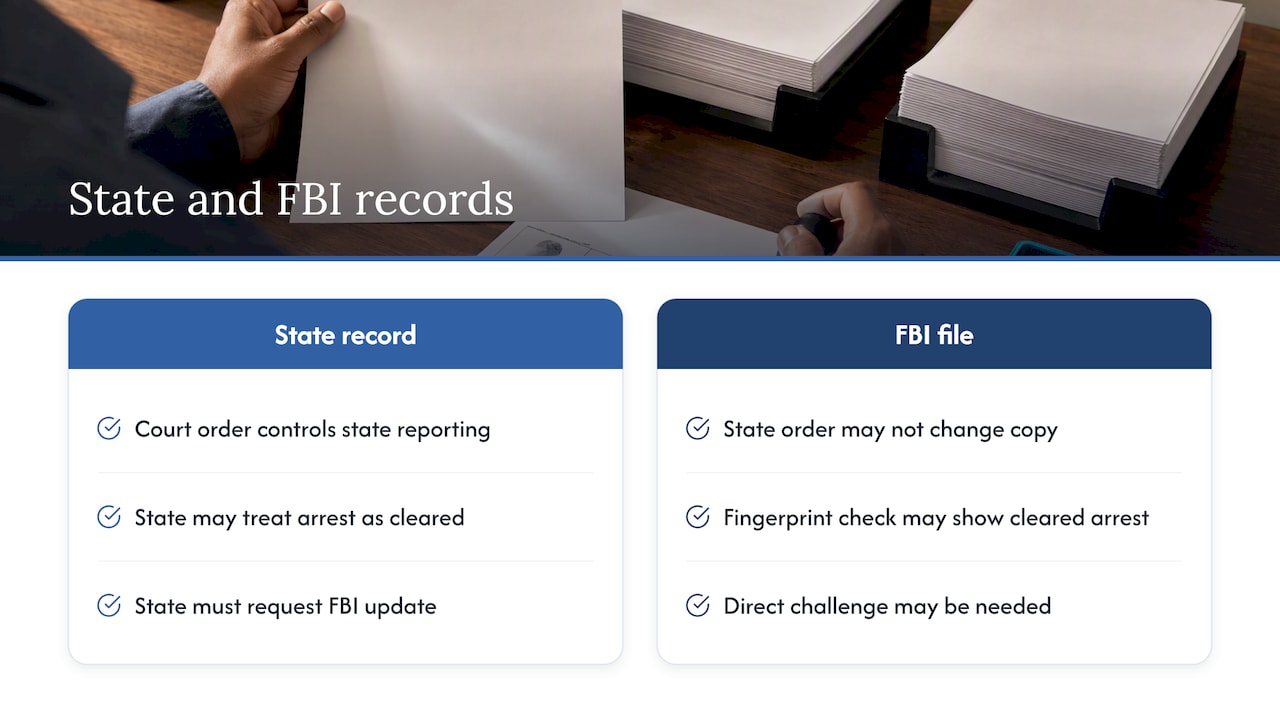
This is the gap that catches people. A state court order controls what that state reports. It may not change the FBI’s copy. Massachusetts attorneys, for example, explain that no state court can order the FBI to seal or expunge its record. The state has to request the update, and a person may need to challenge the federal file directly.
The practical result: a fingerprint check for a federal job, a security clearance or certain licenses may show an arrest that your state treats as cleared. Some forms also ask about arrests and convictions “regardless of expungement.” Read each question closely. Answering wrongly in either direction can cost you, so get legal advice on those forms.
You can request your own FBI Identity History Summary to see what the file shows before anyone else does. Do this before you apply for a federal or high-security job, not after.
Data brokers and old database copies
Most people who see an expunged record on a report are dealing with a stale copy. Private companies scrape court data, store it, and resell it. If they never receive the update, the old record sits in their database.
That is why expunged charges can show up even when the court did everything right. A cleared case in the courthouse system can still live on a people-search site. Employers who use a legitimate screening company are covered by the accuracy rules above. Random lookup sites are another matter. Anyone can search them, and they may not follow the same standards.
That’s the part you can control. See our walkthrough on how to remove yourself from the internet and our guide to removing your info from Spokeo.
Why a screening report might still be wrong
A few common causes:
- Stale data. The screener pulled from a database that never received the expungement.
- Weak procedures. The company did not cross-check against updated court sources, which the CFPB says falls short of reasonable procedures.
- Paperwork never finished. The order was granted but never sent to the state repository or the arresting agency.
- Different record trail. The court record is cleared, but the arrest record at the police agency was not.
- Misleading terms. Your state’s relief is sealing or a dismissal, not full destruction, so some agencies keep access.
For how accuracy problems arise more generally, see our piece on background check accuracy.
What to do if an expunged record shows up
⏱️ Plan on about an hour to gather paperwork, plus time for the agency to respond.
- Get your court order. Keep a certified copy. It is your proof.
- Request the report. If an employer used a third-party check, you can ask for a free copy. Connecticut legal aid, for example, explains that you can request the report and dispute its accuracy.
- Dispute in writing. Send the screening company a letter that names the record, says it was expunged, and attaches the order. Keep copies and proof of delivery.
- Watch for adverse action. When an employer rejects you based on a third-party report, federal rules require notice first. The same Connecticut guidance says the employer must provide notice of adverse action. Use that window to dispute the record.
- Check the source. If the error traces back to a state repository or police agency, ask that office to update its file.
- Get legal help. If you lost a job, housing or a license over a record that should have been cleared, talk to an employment or consumer attorney or a legal aid office.
We walk through the dispute process step by step in 5 steps to dispute background check errors. If the question is how long a corrected report takes, see how background check turnaround works.
Our perspective
We test privacy services hands-on, and we see the same pattern again and again. Court records are only one piece of what gets reported about a person. The rest is a patchwork of private databases that copy each other, and corrections travel slowly. A clean court order does not clean that patchwork on its own.
That is why we tell readers to work both ends. Confirm the legal side: certified order, state repository updated, federal file checked if your job needs it. Then deal with the commercial side by finding and removing your listings on people-search sites. Our reviews rank services on measured performance, not on affiliate payouts, and we say so in our affiliate disclosure. We are not a law firm. For what your state’s expungement does and does not hide, a licensed attorney is the right call.
— TechStackTeam
Clean up what the courts can’t
Expungement fixes the official record. It does not reach the people-search sites that copied it years ago. If you want those listings gone, we compare data removal options based on hands-on testing in Is a data removal service worth it?, and you can find our full picks on the TechStackToday homepage.

If you prefer to do it yourself, our personal data deletion action plan lays out the opt-out steps.
Questions to ask before your next background check
A short checklist saves surprises:
- ✅ Is this a private employer check, or a fingerprint check tied to a license or federal job?
- ✅ Does my state treat my case as expunged, sealed, dismissed or set aside?
- ✅ Does the application ask about sealed or expunged matters, and what exactly does the question say?
- ✅ Has my court order reached the state repository and the arresting agency?
- ✅ Are my old records still on people-search sites?
Employers also have rules to follow. If you are on the hiring side, read how to run employee background checks legally and the background check compliance requirements. Our note on how far back checks go also explains why time limits differ for convictions.
FAQ
Do expunged records show up on a basic background check?
In most cases, no. A basic employer check from a screening company should not include an expunged offense, and the CFPB says reporting such records is inaccurate. Errors still happen when a database is outdated, so review your report if you can.
Can employers see expunged records?
Most private employers cannot legally use them, and many states bar them from asking. Certain employers, such as law enforcement agencies, can have statutory access. Banking, teaching and childcare roles are also listed as fields where sealed records may be reachable.
Will an expunged record show on an FBI background check?
It can. A state expungement controls what the state reports, but the FBI’s file may not update on its own. Request your own Identity History Summary before applying for federal or high-security work, and ask an attorney how to correct it.
Can I say I have no record after expungement?
Often yes, but it depends on your state and on the question asked. The ABA notes people can generally say they were never arrested or convicted without perjury risk. Some applications ask specifically about expunged matters, so confirm with an attorney first.
What if a background check wrongly lists my expunged record?
Request the report, dispute the item in writing with your court order attached, and keep proof of delivery. If you were denied a job over it, ask an employment or consumer attorney about your FCRA rights.
Sources
- Fair Credit Reporting; Background Screening, Federal Register (CFPB)
- Will Expunged Records Show Up on a Background Check?, LawInfo
- Expungement FAQ, San Diego County Public Defender
- Making the Promise of Expungement a Reality, National Center for State Courts
- May background screeners lawfully report expunged records?, Criminal Records Center
- Criminal history and job applications, California Courts
- Criminal Procedure, Section 10-109, Maryland General Assembly
- Working with a Criminal Record, Connecticut Legal Help
- The Evolving Landscape of Sealing and Expungement Statutes, American Bar Association
- Expunging or Sealing a Federal Criminal Record in Massachusetts