Most identity theft protection plans run $10 to $30 a month for solid mid-tier coverage, with entry-level monitoring starting under $10 and premium family plans climbing to $60 or more. For the majority of consumers, a mid-tier single-bureau or 3-bureau plan hits the sweet spot. If your budget is tight, a homeowners or renters insurance add-on paired with free credit freezes may provide coverage for common recovery costs at substantially lower expense.
TL;DR:
- Full 3-bureau monitoring adds about $5 to $15 per month compared to single-bureau plans, reflecting higher data feed costs for comprehensive coverage.
- Identity theft insurance caps generally have minimal impact on claim costs, as actual recovery expenses commonly stay below $25,000 despite higher maximums advertised.
- A homeowners or renters insurance add-on costs roughly $25 to $45 annually and can cover most recovery expenses without the need for expensive monitoring plans.
- Many household protections already include some credit monitoring or fraud reporting through banks or employers, making paid plans unnecessary for some users.
- Effective evaluation involves comparing plans based on real features and response times, not just price or marketing claims, to ensure value aligns with actual protection needs.
Table of Contents
- How Much Does Identity Theft Protection Cost Per Month?
- What Features Actually Drive Up the Price?
- How Do You Choose the Right Price Tier?
- Are There Cheaper Alternatives to a Monthly Subscription?
- How TechStackToday Tests Identity Protection Value
- Why Most Pricing Advice Misses the Point
- Compare Real Prices Before You Commit
- Sources
How Much Does Identity Theft Protection Cost Per Month?
Here’s the breakdown you actually need before you swipe a card. Prices vary by bureau coverage, insurance limits, and how many people you’re protecting, but three clear tiers show up again and again across the market.
Entry-level plans typically run under $10 to $10 a month, or as low as $25 to $60 a year when they’re sold as a bare-bones insurance add-on rather than a monitoring service. These plans usually cover single-bureau credit monitoring and basic identity theft insurance, but skip real-time alerts across all three credit bureaus. If you’re mainly worried about reimbursement for recovery costs, not daily surveillance, this tier does the job.
Mid-tier plans land between roughly $10 and $38 a month according to Consumer Financial Protection Bureau guidance, and this is where most individual buyers end up. You get 3-bureau monitoring, dark web scanning, Social Security number tracking, and identity theft insurance with caps in the tens of thousands. It’s the range where price and feature depth actually balance out.
Premium and family plans push $25 to $60+ a month, based on ConsumerAffairs 2026 pricing data. That buys higher insurance caps, coverage for multiple household members, device-level monitoring, and sometimes a bundled VPN or password manager.
By the Numbers: Annual totals across the market commonly fall between $150 and $700 depending on tier and household size, per ConsumerAffairs.
A few things to watch on the billing side:
- Annual billing usually saves 15% to 25% versus paying monthly, but that discount often applies only to the first year.
- Promotional pricing commonly increases upon renewal, so the initial low monthly rate can rise significantly without clear advance notice.
- Family plans generally add a moderate additional monthly cost for extra household members, rather than charging full individual prices for each person, making cost-per-person calculations helpful.
Pro Tip: Before you commit to annual billing, check the cancellation window. Some providers require written notice 30 days before renewal, or you’re locked in for another year.
What Features Actually Drive Up the Price?
Not every dollar you spend buys the same protection. Some features move the price needle hard; others are marketing flourishes.
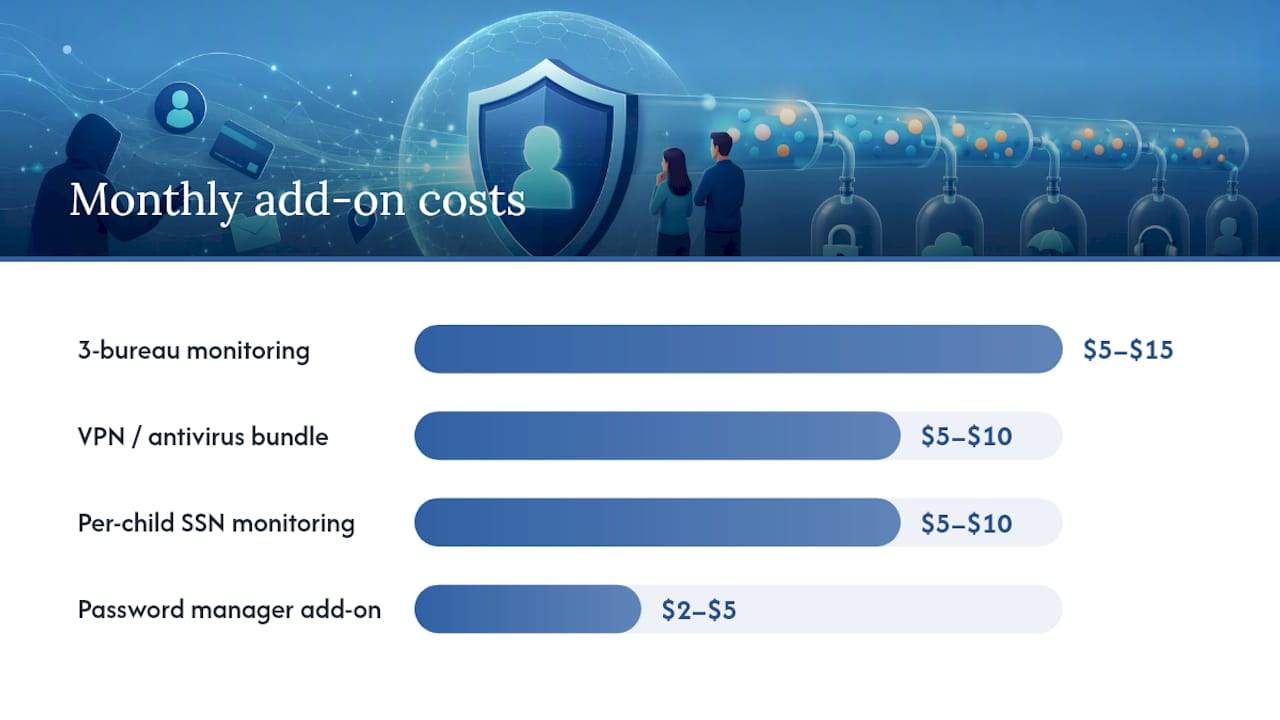
Bureau coverage is the biggest lever. Single-bureau monitoring (usually Experian or one of the others) sits at the bottom of the price scale. Full 3-bureau monitoring, which checks Equifax, Experian, and TransUnion simultaneously, typically adds $5 to $15 a month because the provider is paying for three separate data feeds instead of one.
Insurance caps sound dramatic but rarely change the real cost of a claim. Mass notes that identity theft insurance covers recovery costs like legal fees, notary charges, and lost wages, not stolen funds themselves. A plan advertising a $1 million cap usually costs only marginally more than one capped at $25,000, because actual claims rarely approach either number. Read our breakdown of what identity protection reimbursement really covers before you pay extra for a bigger number on paper.
White-glove recovery, where a dedicated case manager handles calls to banks, credit bureaus, and government agencies on your behalf, adds real value if you’re short on time. Learn more about how identity restoration services actually work before assuming it’s a luxury add-on.
Bundled extras push price up fast:
- VPN or antivirus bundling: adds $5 to $10 a month
- Password manager inclusion: adds $2 to $5 a month
- Per-device monitoring beyond 3 to 5 devices: often a separate fee tier
- Adding minor/child SSN monitoring: typically $5 to $10 a month extra
How Do You Choose the Right Price Tier?
Work through this before you buy anything:
- Check what you already have. Many credit cards, employers, and homeowners policies already include some identity theft coverage or monitoring at no extra cost. Duplicate coverage is wasted money.
- Calculate cost per covered person. Take the annual price and divide by the number of adults protected. A $300/year family plan covering four people costs $75 per person, often cheaper than four individual plans.
- Ask providers direct questions. What’s the actual insurance cap? What’s excluded? What does the “case manager” do day to day? What’s the exact cancellation process?
- Watch for red flags. Vague renewal pricing, hard-to-cancel free trials, and insurance terms that dodge specifics on exclusions are all signs to walk away.
- Apply the final rule. Buy monitoring if your time is worth more than the subscription cost. Buy the insurance add-on alone if you mainly want reimbursement for recovery expenses, not daily alerts.
Are There Cheaper Alternatives to a Monthly Subscription?
Yes, and they cover more real risk than most people assume. A homeowners or renters insurance add-on for identity theft typically costs $25 to $45 a year, according to Gerald’s identity theft insurance analysis. That’s a fraction of a $30/month subscription for coverage that hits many of the same recovery costs.
Quick Stat: Free weekly credit reports and free credit freezes, both available through federal resources, eliminate the need for paid monitoring for a large share of consumers according to the FTC.
Practical low-cost combinations to consider:
- Free weekly credit reports plus a free credit freeze at each bureau covers the monitoring function most paid plans charge for.
- Identitytheft provides free reporting and a personalized recovery plan if fraud actually happens.
- Standalone recovery-only insurance policies (no monitoring attached) run roughly $25 to $60 a year and make sense if you’re confident in your own vigilance but want a financial backstop.
- If your bank already flags suspicious activity and your employer offers coverage through benefits, you may not need to buy anything at all.
How TechStackToday Tests Identity Protection Value
Price only tells half the story, so Techstacktoday’s evaluations weigh cost against what a plan actually delivers in practice. Testing scenarios simulate real fraud situations, then track how each service performs.
- Alert usefulness: how fast and how specific the notifications are when something changes on a monitored account.
- Response and resolution speed: how quickly a case manager or support team engages once a problem is flagged.
- Insurance clarity: whether policy documents state exclusions and caps in plain language or bury them in fine print.
- Cost-per-feature math: what you’re actually paying for each meaningful protection layer, not just the sticker price.
When you read a Techstacktoday score next to a price tag, treat the score as the answer to “does this justify the extra dollars,” not a standalone popularity ranking. A cheap plan with a high value score often beats an expensive one with a low one. Understanding how identity theft affects your credit score also helps clarify why certain monitoring features matter more for some households than others.
Why Most Pricing Advice Misses the Point
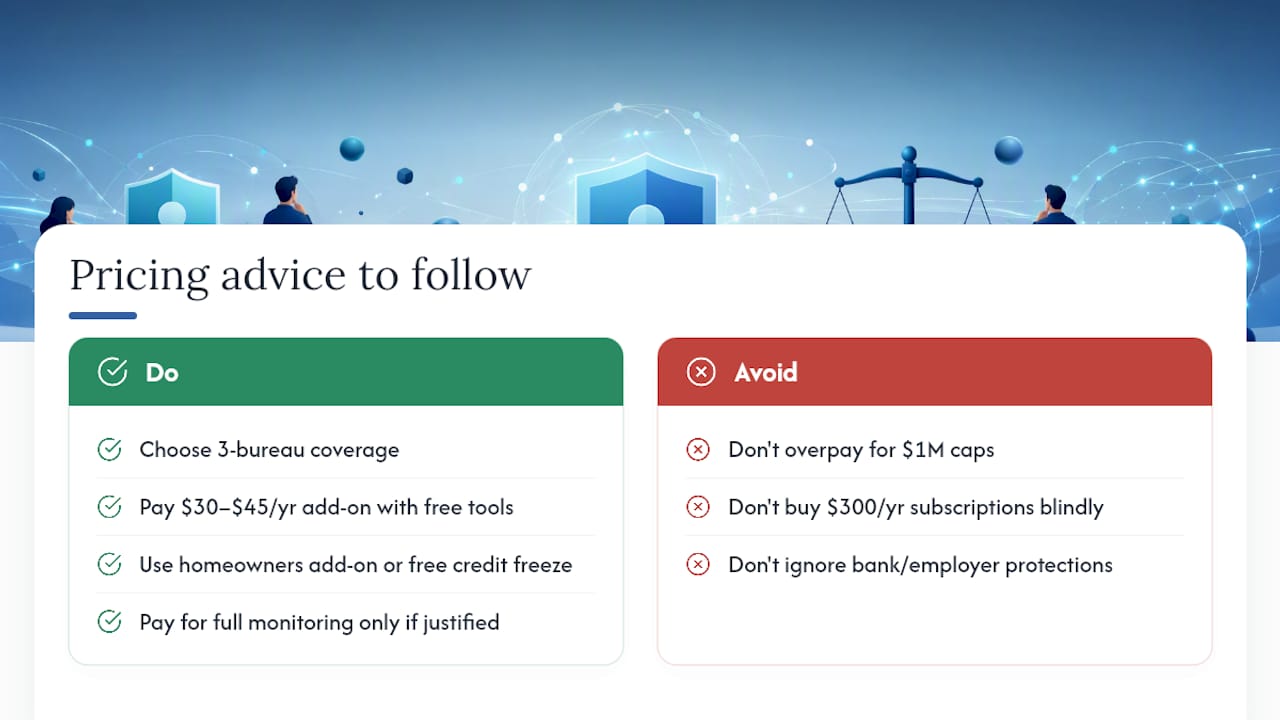
The conventional advice on this topic obsesses over insurance caps, and that’s backwards. A $1 million cap on paper rarely matters because actual identity theft recovery costs, legal fees, notary charges, lost wages, tend to land in the low thousands at most. What matters far more is whether the plan covers three bureaus or one, and whether the price reflects real feature depth or just a bigger number on a marketing page.
Our honest read: most consumers overspend on caps they’ll never use and underspend on the cheap coverage that would actually help, like a homeowners policy add-on or a free credit freeze. If your household already has decent bank and employer protections, a $30 to $45 a year insurance add-on plus free monitoring tools beats a $300 a year subscription almost every time. Pay for full-service monitoring only when the time savings and 3-bureau coverage genuinely justify the gap.
— TechStackTeam
Compare Real Prices Before You Commit
Some review sites test identity protection plans hands-on and side by side, aiming for impartial rankings without paid placements. Therefore, price comparisons should reflect what a plan actually delivers per dollar, not just what marketing pages claim.

If you’re ready to see current pricing and feature breakdowns side by side, our best identity theft protection services of 2026 roundup ranks plans by coverage, alert quality, and real cost, updated as providers adjust their tiers. Pair that with our internet privacy tools comparison checklist to build your own cost-per-feature comparison before you commit to a monthly charge. Start there, shortlist two or three plans that fit your budget, and check current promotional pricing before the renewal rate kicks in.
Where to Verify the Numbers Yourself
- FTC guidance on free weekly credit reports and credit freezes
- Identitytheft for official recovery plans and fraud reporting
- 2024 IC3 Report for fraud trend data
Sources
- What is identity monitoring or “identity theft” service? | Consumer Financial Protection Bureau
- Mass
- Identitytheft
- Cost of Identity Theft Protection (2026) | ConsumerAffairs
- 2024 IC3 Report